

You’ve probably seen the posts. “Earn $5 a day just by answering surveys.” “Make money from your phone without any experience.” “Get paid to watch videos, test apps, or complete simple tasks.”
Sounds good, especially in Rwandan francs. Even a few dollars can help if you’re a student, unemployed, or just trying to cover daily expenses. So you try.
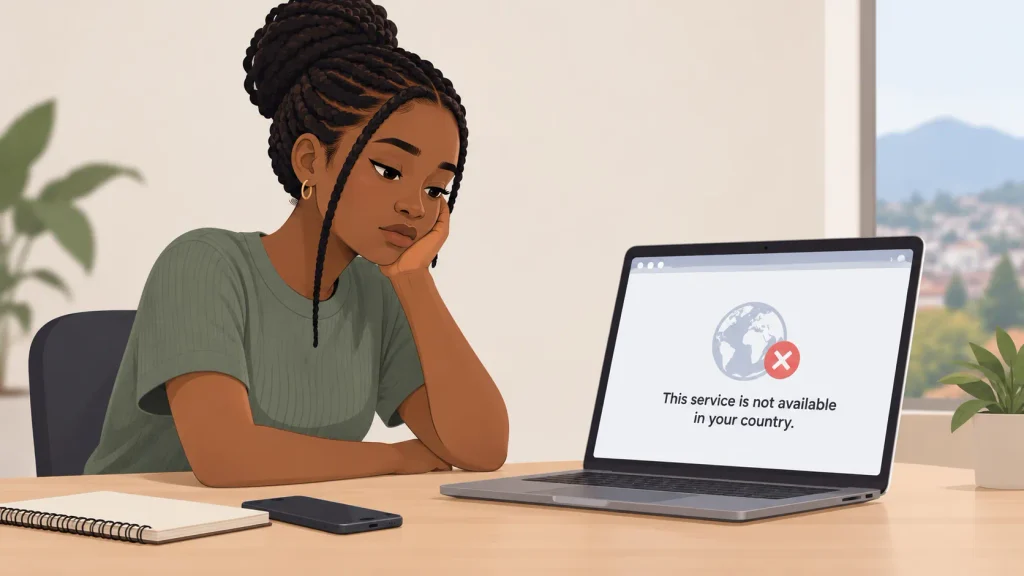
You create an account. Then: “This service is not available in your country.” You try another website. Same message. On a third, you register, but there are no surveys for you. And sometimes you finish a few tasks only to find the payment method doesn’t work in Rwanda.
I’ve run into this myself. People talk about online side hustles as if everyone with a smartphone and internet has the same opportunities. From Rwanda, the experience can be very different.
So do online side hustles actually work in Rwanda, or are we following advice meant for people in other countries?
Short answer: Earning money online from Rwanda is possible, but many popular “easy money” websites don’t support Rwanda or can’t pay you. Skill-based work (freelancing, tutoring, services for small businesses) is usually more realistic than tiny survey rewards, though it takes longer to start.
In this article
Can You Really Make Money Online in Rwanda?
Yes. But there’s a big difference between making money online and making easy money online.
Some people in Rwanda earn through online work: freelance projects, remote jobs, or businesses that use the internet to reach customers. That doesn’t mean every money-making website works here, and it doesn’t mean you can join a random platform today and earn reliably tomorrow.
Beginners often struggle to find clients, qualify for tasks, receive payments, or compete with people who already have experience.
The evidence points the same way. A 2025 report in The New Times, discussing research on Rwanda’s digital labour market, said 1,437 Rwandans earned about $6 million collectively through Upwork between 2017 and 2023. But the top 20 freelancers reportedly earned 69% of that total.
That tells us two things. Some people really have earned money from Rwanda through international freelancing. And a few people earning a lot doesn’t mean everyone who joins will have the same result.
Online work is real. But opportunities, competition, and rewards are not equal.
Source: The New Times — From scam to success: How Rwandans are navigating online work
Why Do So Many Online Survey Websites Not Work in Rwanda?
Surveys are among the most recommended side hustles, so let’s start there. Companies and researchers want to know what people think about products, services, and ads. Survey platforms collect those answers, and some reward participants.
Not every survey wants people from every country
Say a company wants to know what American shoppers think of a new supermarket product. It may pay a platform to collect answers only from people in certain US states. If you’re in Rwanda, your opinion isn’t relevant to that project.
That doesn’t make your opinion less valuable. You’re just outside the target group. The same happens with surveys about banking, insurance, or products sold only in some markets.
Some platforms don’t support Rwanda at all
Prolific, which connects researchers with paid study participants, says in its eligibility information that it accepts participants from most OECD countries and keeps a list of supported countries. Rwanda is not currently on that list.
So someone in a supported country may truthfully say they earn on Prolific, but you can’t copy that from Rwanda.
A website being legitimate doesn’t mean it’s available to you.
Source: Prolific — Who can participate in studies?
Are there survey sites that accept people in Rwanda?
Some do list Rwanda. A September 2026 survey-site review pointed to Triaba, TGM Panel, and Surveyeah as having evidence of Rwandan enrollment. But being able to register doesn’t mean you’ll get surveys regularly, and getting surveys doesn’t mean the pay is worth your time.
Also check how rewards are paid: some platforms offer vouchers instead of cash, or set a minimum before you can redeem anything.
| Platform | What to check before joining |
|---|---|
| Triaba | Has a Rwanda-specific survey offering; check current rewards and redemption conditions |
| TGM Panel | Lists Rwanda in its panel directory; invitations may vary |
| Surveyeah | Lists Rwanda for enrollment; verify local reward options |
| Prolific | Rwanda is not currently on its supported-country list |
PollsAfrica also advertises paid polls for Rwanda, but currently describes participation there as a waiting list, with rewards in mobile airtime rather than cash.
I haven’t personally tested withdrawals from any of these, so I won’t promise they’ll pay you. Check the official website for current rules first. The key question isn’t “Can I create an account?” It’s “Can I actually receive a useful reward from this platform while living in Rwanda?”
The Problem Nobody Talks About Enough: Getting Paid
Picture this. You’ve spent several evenings on online tasks and your account shows $15. You click “Withdraw,” and discover the platform only pays through a method you can’t use in Rwanda. Sometimes the hard part isn’t the work. It’s receiving the money.
Platforms use different payment systems: bank transfers, PayPal, Payoneer, gift cards, and others. These services don’t offer the same features in every country.
UserTesting, for example, says it pays contributors through verified PayPal accounts, and its country eligibility depends on current demand and is checked at registration.
Upwork lists several withdrawal methods, including bank transfers and Payoneer, but says options can vary. A payment logo on a website doesn’t mean it will work for your account.
Check these before you do any work
- Does the platform officially accept users living in Rwanda?
- Are paid tasks actually available to Rwandan users?
- How does it pay?
- Can I legally receive and withdraw payments in an account registered in my name?
- Is there a minimum withdrawal amount?
- Are there transaction, currency conversion, or withdrawal fees?
- How long does payment take?
If you can’t get clear answers, be careful about investing much time.
Don’t fake your location. Using false addresses, borrowed identities, or location-masking tools to get around country rules can lead to restricted accounts and unpaid earnings. Look for opportunities that legitimately support where you live.
So, Which Online Side Hustles Are More Realistic in Rwanda?
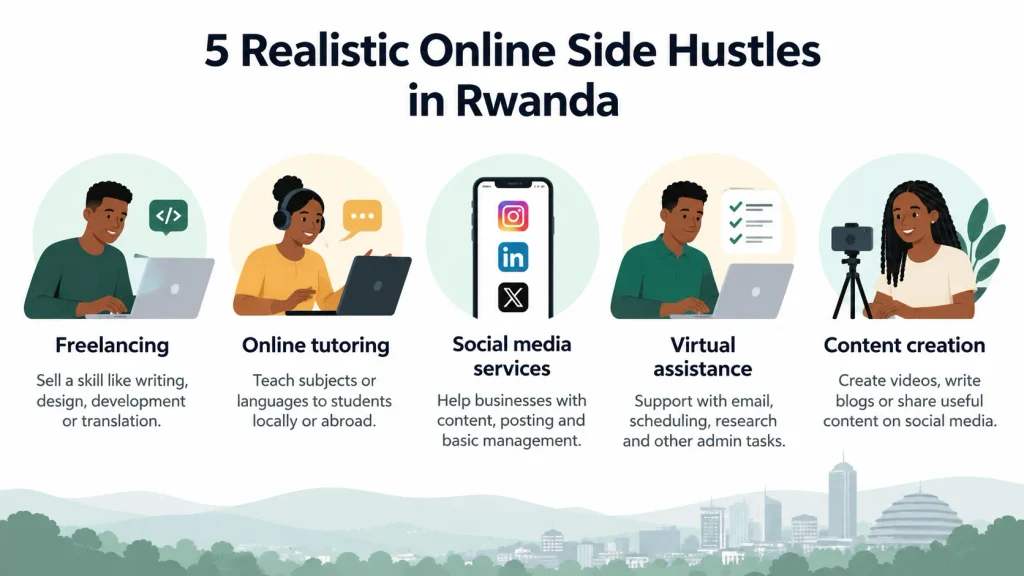
If I were starting again, I wouldn’t spend all my time hunting for sites that pay a few cents per click. I’d also look at work where people pay for a useful service. It often takes more learning at the start, but it leaves you with something valuable: a skill you can keep improving.
1. Freelancing: sell a skill, not random tasks
Freelancing means providing a service to clients without being their permanent employee. Someone might pay you to design a poster, edit a video, write an article, organize data in Excel, or build a website.
Some freelancers serve local clients; others work with businesses abroad. Platforms like Upwork and Fiverr connect freelancers and clients, but an account alone won’t get you hired.
Say you’ve spent a few weeks learning to design social media posters. Your profile says, “I am a graphic designer. Please hire me.” You have no samples. Why would a client pick you over someone with a portfolio and reviews? (This example is fictional, but the situation is common.)
Build evidence first. Make sample posters for imaginary businesses, then gather your best work into a small portfolio. You can also approach legitimate local businesses. The first client may be hard to find, but good work, clear communication, and a growing reputation can create more.
Skills you could explore: graphic design, video editing, writing and proofreading, website development, spreadsheets and data organization, social media management, translation (if you’re proficient in the languages), and virtual assistance.
You don’t need all of them. Pick something you’re interested in and people actually need. Learning a skill doesn’t guarantee paid work; you’ll still have to find clients and agree on fair terms.
2. Online tutoring and teaching
Are you good at mathematics, English, French, Kinyarwanda, or another subject? A university student strong in maths could offer lessons to secondary students by video call or messaging, depending on the subject and the students’ needs.
Paying students won’t appear automatically. You’ll need to show you can teach, agree a schedule, and make the price and expectations clear to students or parents.
If you consider an international tutoring platform, verify that it accepts tutors in Rwanda and offers a usable payment method. Or start with local students and referrals. Sometimes an online side hustle simply means using the internet to reach people who need your help.
3. Social media services for small businesses
Restaurants, salons, clothing shops, and photographers often use social media. Some owners need help with posts, short videos, replies to customers, or planning content. If you can make simple, attractive posts, you could send a polite, specific message:
“Hello, I noticed your business shares products on Instagram. I create social media graphics and short promotional videos. If you’re interested, I can show you examples of my work and explain the services I offer.”
This won’t always get a reply, and a quiet page doesn’t prove a business needs help. But you’ve offered something concrete. If the owner is interested, agree on the number of posts, deadlines, payment, and revisions before you begin.
4. Virtual assistance and remote admin work
Virtual assistants organize schedules, prepare documents, update spreadsheets, research information, or handle routine communication. It isn’t effortless money: clients often expect good written communication, reliability, attention to detail, and comfort with common digital tools, and some want experience.
Start by learning spreadsheets, calendars, documents, and professional email. Create sample work to show what you can do. Be wary of ads promising unusually high pay for very simple admin tasks, especially if the recruiter won’t explain who the employer is or what the work involves.
5. Content creation: possible, but not quick
YouTube, blogs, social media, and digital products can earn money, but building an audience takes a long time. Imagine you post three videos and only a few people watch. That doesn’t prove YouTube “doesn’t work.”
It also doesn’t mean you’ll earn just by posting for long enough. You need an audience, useful or entertaining content, consistency, and a realistic way to earn revenue.
Monetization programs also have country-specific eligibility rules, so check whether a method is currently available in Rwanda before planning around it. And don’t buy expensive equipment before you know what you’re making and who it’s for. Start with what you have and learn from the response.
What About Sites That Pay You to Watch Videos, Like Posts, or Do Simple Tasks?
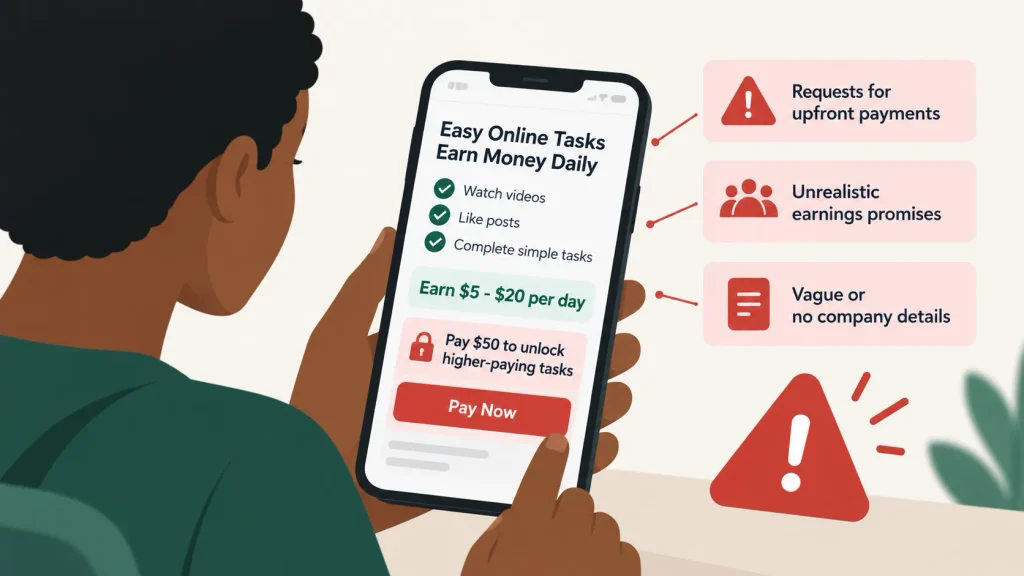
Be particularly careful here. Not every small online task is a scam; some legitimate businesses pay for data labelling, product testing, or user-experience reviews. But a growing category of scams imitates them.
Imagine a WhatsApp message: “We’re recruiting online workers. You can earn money by liking videos and completing daily tasks.” The first tasks are easy, and you may even get a small payment. Then you’re told to deposit money to unlock higher-paying tasks or to withdraw your earnings. That’s a serious red flag.
The US Federal Trade Commission has documented scams that follow this pattern, sometimes showing fake earnings and paying small amounts at first to build trust.
Never pay someone to unlock work or release money you’ve supposedly earned. Screenshots of payments can be edited, and a small first payout can be part of the scam. If a platform won’t clearly explain who pays you and why, investigate before taking part.
Source: FTC — How to Spot and Avoid Task Scams
Is It Worth Spending Hours on Online Surveys?
It depends on what you want. If a platform supports Rwanda, has studies available, and offers rewards you can use, trying it in your free time is fine. But I wouldn’t treat surveys as a replacement for a job, and I wouldn’t build financial plans around them.
Here’s a fictional example. You have ten free hours this week. You could spend them trying to qualify for surveys, which might bring a small reward sooner if you qualify and can redeem it.
Or you could spend them learning a practical skill and making two sample projects, which may bring no money now but could prepare you to offer a service later. Neither path is guaranteed. If you need income urgently, don’t assume weeks of learning will solve it. You may need to pair a longer-term plan with other legitimate work.
How I Would Start an Online Side Hustle in Rwanda With Little Money
Step 1: Look at what you already have
Do you have a smartphone, a laptop, reliable internet? How many hours can you realistically give each week? Are you more comfortable writing, speaking with customers, designing, teaching, or organizing information?
Professional video editing may be hard on an older phone, while writing, communication, or tutoring may be more manageable. Choose something that fits your situation, not just something that “pays well.”
Step 2: Pick one direction to investigate
Don’t open ten accounts in one afternoon. Choose one path: graphic design, tutoring, Excel-based admin work. Research what people pay for, what skills are needed, and how beginners find clients. Be realistic about competition.
Step 3: Check how you’ll get paid
Do this before investing real time. For international platforms, verify country eligibility and withdrawal methods. For local clients, agree on a payment method before starting. For international clients, understand transfer fees, exchange rates, identity verification, and any tax obligations that may apply to you.
Step 4: Build something you can show
Designers can make sample designs, writers can prepare writing samples, and spreadsheet users can build a sample inventory tracker or budget. Tutors can prepare a short lesson plan. Make it easy for someone to see what you can do.
Step 5: Look for clients or suitable tasks
Use legitimate freelance platforms where you’re eligible, professional communities, referrals, and direct outreach to businesses. Don’t spam people. Explain what you offer, share relevant examples, and be clear about what you can deliver.
Step 6: Start small and learn
Your first project doesn’t need to be big. Focus on understanding what the client expects, delivering what you promised, communicating clearly, and getting paid through the agreed method. Don’t work for free indefinitely hoping someone will hire you. As you gain experience, improve your portfolio and notice which services people actually ask for.
A Simple 30-Day Plan to Explore Online Work
| Period | Your focus |
|---|---|
| Week 1 | Research three possible side hustles and choose one that fits your skills, equipment, and circumstances |
| Week 2 | Learn or improve one relevant skill and study examples of good work |
| Week 3 | Create two or three sample projects and organize a simple portfolio |
| Week 4 | Verify payment options, approach suitable clients or platforms, and review what you’ve learned |
This isn’t a promise of income in 30 days. Developing a skill or finding a first paying client can take much longer. The point is to stop jumping from one random website to another and test a more focused approach.
So, Do Online Side Hustles Actually Work in Rwanda?
The honest answer is more complicated than yes or no.
Yes, earning money online from Rwanda is possible. But not every online earning opportunity is available, worthwhile, or realistic for someone living here.
Someone in another country may really earn from a survey platform you can’t access. Someone else may build a good income from freelancing after years of developing skills and client relationships. Another person may spend months looking for a first online client.
All of these experiences can be real. The mistake is assuming that because something worked for one person, it will work the same way for you.
Country restrictions matter. Payment methods matter. So do your skills, equipment, internet access, and available time. And sometimes, even when you do everything right, the opportunities just aren’t there.
If you’ve been frustrated by survey websites that don’t support your country, I wouldn’t keep chasing every new site that promises easy money.
First check that it’s legitimate, available to you, and able to pay you. Then consider learning a skill or offering a service someone needs. Not because freelancing is guaranteed to work, but because a useful skill gives you more ways to look for opportunities, online and offline.
Instead of only asking, “Which website will pay me for simple tasks?” we can also ask, “What can I learn or offer that someone would pay for?”
That question won’t make you rich overnight. But it’s a much better place to start.
Information about platforms, eligibility, and payment methods changes often. Check each platform’s official website before you sign up. This article is general information, not financial or legal advice.
