
TL;DR: Outlier AI pays people to help train AI models — ranking answers, writing responses, and reviewing outputs for quality. Pay typically runs $10–$60/hour depending on your skills and the project. Unlike some entry-level AI platforms, Outlier leans toward applicants with strong writing, reasoning, or subject-matter skills — it’s not the easiest first stop for a total beginner, but it’s one of the better-paying ones once you’re in.
If you’ve been searching “how do I get paid to train AI” and Outlier AI keeps showing up, I get why you’re curious — and why you’re also a little hesitant to hand over your ID and sit through a timed test for a job you don’t fully understand yet.
I felt the same way the first time I looked into AI training platforms. The websites all sound similar, the pay ranges are vague, and it’s genuinely hard to tell which ones are worth your time as someone starting from zero.
So let’s slow down and go through this one honestly: what Outlier AI actually is, what it pays, who really gets accepted, and the exact steps to apply — without any of the “quit your job” hype you’ll find elsewhere.
“Outlier isn’t a job you can talk your way into. It’s a job you have to actually be able to do — and that’s exactly why it pays better than most beginner platforms.”
What Is Outlier AI?

Outlier AI is a platform, owned by Scale AI, that connects freelancers with paid tasks that help improve large AI models — things like ranking AI-generated answers, writing sample responses, and checking outputs for accuracy.
Contributors are called “Outlier Experts,” and the work is fully remote, on your own schedule.
In plain terms: AI companies need real humans to tell their models what a good answer looks like. That’s the job. You’re not coding the AI — you’re teaching it, one task at a time, using your own judgment and knowledge.
How Does Outlier AI Actually Work?
You apply, choose the skill areas you’re strongest in, and complete a timed assessment matching that domain. If you pass, you’re placed in a pool and matched to active projects as they open up. Each project has its own short training before you start earning on real tasks.
A typical task might involve reading two AI-generated responses to the same prompt, judging which one better satisfies a rubric, and explaining why. Other tasks involve writing a “gold standard” answer yourself, or checking factual accuracy in a technical field you know well.
Key Takeaways
- Outlier AI pays contributors to evaluate, rank, and write responses that help train AI models — it’s real, paid, remote work, not a survey site or micro-task app.
- Pay generally runs $10–$60/hour depending on task type, your expertise, and location — specialists in coding, law, medicine, or advanced math tend to earn at the top end.
- Outlier is more selective than some beginner-friendly platforms — it favors strong writers, coders, and subject-matter experts over complete beginners with no analytical background.
- The full process from signup to your first paid task usually takes one to two weeks, and task volume can fluctuate week to week.
- If you’re a true beginner with no specialized background, general data annotation work may be an easier starting point before you try Outlier.
How Much Does Outlier AI Pay?
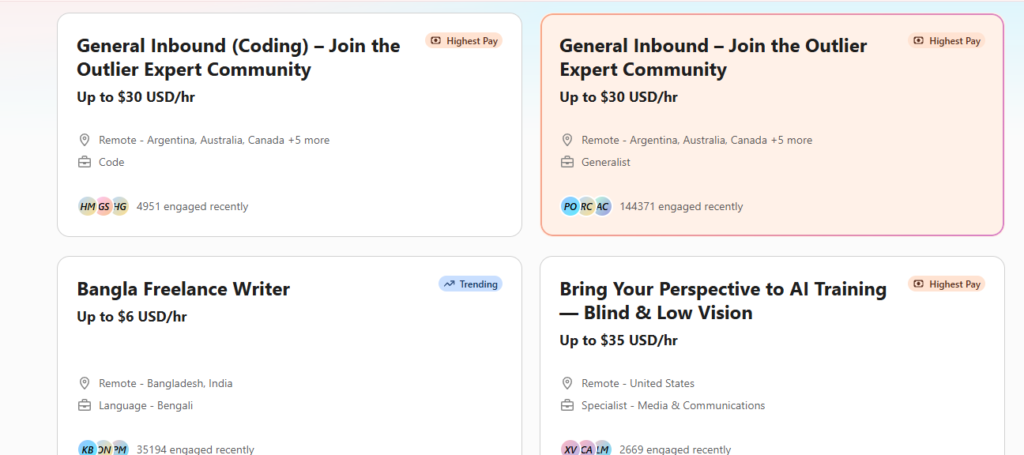
Outlier AI pays contributors between roughly $10 and $60 per hour, with most contributors landing in the $15–$30 range on standard projects and specialists in high-demand fields like coding, law, or advanced science earning at the higher end.
Pay is shown upfront before you accept a task, and payments are typically issued weekly.
| Contributor Type | Typical Hourly Range | Common Task Types |
|---|---|---|
| General writing / reasoning | $15–$30 | Ranking responses, writing sample answers |
| Coding (Python, JavaScript, etc.) | $25–$50+ | Reviewing code, debugging, technical evaluation |
| Specialist (law, medicine, finance, advanced math) | $30–$60 | Domain-specific fact-checking and evaluation |
One honest caveat worth repeating from real contributor reports: task availability isn’t constant. Some weeks bring plenty of work; others go quiet with little warning.
Most people treat Outlier as solid supplemental income rather than a guaranteed full-time replacement — which fits the same realistic pattern we cover in our full breakdown of what it actually takes to earn a full-time income with AI as a beginner.
Is Outlier AI Good for Complete Beginners?
Outlier AI isn’t the easiest entry point for someone with zero writing, reasoning, or technical background — most projects expect strong English communication and analytical thinking, and the assessment is intentionally difficult.
It works best for people who already write well, code, or have subject-matter expertise, even without formal AI experience.
Here’s the thing nobody selling you on “easy AI jobs” will tell you: Outlier is selective on purpose. It’s built for AI labs that need high-quality human judgment, not just anyone willing to click through tasks.
That’s actually good news if you do have relevant skills — it’s part of why the pay is meaningfully higher than more open-entry platforms.
If you’re brand new and want to build confidence and a track record first, general data annotation platforms tend to have a lower bar to entry.
You can always apply to Outlier once you’ve got a bit of experience and a stronger sense of your own strengths — and for a wider view of where you might fit best, our guide on choosing your AI freelance niche as a complete beginner walks through exactly how to figure that out.
How Do You Apply to Outlier AI?
Applying to Outlier AI involves creating a profile, selecting your skill areas, passing a timed assessment in that domain, completing identity verification, and then waiting to be matched with an active project. The whole process typically takes one to two weeks from signup to your first paid task.
1. Sign up
Create your account with your email, location, and background details.
2. Choose your skills
Pick a focused set of domains you’re genuinely strong in — quality over quantity here.
3. Pass the assessment
Complete a timed test matching your chosen domain (writing, coding, or subject-specific).
4. Verify your identity
Submit a government ID and, in some cases, a short video selfie for verification.
5. Wait for a project match
Once approved, you’re placed in a pool and matched when a relevant project opens up.
6. Complete project onboarding
Each new project includes a short training and practice round before real paid tasks begin.
What Do You Need to Get Started?
To apply, you’ll generally need a laptop or computer, reliable internet, a government-issued ID for verification, and — most importantly — genuine skill in at least one area you select, since the assessment is designed to filter out guesswork.
A LinkedIn profile or resume can help but isn’t always required.
Outlier AI vs. Data Annotation: Which Should a Beginner Try First?
If you’re weighing your options, it helps to see them side by side. We’ve covered general data annotation work in detail in this beginner’s guide to data annotation — here’s how the two compare:
| Outlier AI | Data Annotation Platforms (general) | |
|---|---|---|
| Entry bar | Higher — assessment can be difficult | Lower — more accessible to true beginners |
| Typical pay | $10–$60/hr | Often $10–$25/hr |
| Best for | Strong writers, coders, subject experts | Anyone building their first track record |
| Task consistency | Fluctuates by project demand | Also fluctuates, but tasks tend to be simpler to pick up |
Many people in FWN’s community end up running both at once to smooth out the gaps — an approach worth considering once you’ve got a feel for each platform.
If you want the fuller menu of beginner-friendly AI income paths, our roundup of 20 AI services you can sell is a good next stop.
Common Mistakes to Avoid With Outlier AI
- Selecting too many skill categories. Listing ten skills you’re only “okay” at hurts you more than picking two or three you’re genuinely strong in.
- Treating it as guaranteed income. Task flow isn’t constant — plan for it as supplemental income, not a fixed paycheck, especially at first.
- Rushing the assessment. The test is intentionally rigorous. Take your time rather than racing through it.
- Giving up after one rejection. If you don’t pass or don’t get matched right away, building relevant experience elsewhere — like the freelance work covered in our guide to the best platforms for AI freelance work — can strengthen a future application.
None of these are unique to you — they’re the same honest stumbling blocks we cover across the hidden challenges beginners face learning AI, and knowing them ahead of time puts you a step ahead.
Frequently Asked Questions
Is Outlier AI legit?
Yes. Outlier AI is a real platform owned by Scale AI, a major AI data infrastructure company, and it pays contributors for approved, completed work through standard methods like PayPal and bank transfer.
Do I need a college degree to work on Outlier AI?
Not always. While some specialist projects prefer relevant degrees or professional experience, many contributors are accepted based on strong writing, reasoning, or coding skill alone — degrees can help but aren’t a strict requirement for every project.
How long does it take to start earning on Outlier AI?
Most applicants go from signup to their first paid task within one to two weeks, though this depends on assessment results and whether an active project currently needs your skill set.
Can beginners with no AI experience apply?
Yes — prior AI experience isn’t required. What matters more is your existing skill in writing, reasoning, coding, or a specific subject area, since that’s what the assessment actually tests.
Is Outlier AI available outside the US?
Yes, Outlier hires globally, though pay and project availability can vary by country, language, and current client demand.
Conclusion: Is Outlier AI Worth Trying?
Outlier AI is a legitimate way to earn real money using skills you may already have — writing, reasoning, coding, or subject expertise — but it’s not the softest landing spot for someone who’s never earned a cent online.
If the assessment feels tough, that’s not a sign you’re not cut out for AI income. It’s a sign this particular platform is built for a slightly different starting point than yours right now.
The good news is you don’t have to start here.
Building a bit of experience and confidence on lower-barrier platforms first, then coming back to Outlier once you’re ready, is a completely reasonable path — and it’s exactly the kind of realistic, step-by-step approach we lay out in our full guide to earning a real income with AI as a complete beginner.
I’m a fresher please give me any tasks because I’m a beginner