

TL;DR
- Yes, you can earn money with AI with no degree, no certificate, and no experience — but it’s a skill-building path, not a quick scheme.
- A realistic route looks like: choose a niche → learn core skills → freelance for early income → build toward a full-time career.
- Most beginners who succeed aren’t the most “technical” people — they’re the ones who stay consistent and keep learning as AI tools change.
- Full-time income is possible, but it usually takes months of steady effort, not days.
“I’m a complete beginner. No degree, no certificate, no experience. Can I actually earn money with AI? Can I build a full-time income or a stable career out of this?”
If you’ve typed some version of that into Google, I want you to know something first: you’re not behind, and you’re not asking a silly question. I asked myself the exact same thing when I started Future Work Navigator — no tech background, no portfolio, just curiosity and a willingness to figure it out one messy step at a time.
In this guide, I’m going to give you a clear, honest answer — not hype, not a “get rich with AI” pitch. Just the real path, the real timeline, and the real mistakes to avoid, based on what’s actually working for beginners right now.
“You don’t need permission, a degree, or perfect timing to start earning with AI. You need a niche, a bit of patience, and the willingness to learn in public.”
Key Takeaways
- Earning with AI as a beginner is realistic, but it’s built on skills and consistency — not luck or a single “magic tool.”
- Freelancing is usually the fastest way to your first dollar; a career or business is how you eventually reach full-time income.
- You don’t need to master every AI tool — you need to master the two or three that match your chosen niche.
- Certificates can help build client trust, but they’re optional — real, demonstrated skill matters more.
- The biggest beginner mistake isn’t lack of talent. It’s trying to do everything at once instead of picking one lane first.
Can You Really Earn Money With AI With No Degree or Experience?

Yes. AI has lowered the barrier to entry for dozens of income paths — freelance services, content creation, automation, data work, and more — because clients now care more about results than credentials.
What you need instead of a degree is a specific skill, a small portfolio, and the patience to learn as you go. It’s genuinely possible, but it isn’t instant.
This matters because the old rule — “you need a degree to get paid for a skill” — simply doesn’t hold up the same way anymore. Clients hiring for AI-related work on freelance platforms are usually far more interested in “can you actually do this task well” than “where did you study.”
That’s genuinely good news if you’re starting from zero, and it’s part of why we wrote Can You Really Get an AI Job Without a Degree in 2026? as a deeper companion piece to this one.
What the Data Says About AI Freelancing Right Now

This isn’t just a feeling — the numbers back it up. Upwork’s Future Workforce Index 2026, published this month, surveyed 2,400 U.S.-based skilled workers alongside real marketplace earnings data, and the trend is unmistakable: AI freelancing and the AI side hustle economy are growing fast, not shrinking.
38%
of skilled U.S. knowledge workers now freelance, up from 28% a year earlier
+34%
more hourly pay for freelancers doing AI-related work vs. those who don’t
+72%
growth in volume for AI-augmented professional services work
+45%
year-over-year earnings growth for freelancers doing complex, judgment-heavy AI work
Source: Upwork Future Workforce Index 2026 (July 2026)
There’s an honest nuance worth flagging here, because it directly explains why “choose a niche and go deep” beats “do everything” as a strategy.
The same report found that lower-complexity, high-volume AI execution work — the kind any beginner can jump into with generic prompts — is growing fast in demand but actually paying less per project as more people compete for it.
Meanwhile, freelancers who bring real judgment, business context, and depth in one area are being paid significantly more. In other words: the AI job market isn’t rewarding people who dabble in everything. It’s rewarding people who go deep enough in one AI business or service to actually be good at it.
The Realistic Path to Earning Money With AI
Here’s the thing — most guides make this sound complicated. It isn’t. When I strip away the noise, earning money with AI as a beginner comes down to six steps, done in order:
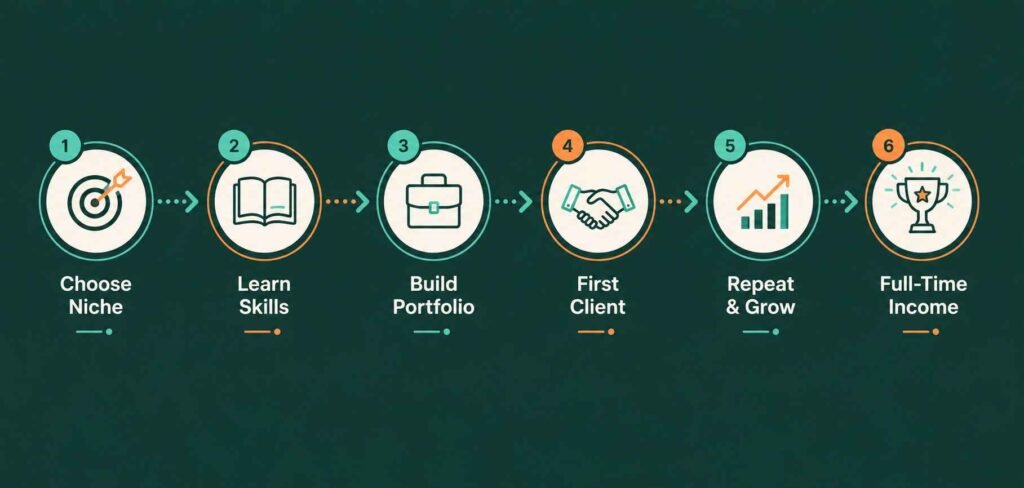
1. Choose a niche
Pick one lane instead of trying to do everything AI can do.
2. Learn core skills
Get functional at the 2–3 tools your niche actually needs.
3. Build a small portfolio
Create 2–3 sample projects so clients can see proof, not promises.
4. Land your first client
Start freelancing and earn your first real income, even part-time.
5. Repeat and grow
Take on more clients, raise your rates, refine your AI services.
6. Build toward full-time income
Turn steady freelance work into a stable, scalable AI career.
How Do You Choose the Right AI Niche as a Beginner?
Choose a niche by matching a real market demand (what people already pay for) with something you can realistically learn in weeks, not months — like AI writing, prompt engineering, data annotation, or basic automation. Starting narrow lets you build visible proof of skill fast, and you can always branch out once you’re earning.
AI is a huge space, and that’s exactly the trap most beginners fall into — trying to learn everything at once and ending up confident in nothing.
I did this myself in my first few weeks: I bounced between AI writing, automation, and prompt engineering in the same week, made a little progress on all three, and real progress on none of them. It wasn’t until I forced myself to pick one lane and ignore the rest for a month that things actually started moving.
Instead, pick one starting lane. If you want a full walkthrough of how to do this step-by-step, I go much deeper in How to Choose Your AI Freelance Niche as a Complete Beginner.
What Skills Should You Actually Learn First?
Learn the skills tied to your chosen niche, not every AI tool that exists. If you’re leaning toward content, start with prompt writing and an LLM like ChatGPT. If you’re leaning toward automation, start with a no-code tool like Make.com. Depth in one or two tools beats surface-level familiarity with twenty.
This is the step people either rush through or get stuck on forever. A few honest notes from experience: learning never fully stops in the AI space — new tools launch constantly, so treat this as an ongoing habit, not a one-time course.
If large language models (LLMs — AI systems trained to understand and generate human-like text, like ChatGPT) are new to you, start with What Is ChatGPT? The Complete Beginner’s Guide.
If automation feels more like your lane, Make.com: The Complete Beginner’s Guide to No-Code Automation or What Is n8n and Should Beginners Use It? are good next stops, and our Zapier vs Make.com vs n8n comparison can help you pick the right tool instead of guessing.
Certificates aren’t required, but they’re not wasted effort either — a relevant certificate can build trust with a client who’s on the fence, even if your portfolio is thin. Just don’t let “collecting certificates” become a way to avoid actually doing paid work.
| What You Want | Recommended Career | Why It Fits |
|---|---|---|
| 💰 Fast first income | AI Writing | High demand and quick to start with basic AI tools. |
| 📈 Long-term earning potential | AI Automation | Businesses pay premium rates for workflow automation. |
| 🌱 Easy entry for beginners | Data Annotation | Requires minimal technical skills or experience. |
| 🎨 Creative work | AI Content Creation | Great for writing, design, social media, and video. |
| 🧩 Technical problem-solving | AI Automation | Best if you enjoy improving processes and systems. |
Where Do You Find Your First Freelance Clients?
Most beginners find their first paid work on general freelance marketplaces, niche AI-specific platforms, or by directly pitching small businesses that clearly need help but haven’t adopted AI yet. A small, honest portfolio — even 2–3 sample projects — matters more at this stage than years of experience.
I suggest starting with freelancing specifically because it shortens the gap between “I’m learning” and “I got paid.” You can build your longer-term career in parallel — the same way a musician might write and sell songs to others while also building their own catalog.
See Best Platforms to Find AI Freelance Work as a Beginner and AI Freelance Portfolio for Beginners: How to Get Clients Without Experience for the practical, step-by-step version of this.
How Long Does It Take to Reach a Full-Time Income With AI?
Most beginners see their first small payment within weeks of consistent effort, but replacing a full-time income usually takes several months to a year or more of steady work, skill-building, and reputation-building. Treat early timelines as encouraging signs, not guarantees — the speed depends heavily on your niche, effort, and consistency.
Let’s be honest: growing this into a full-time career — the kind that can, for a small number of people, eventually reach six-figure income — takes real time. That’s not meant to discourage you.
It’s meant to protect you from the burnout that comes from expecting month-one results. Freelancing bridges that gap by giving you income while the bigger career compounds in the background.
Beginner-Friendly Ways to Actually Earn With AI
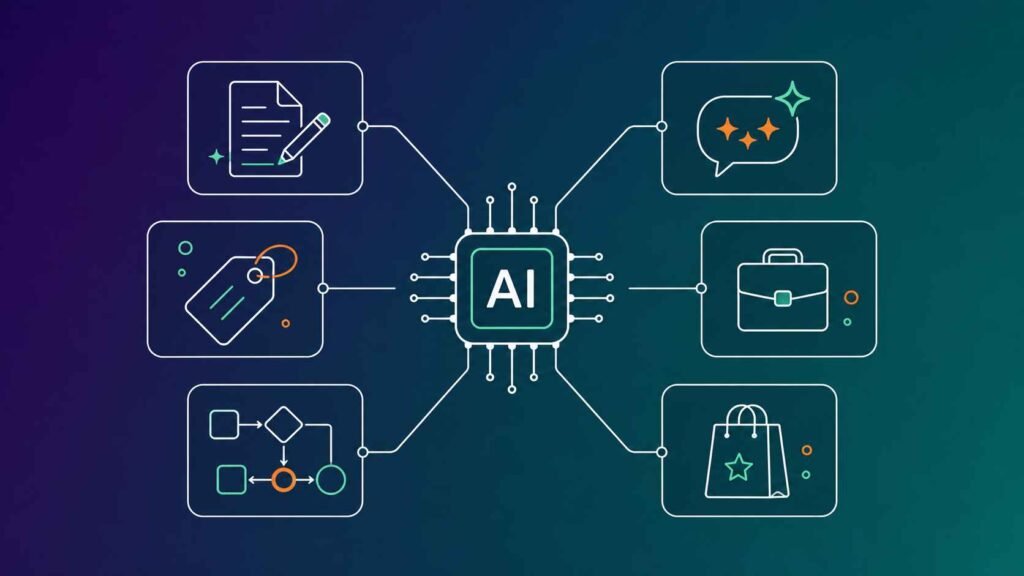
You don’t need to invent your own AI business idea from scratch. Here are proven entry points beginners are using right now to start an AI side hustle — each with a deeper guide if you want to go further:
| Path | Difficulty | Time to First Income | Long-Term Potential |
|---|---|---|---|
| ✍️ AI Writing / Content | Easy | Fast | High |
| 🏷️ Data Annotation | Easy | Fast | Medium |
| ⚙️ Automation Services | Medium | Medium | Very High |
| 💬 Selling AI Prompts | Medium | Slow | High |
Difficulty, timeline, and potential are general patterns, not guarantees — your actual results will vary by niche, effort, and market conditions.
AI Content Writing
Use AI tools to write faster and better for clients. See How to Become an AI Content Writer and Get Paid.
Data Annotation
Label and review data that trains AI models — one of the lowest-barrier entry points. See What Is Data Annotation and How Can You Get Paid for It?.
Automation Services
Build simple workflows for small businesses using Make.com. See How to Make Money With Make.com: 6 Real Services.
Selling AI Prompts
Package tested, reusable prompts as a small digital product. See How to Make Money Selling AI Prompts as a Beginner.
AI Automation Client Work
Land your first automation client, even with zero portfolio. See How to Get Your First AI Automation Client.
Broader Service Menu
Not sure which service fits you? Browse 20 Best AI Services You Can Sell on Freelance Platforms.
Mistakes Beginners Make When Trying to Earn Money With AI
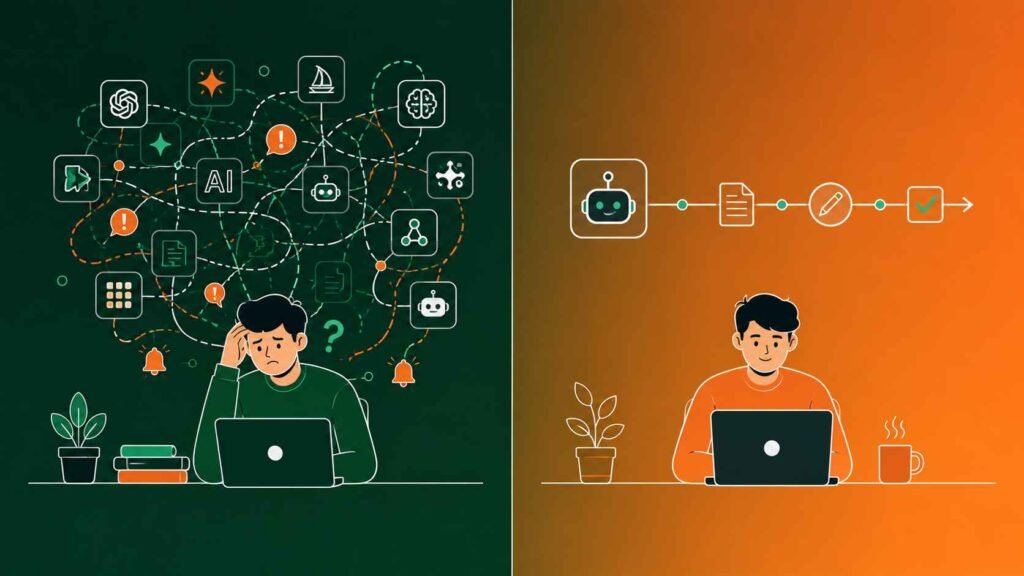
I’ve made a few of these myself, and I see them constantly in beginner communities:
- Trying to learn everything at once instead of committing to one niche long enough to get good at it.
- Chasing every new AI tool the moment it trends, instead of going deep on the two or three tools their niche actually needs.
- Waiting to feel “ready” before applying for any paid work — confidence usually comes after the first client, not before.
- Believing income-hype content that promises thousands of dollars in days — this sets you up to quit the moment reality doesn’t match the promise.
- Skipping the freelance step entirely and trying to build a full “career” or product business with zero income cushion.
If any of this feels familiar, you’re not doing it wrong — you’re doing it like every beginner does at first. For a closer look at what actually trips people up early on, read The Hidden Challenges Beginners Face When Learning AI (And How to Overcome Them).
Tips to Actually Succeed With AI as a Beginner
- Pick one niche and commit for at least 60–90 days before deciding whether to pivot.
- Build a tiny portfolio before you need one — even self-initiated sample projects count.
- Treat learning as ongoing, not a one-time course you finish and forget.
- Keep freelancing while you build your bigger career — it protects you from financial pressure derailing your progress.
- Track what’s working — which pitches get replies, which services clients actually ask for — and do more of that.
Frequently Asked Questions
Do I need to know how to code to earn money with AI?
No. Most beginner-friendly AI income paths — content writing, data annotation, prompt writing, no-code automation — require zero coding. Coding can open additional doors later, but it’s not a prerequisite to start earning.
Is it too late to start with AI in 2026?
No. The AI space is still expanding rapidly, and new tools and niches keep emerging. The barrier isn’t timing — it’s whether you’re willing to start now and keep learning as things evolve.
How much money can a beginner realistically make with AI?
It varies widely by niche, effort, and consistency — from modest side income in the first weeks to a full-time replacement income over months of sustained work. Be wary of any source promising a specific guaranteed number.
Should I get a certificate before I start freelancing?
Not necessarily. A certificate can help build trust with a hesitant client, but it’s not required to start. Many beginners land their first paid work with a small self-built portfolio and no formal certification at all.
What’s the very first thing I should do today?
Pick one niche direction from the list above, then spend this week going deep on just one core tool tied to it — rather than researching every option available.
Conclusion: You Don’t Need to Be “Ready” — You Need to Start

Here’s the honest truth I’d want someone to tell me if I were starting today: yes, you can earn money with AI, and yes, a full-time income and a real AI career are possible — even with no degree, no certificate, and no experience. But it’s built the same way any real skill is built: one niche, one habit of learning, one client at a time.
Every experienced AI freelancer, automation specialist, and remote AI worker you’ll ever look up to started as someone who knew nothing. The only real difference between them and you is that they started before they felt ready. Your first project doesn’t need to be perfect — it just needs to exist.