
TL;DR — Skip to What You Need
- Upwork — Best overall for AI jobs and long-term clients. High competition, but the biggest opportunity.
- Fiverr — Best for getting your first client fast with a packaged gig. Higher fee (20%).
- Contra — Best for beginners who want zero commission and a clean start.
- Freelancer.com — Good for variety and beginner projects. Watch out for low-budget clients.
- Guru — Lower fees (5–9%) and less competition than Upwork. Underrated pick.
- AI freelance skills grew 109% year-over-year in 2026 — the opportunity is real and growing.
When most people think about making money online, they picture quick-win tactics — affiliate links, dropshipping, or selling digital products. And honestly, those things can work. But on this blog, I usually talk about something different: building a genuine long-term career in the AI space. Because that’s what creates real, lasting income.
Today, though, I want to talk about something that fits perfectly alongside that long-term vision — freelancing. Specifically, AI freelance platforms.
Here’s the thing: freelancing isn’t the opposite of building a career. It can actually be one of the best ways to fund and accelerate it. When I first started learning AI tools, I wanted access to premium software, courses, and resources that actually cost money.
Freelancing gave me a way to earn that income while still learning. Real-world client work also forces you to get good fast — faster than any course ever could.
So whether you’re building toward a full-time AI career or just want flexible income while you learn, this guide is for you. Let’s break down the best AI freelance platforms for beginners in 2026 — honestly, with no hype.
Why 2026 Is Actually a Great Time to Start AI Freelancing
I know it can feel like you’ve missed the boat. The internet is full of people who seem like they’ve already figured out AI while the rest of us are still catching up. But here’s what the actual data says.
Demand for skills that explicitly reference AI grew 109% year over year, with particularly strong surges in AI video generation and editing (+329%), AI integration (+178%), AI data annotation and labeling (+154%), and AI chatbot development (+71%). These aren’t forecasts or wishful thinking — they’re drawn from completed contracts and real spending on the platform.
What makes this even more interesting is what’s not happening. Hiring for skills that “AI can supposedly do,” like video editing, image editing, or illustration, has not dipped — and businesses continue to search for people who know how to perform those functions using AI tools. In other words, clients aren’t replacing skilled people with AI. They’re looking for skilled people who know how to use AI.
That’s the opening. And it’s wide right now.
How I Ranked These Platforms
There are dozens of freelance platforms out there. Many of them are fine for general work, but not all of them are worth your time if you’re specifically trying to build AI-related experience and income. To narrow the list down to the ones that genuinely make sense for beginners, I evaluated each platform across eight criteria.
- Availability of AI-related jobs — How many relevant opportunities actually exist?
- Beginner-friendliness — Can you realistically land work without years of experience or a massive portfolio?
- Competition level — How many people are applying for the same jobs?
- Payment security — Is your money protected with escrow, clear dispute resolution, and reliable payouts?
- Earning potential — What can you realistically expect to earn, especially as you grow?
- Ease of getting started — How straightforward is it to create a profile and start applying?
- Platform reputation and trustworthiness — Has it been around long enough to trust?
- Long-term client potential — Can you build ongoing relationships, not just one-off gigs?
I’m not affiliated with any of these platforms. These are just my honest assessments based on the research and data available as of June 2026. Always check the platforms themselves for the most up-to-date fee structures before you sign up.
The Best AI Freelance Platforms for Beginners in 2026
1. Upwork — Best Overall for AI Jobs and Long-Term Growth
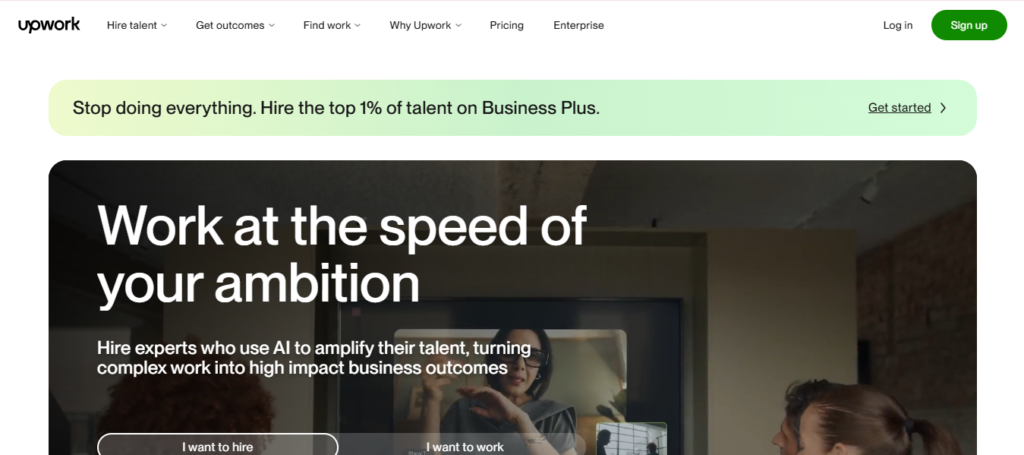
If there’s one platform that shows up in every serious conversation about AI freelancing, it’s Upwork. And the numbers back it up. Upwork boasts over 18 million freelancers and a vast client base, with over 796,000 active clients and more than $4 billion in annual client spend.
For AI work specifically, Upwork is where the demand is concentrated. The majority of AI engineering and ML contracts in 2026 are placed through the dedicated AI sections of the large established platforms — they have the talent pool, the deal volume, and the vetting infrastructure already in place.
Upwork’s AI Services category covers generative AI, RAG and LLM integration, ML engineering, and AI consulting.
The platform uses a proposal-based system, which I actually think is an advantage for beginners. You can browse real job listings, see exactly what clients need, and apply with a tailored pitch. That’s a better learning experience than waiting for clients to find you.
What beginners should know about fees: As of 2026, Upwork charges freelancers a flat 10% service fee on all earnings. Clients pay an additional 5% marketplace fee plus up to $4.95 as a contract initiation fee.
Freelancers also spend on Connects ($0.15–$0.90 each) to submit proposals, typically needing 4–6 per application. You get 10 free Connects per month on a basic account, so you can get started without spending anything.
The honest downside: competition is fierce — top freelancers earn $50–$200 per hour, but beginners often struggle with low initial bids. It takes time to build a profile with reviews and a track record. Don’t expect instant results. But if you’re consistent and strategic, Upwork is where the biggest long-term opportunity lives.
- Fee: 10% freelancer service fee
- Best for: Long-term clients, AI writing, automation, chatbot work, content creation
- Payment protection: Escrow for fixed-price; time-tracking for hourly
- Beginner difficulty: Moderate — takes patience to land first client
Bottom line: This is the platform I’d start with if I was serious about AI freelancing. The competition is real, but so is the demand. Focus on a specific niche, write proposals that speak directly to the client’s problem, and be patient.
2. Fiverr — Best for Getting Your First Client Fast
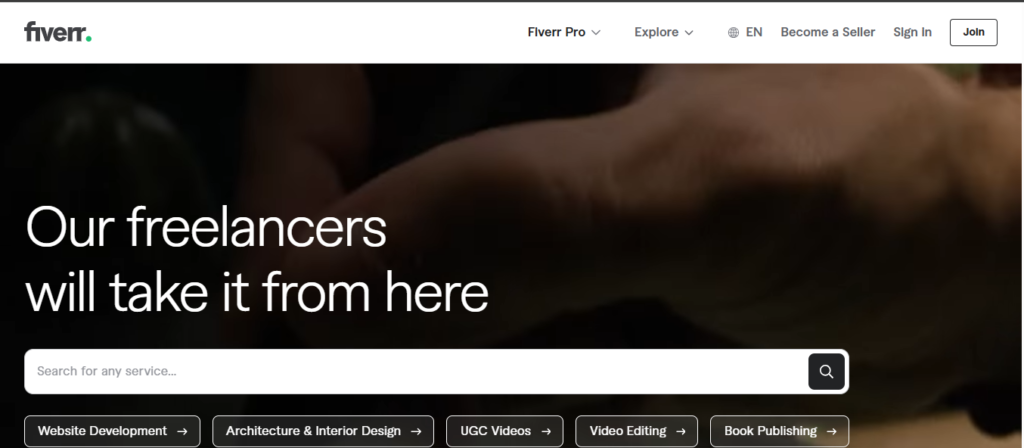
Fiverr works completely differently from Upwork. Instead of browsing job listings and pitching clients, you create a “gig” — a packaged service with a clear description, price, and delivery time — and clients come to you. That’s a big deal when you’re starting out and don’t feel confident writing proposals yet.
Fiverr has pivoted in 2026 to emphasize micro-services and subscription models, and now lists over 700 service categories. Beginners love the low barrier to entry, with many starting to earn within days by offering niche services like AI art generation.
The honest downside is the fee. Fiverr applies a flat 20% commission on earnings, which is the highest of any major platform on this list. That means for every $100 you earn, you keep $80. It adds up, especially when you’re building volume.
That said, Fiverr has a real advantage for beginners: you don’t need to spend Connects or write dozens of proposals. Once your gig is live and optimized, you can start getting inquiries passively.
It’s also an excellent place to package AI skills — things like AI image editing, ChatGPT prompt writing, AI-assisted blog content, or chatbot setup — into simple, clear offers that clients can purchase in a few clicks.
- Fee: 20% flat commission on all earnings
- Best for: Packaged AI services, quick wins, creative AI work
- Payment protection: Escrow held until project delivery is approved
- Beginner difficulty: Low — clients come to you once your gig is set up
Bottom line: Fiverr is a great place to get your first paid client quickly. Just be strategic about what gig you create — niched, specific services perform far better than generic ones. And as you scale, factor that 20% into your pricing from day one.
3. Contra — Best for Beginners Who Want Zero Commission
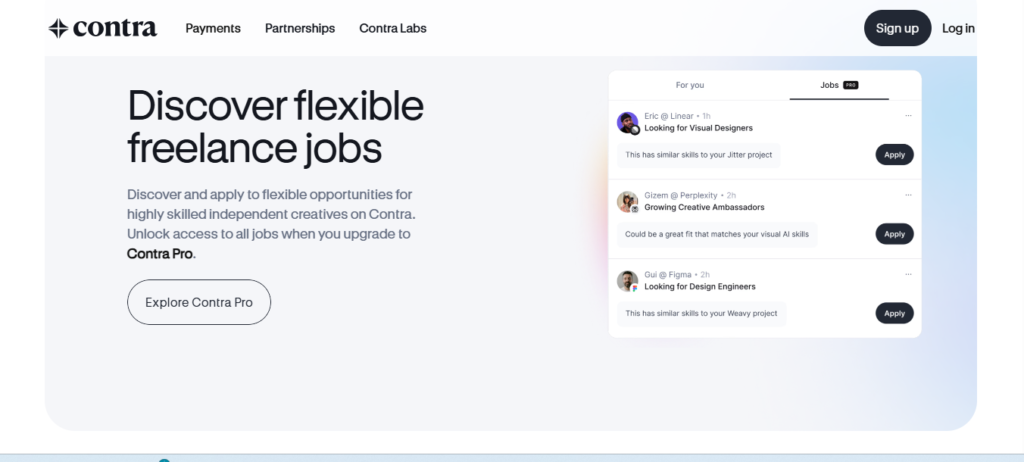
Contra is one of those platforms that often gets overlooked, and I think that’s a mistake — especially for beginners who are just starting to build their portfolio and don’t want a platform taking a big cut of their early earnings.
Contra charges 0% commission to freelancers. It’s free to join and use, with clients covering invoice processing fees. That means every dollar a client pays you lands in your pocket. When you’re just starting out and working for lower rates while you build experience, that makes a real difference.
Contra is great for beginners because it’s free and lets you build a portfolio without fees. The platform has a clean, modern profile system that showcases your work well — which matters when your profile is your main selling point.
The main tradeoff is volume. Contra is smaller than Upwork or Fiverr, so there are fewer jobs posted on any given day. Think of it less as a high-volume job board and more as a portfolio platform that also has work attached to it. For digital services and AI-adjacent creative work, it can be a solid starting point.
- Fee: 0% for freelancers
- Best for: Building your first portfolio, creative and digital AI services
- Payment protection: Invoice-based with built-in processing
- Beginner difficulty: Low — clean profile setup, no bidding costs
Bottom line: Use Contra alongside another platform. It’s a great zero-cost way to start collecting portfolio pieces and getting paid without losing a cut to fees. Don’t rely on it as your only source of work.
4. Freelancer.com — Good for Variety and Global Clients
Freelancer.com is one of the largest freelance marketplaces in the world by sheer number of users. AI-related work on the platform includes machine learning development, data analysis, and automation projects. The platform uses a bidding system where freelancers compete for projects by submitting proposals.
The platform can be a good place to find beginner-level AI projects — things like data entry, content writing with AI tools, basic automation setup, and research tasks. It tends to attract a wide range of clients, from small businesses to individuals, which means the job quality varies quite a bit.
In terms of fees, Freelancer.com takes a 10% flat fee from freelancers, with a $5 minimum per project, while buyers incur around 3% project fees. That’s comparable to Upwork in practice. The platform also gives you 10 free monthly bids, which makes it accessible to try without spending anything upfront.
One thing to watch for: Freelancer.com is known for attracting clients who post projects at very low budgets. You’ll need to be selective about which projects you bid on to make sure your time is worth it.
- Fee: 10% flat commission
- Best for: Variety of beginner AI tasks, global client access
- Payment protection: Milestone-based payments available
- Beginner difficulty: Moderate — bidding competition is high
Bottom line: Worth trying if you’re casting a wide net early on. Just be selective — filter for clients with verified payment methods and a history of completed projects. Avoid the race-to-the-bottom bidding that can hurt your confidence and your rates.
5. Guru — Lower Fees and Less Noise Than the Big Names
Guru doesn’t get talked about as much as Upwork or Fiverr, but that’s actually part of what makes it interesting. Less buzz often means less competition — and for beginners, lower competition can mean a better chance of landing your first project.
Guru charges 5–9% fees, the lowest among open marketplaces. Compare that to Fiverr’s flat 20% or Upwork’s 10%, and you’re keeping meaningfully more of what you earn — especially useful when you’re building up and working at introductory rates.
Guru has gained traction in 2026 for its flat-fee model and workroom collaboration tools, and user experiences highlight a less crowded marketplace — ideal for mid-level freelancers in writing and admin support. The workroom feature is actually quite useful for staying organised with ongoing clients, which matters if you’re trying to build longer-term relationships.
The main limitation is volume — there are simply fewer clients on Guru than on Upwork or Fiverr. But if you’re in writing, content creation, AI-assisted research, or admin work, it’s a solid option that many beginners overlook entirely.
- Fee: 5–9% (lowest of any open marketplace)
- Best for: Writing, content, admin, AI-assisted research work
- Payment protection: SafePay escrow system
- Beginner difficulty: Low to moderate — less competition than major platforms
Bottom line: Guru is the underrated pick on this list. If you’re in a writing or content niche and want to keep more of your earnings while competition is lower, give it a serious look.
Quick Comparison: Which Platform Is Right for You?
| Platform | Freelancer Fee | Best For | Competition | Beginner Rating |
|---|---|---|---|---|
| Upwork | 10% | AI jobs, long-term clients | High | ⭐⭐⭐⭐ |
| Fiverr | 20% | Quick first client, packaged gigs | Medium–High | ⭐⭐⭐⭐⭐ |
| Contra | 0% | Portfolio building, zero fees | Low | ⭐⭐⭐⭐ |
| Freelancer.com | 10% | Variety, global reach | High | ⭐⭐⭐ |
| Guru | 5–9% | Writing, content, admin | Low–Medium | ⭐⭐⭐⭐ |
What Kind of AI Work Can Beginners Actually Get Hired For?
This is where it gets genuinely exciting. You don’t need to be a developer or data scientist to get paid for AI-related work in 2026. A lot of the fastest-growing demand is in areas where beginners can genuinely compete — especially if you pair your existing skills with AI tools.
Here’s what the data says about where clients are spending money right now. Demand is surging across familiar creative and technical workflows, with AI video generation and editing leading at 329% growth, followed by AI integration at 178%, AI image generation and editing at 95%, and AI chatbot development at 71%. And crucially, 84% of skilled freelancers say they are excited by the prospect of AI tools reshaping their services, offerings, and workflows.
For beginners, some of the most accessible entry points include:
- AI-assisted content writing — Blog posts, product descriptions, email copy using tools like ChatGPT or Claude. Writers who use AI to work faster and produce more are in real demand.
- AI image editing and generation — Creating graphics, social media visuals, or product images using tools like Midjourney or Adobe Firefly.
- AI video editing — One of the fastest-growing categories. If you can use tools like Runway or CapCut’s AI features to produce clean, edited video, this is worth exploring.
- Chatbot setup and prompt writing — Helping small businesses set up simple AI chatbots or write effective prompts for their workflows.
- Data annotation and AI training tasks — Labelling data, reviewing AI outputs, and providing human feedback. These tasks often don’t require technical skills at all.
- Virtual assistance with AI tools — General virtual assistant work combined with AI-powered productivity tools. Virtual assistants, project managers, and customer support specialists who integrate AI tools into their daily operations are seeing increased demand.
The pattern here is that clients aren’t looking for people to replace AI — they’re looking for people who can work with it. That’s a skill you can start developing today, even as a complete beginner.
Practical Tips for Getting Your First AI Freelance Client
Landing your first client is always the hardest part. Here’s what actually moves the needle, based on how platforms work in 2026.
1. Pick one platform and one niche to start
Signing up for five platforms at once and offering five different services is a recipe for overwhelm and mediocre profiles everywhere. Pick one platform — I’d suggest Upwork or Fiverr depending on how you prefer to work — and choose one specific service to offer. The narrower you go, the easier it is to stand out.
2. Write your profile for one type of client
The most common beginner mistake is writing a profile that tries to appeal to everyone. Think about one specific type of business that needs the service you’re offering, and write your entire profile as if you’re talking directly to them. “I help e-commerce brands write product descriptions using AI” is far more compelling than “I offer writing services.”
3. Take the first few projects at a strategic rate
When you have no reviews and no portfolio, you need to close that credibility gap fast. Taking your first two or three projects at a slightly lower rate in exchange for a glowing review is a smart investment — not a permanent compromise. Once you have reviews and samples, you can start raising your rates.
4. Over-deliver on every early project
Your reputation on these platforms is everything. One five-star review from an early client can generate momentum that no marketing ever could. Deliver early when you can, communicate clearly, and make the experience easy and pleasant for the client.
5. Use AI tools to work faster, not to cut corners
Freelancers who have adopted AI workflows report that deliverables that previously took 6 hours now take roughly 2.5 hours, while rates remain the same. That’s not cutting corners — that’s smart leverage. Use AI tools to handle the repetitive parts of your work, and spend the time you save on quality control and personalisation.
Should You Freelance or Focus on Building a Long-Term AI Career?
This is a question I get a lot, and the honest answer is: it doesn’t have to be either/or.
On this blog, I write a lot about building a long-term AI career — becoming a specialist in a specific niche, building real expertise, and growing income in a sustainable way. That path takes time. Freelancing can fund that journey while you’re on it.
Think of it this way. Freelancing gives you real-world experience with actual clients — something you simply can’t get from watching tutorials. It gives you income to invest in premium tools and learning resources. And it gives you something even more valuable: proof that you can do the work. Every client project is a portfolio piece and a reference.
According to recent data, 82% of skilled freelancers say their work opportunities have grown since last year, and 39% of all U.S. workers now freelance — up 4% from 2025. The market is moving in one direction. Getting on the platform now, even at beginner rates, means you’re building a track record while the opportunity is still growing.
If you’re thinking about the bigger picture — where you want to be in two or three years — I’d encourage you to read my post on AI automation as a career path and how to make money online without experience. Freelancing is a great bridge between where you are now and where you want to go.
Key Takeaways
- AI freelance demand is real and growing. Skills tied to AI grew 109% year-over-year on Upwork in 2026 — based on what clients actually paid for, not job postings.
- Upwork is the best overall platform for AI jobs and long-term clients, but expect a slower start due to competition. Patience pays off.
- Fiverr is the fastest path to your first client — create a niched gig and clients come to you. Just factor in the 20% fee.
- Contra charges zero commission — great for building your portfolio early without losing money to platform fees.
- You don’t need to be technical to start AI freelancing. Content, editing, chatbot setup, and virtual assistance are all entry points that beginners can access today.
- Freelancing and long-term career building aren’t competing paths — they work together. Freelancing funds and accelerates your growth.
Ready to Start? Here’s Your First Step
If you’ve been sitting on the sidelines of AI freelancing, waiting until you feel “ready enough,” I want you to hear this: the best time to start building your profile was six months ago. The second-best time is today.
You don’t need a perfect portfolio. You don’t need years of experience. You need one clear service, one well-written profile, and the willingness to do a great job on your first project. Everything else builds from there.
If I were starting from scratch today, I’d create a Fiverr gig offering one specific AI-assisted service — something simple like AI blog post writing or AI image editing — and I’d also set up an Upwork profile targeting the same niche. Running both in parallel means you’re covered whether clients are searching for gigs or posting jobs.
Pick one platform. Pick one niche. Create one great profile. Then start.
You may also read: How to Get Your First AI Automation Client in 2026 (Even With No Portfolio)
Have questions about getting started on any of these platforms? Drop them in the comments below — I read every single one and I’m happy to help you figure out your next move.
Je veux me lancer dans freelancing IA
Business
На этом веб-сайте удастся обнаружить нужную информацию.
https://1-mk.ru/detail/262-lyogkiy-ovoshchnoy-sup-s-risom-bystryy-retsept-dlya-zdorovogo-obraza-zhizni/