
You want to earn money with AI. You’ve read the articles, watched the videos, maybe even browsed this blog for ideas. But every time you sit down to pick a direction, the options multiply and the overwhelm kicks in. This guide cuts through all of that and gives you a clear, honest framework for choosing the right AI freelance niche — based on who you already are, not who you think you need to become.
When I first started exploring AI freelancing, I spent weeks bouncing between content writing, automation, and virtual assistant services before realizing that choosing one was far more important than choosing perfectly. This guide is everything I wish I’d had at the start. I’m a fellow learner who figured this out the hard way — and now I’m sharing the shortcut.
You want to earn money using AI. You’ve done the searching, the reading, maybe even the note-taking. And somewhere along the way you landed on a list that looked like this: AI content writer, chatbot creator, automation specialist, prompt engineer, AI graphic designer, social media manager, virtual assistant…
And your brain did exactly what any reasonable person’s brain does when faced with ten directions at once.
It froze.
I’ve been there. And here’s the thing nobody tells you: the overwhelm you’re feeling right now isn’t a sign that you’re not ready. It’s a sign that you’re taking this seriously. People who don’t care about getting it right don’t feel paralysed by the options — they just pick randomly and wonder why it doesn’t work.
You’re asking the right question. Now let’s get you the right answer.
Why Choosing a Niche Feels So Hard (And Why It Doesn’t Have To)
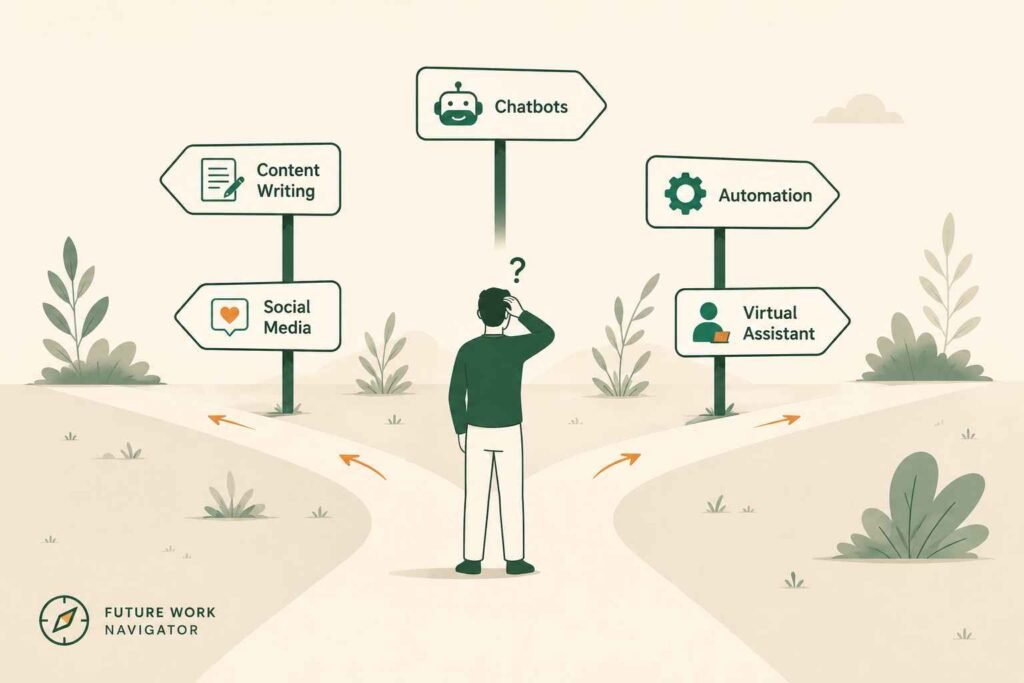
Let’s be honest about what’s really happening when you feel stuck on niche selection.
Most guides approach this backwards. They start by listing every possible AI freelance service — ten, fifteen, sometimes twenty options — and then tell you to “pick the one that interests you most.” As if interest alone is a good enough compass.
As if you’re supposed to magically know which one you’ll be good at, which one pays well, and which one has clients actually looking to hire someone like you.
That’s not helpful. That’s just a longer list with extra steps.
The real reason niche selection feels hard is that most people are trying to make a permanent, life-defining decision. They’re thinking: “If I pick the wrong niche, I’ll waste months. If I pick the right one, I’ll be set.” And that pressure turns a simple practical choice into an existential one.
And yet the demand is real and growing fast. Here are the numbers that put this in perspective:
4× Growth in AI-related freelance job postings since 2023: World Economic Forum, 2026
61% Of Gen Z freelancers already use generative AI in their daily work: Upwork Freelance Forward Report
2,100+ Open automation jobs on Upwork alone as of early 2026: Upwork job listings
75% Of freelancers earn as much or more than in traditional employment: Freelancers Union Survey
Here’s the truth that will take the weight off immediately: your first niche is not your forever niche. It’s your starting niche. It’s the lane you get into so you can start moving — and you can always change lanes once you’re in motion. Sitting still trying to pick the perfect lane is the only guaranteed way to go nowhere.
What we’re looking for today is not perfection. We’re looking for the right-enough-to-start answer. And that’s a much easier thing to find.
The Main AI Freelance Niches for Beginners in 2026
Before we get to the framework that helps you choose, you need to understand what’s actually on the table. Not every AI freelance niche is equally accessible to a beginner — some require coding skills, others require only curiosity and a willingness to learn some new tools.
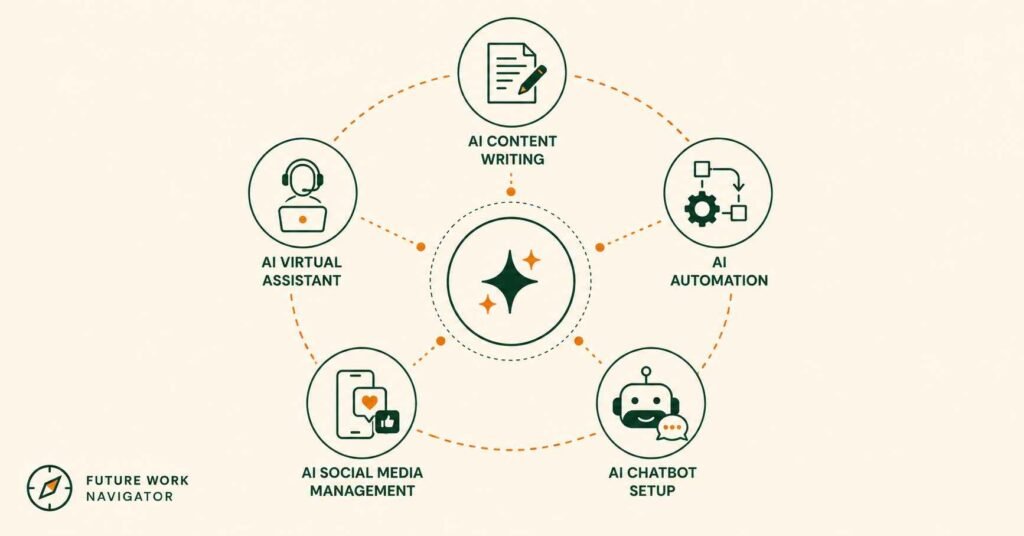
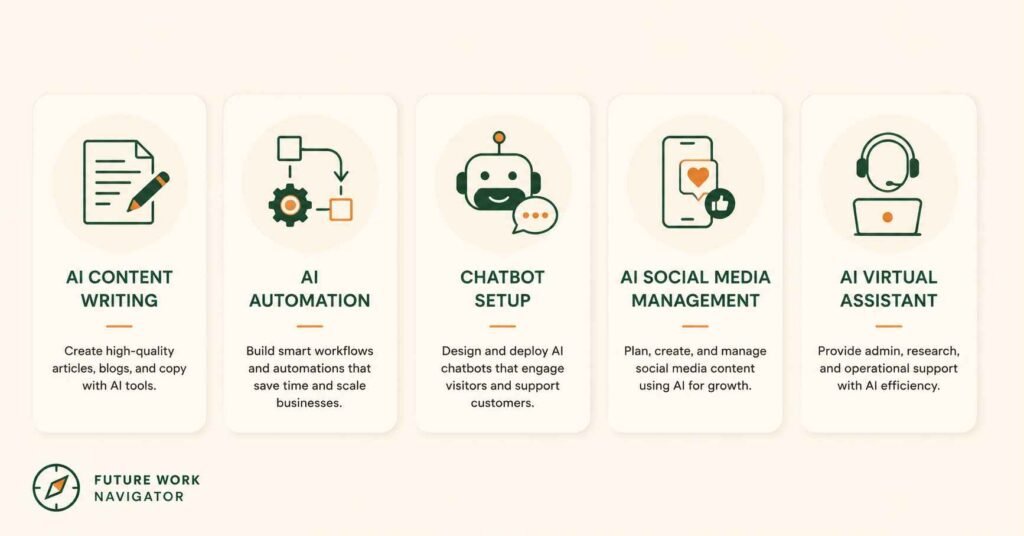
Here are the five most beginner-accessible AI freelance niches right now, with an honest breakdown of each one.
AI-Assisted Content Writing
Best for: people who enjoy writing or have worked in marketing, teaching, or communications
This is the single most accessible entry point for beginners with no technical background. Using tools like ChatGPT or Claude, you help businesses produce blog posts, email newsletters, social media captions, and product descriptions — faster and more consistently than they could manage alone.
Your job is not to press a button and hand over raw AI output. Your job is to use AI to accelerate your thinking, then edit and shape the result into something genuinely good.
Clients pay between £40 and £250 per piece depending on the depth, niche, and SEO requirements. AI content writing is well-suited to retainer work — a business that needs four blog posts a month will happily pay the same person every month rather than hire new freelancers repeatedly.
✅ No tech skills needed✅ Fast to learn✅ High demand⚡ Competitive market
📋 Example beginner project
Write four SEO blog posts for a fictional fitness coach using ChatGPT and free keyword research tools. Document your process, publish samples on a Notion page, and present them as your first portfolio case study.
AI Workflow Automation
Best for: people who enjoy solving problems and connecting systems — no coding required
Small businesses are drowning in manual, repetitive tasks — copying data from one place to another, following up on leads by hand, sending the same emails over and over. Automation freelancers use no-code tools like Make.com, Zapier, and n8n to connect these systems and eliminate the busywork. You don’t write code. You build logic chains — “if this happens, do that” — using visual drag-and-drop interfaces.
This niche pays well relative to the skill investment because clients experience immediate, measurable results. A workflow that saves a business owner five hours a week is worth hundreds of pounds a month in retained time. Automation specialists who package their service as “done-for-you setup” can charge £300 to £1,500+ per project.
✅ High project fees ✅ Low competition at beginner level⚡ Steeper learning curve⚡ Logical thinking required
📋 Example beginner project
Build a Make.com workflow that automatically sends website contact form submissions into a Google Sheet and fires a personalised follow-up email — eliminating 2–3 hours of manual admin per week for a small business.
Chatbot Setup & Configuration
Best for: people with a customer service or sales background who understand how customers think
Businesses are rapidly replacing basic customer service functions with AI chatbots — not to eliminate the human touch, but to handle the routine questions that flood inboxes every day. As a chatbot freelancer, you set up and configure these systems using no-code platforms like Tidio, Manychat, or Voiceflow. You map out the conversation flows, write the responses, and test the experience from the customer’s perspective.
What makes this niche particularly interesting for people with a non-technical background is that the skill being sold is not coding — it’s understanding how people communicate and what they need. That’s a human skill that software alone can’t replicate.
✅ Human skills transfer well✅ Growing client demand⚡ Platform-specific learning needed
📋 Example beginner project
Set up a Tidio chatbot for a fictional online clothing shop that answers the ten most common pre-purchase questions automatically — reducing inbox volume and keeping customers engaged out of hours.
AI Social Media Management
Best for: people already active on social platforms who understand what makes content perform
Every business knows they should be posting consistently on social media. Almost none of them actually do it, because it takes time they don’t have. AI social media managers use tools like ChatGPT, Buffer AI, and Canva to create content calendars, write platform-specific captions, design simple graphics, and schedule posts — all at a pace that no human could match without AI.
This niche is particularly accessible if you’re already comfortable with Instagram, LinkedIn, or TikTok — even as a personal user. You already understand the culture of the platform, what gets engagement, and how to write in a way that sounds like a person rather than a press release. That instinct is genuinely harder to teach than the tools themselves.
✅ Retainer-friendly✅ Great for creatives⚡ Results take time to show
📋 Example beginner project
Create a 30-day Instagram content calendar for a fictional independent coffee shop — including captions, hashtag sets, and Canva graphic templates — using ChatGPT for copy and Canva AI for visuals.
AI-Powered Virtual Assistant
Best for: organized, detail-oriented people who enjoy variety and supporting others
The modern virtual assistant role has evolved significantly. In 2026, the most in-demand VAs are those who use AI to handle research, draft emails, summarize documents, manage content calendars, and automate administrative tasks — all faster and more accurately than a traditional VA could manage manually. Tools like Notion AI, ChatGPT, and various scheduling and email tools make this possible.
This is a strong starting point for people who aren’t sure which single skill to lead with, because the AI VA role can encompass several of them. The trade-off is that it can be harder to command premium rates until you’ve built a strong reputation — so it works well as an entry point, with the plan to specialise over time.
✅ Great starting point✅ Wide variety of tasks⚡ Lower rates at first⚡ Harder to scale
📋 Example beginner project
Build a Notion AI workspace for a fictional online business coach — including a client CRM, a weekly task dashboard, and an AI-assisted email drafting template — to demonstrate what an organised, AI-enhanced VA can deliver.
📌 Want to go deeper on any of these?
- Zapier vs Make.com vs n8n — Which Automation Tool Is Right for Beginners?
- How to Build an AI Freelance Portfolio with No Experience
- Best AI Freelance Platforms for Beginners in 2026
Still Unsure? Start Here
If you’ve read through the five niches and you’re still not sure which one to pick, use this table. Find the sentence that sounds most like you — and that’s your starting niche.
| If you are… | Start with… |
|---|---|
| Good at writing, explaining, or storytelling | AI Content Writing |
| Organized and detail-oriented, enjoy supporting others | AI Virtual Assistant |
| A logical thinker who loves solving systems problems | AI Workflow Automation |
| Already active and comfortable on social platforms | AI Social Media Management |
| From a customer service or sales background | Chatbot Setup & Configuration |
| Need income quickly and want the lowest barrier to entry | AI Content Writing or AI Virtual Assistant |
| Willing to invest more learning time for higher project fees | AI Workflow Automation |
The 4-Question Framework to Find Your Niche
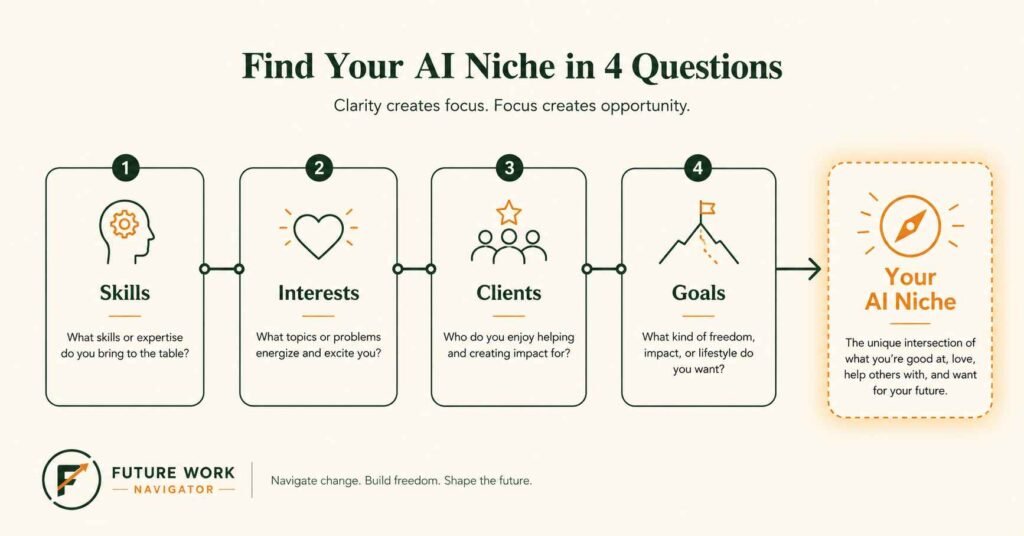
Now that you know what’s available, let’s figure out which one is actually right for you. Instead of guessing or going with whatever sounds most exciting in the moment, I want to walk you through four honest questions. Take your time with each one. Write your answers down if that helps.
By the end of question four, you’ll have significantly narrowed your options — and in most cases you’ll have a clear answer.
1. What skills or experience do you already have?
This is the most important question and the one most people skip entirely. Your previous life — every job, hobby, course, and interest — is a legitimate head start in certain niches. A former teacher is already an excellent candidate for AI content writing. Someone who’s worked in customer service understands chatbot flows instinctively. A person who’s managed a small business knows exactly why automation is valuable. Don’t start from zero. Start from what you already know.
2. Do you prefer working with words, systems, or people?
This question reveals more about the right niche than almost any other. People who light up when they write, edit, or communicate naturally gravitate toward content writing or social media management.
People who get satisfaction from making things work — from building logical processes and seeing messy operations become clean and efficient — tend to love automation and chatbot work. People who enjoy supporting and organizing others often thrive as AI virtual assistants.
None of these is better than the others. They just suit different types of people, and picking the one that matches how you naturally think will make the learning curve far easier.
3. Which type of client do you want to work with?
Think about the kind of business you’d genuinely enjoy helping. A local café? An online coach? An e-commerce brand? A busy startup? Different niches attract different client types — and you’ll do better work, retain clients longer, and charge more confidently when you understand and care about the industry you’re serving.
For example, if you love the wellness world, AI content writing for health coaches is far more compelling than a generic “I write blog posts” offer. Your niche is not just your service — it’s your service plus your industry. The more specific the combination, the easier it is to stand out.
4. How quickly do you need to start earning?
This is a practical question, not a limiting one. Some niches let you start offering services within days of picking up the tools. AI content writing and social media management fall into this category — the barrier to entry is low enough that a determined beginner can produce a respectable spec project within a week.
Other niches, like automation and chatbot setup, require more learning time before you can confidently deliver for clients. Neither path is wrong. But if you need income soon, starting with a lower-barrier niche and adding a higher-value one later is a smarter sequence than waiting until you’ve mastered the hardest option first.
How to use your answers: Look back at what you wrote for each question. You should start to see one or two niches appearing consistently as the natural fit. That pattern is your answer.
Trust it more than any list of “highest-paying” options you’ll find online — because the niche you’ll actually stick with, learn deeply, and deliver well is worth far more than the one that looks impressive on paper but never quite clicks.
The Quick Decision Matrix
Still deciding between two options? This table gives you a direct comparison of the five beginner-friendly niches across the factors that matter most when you’re starting out.
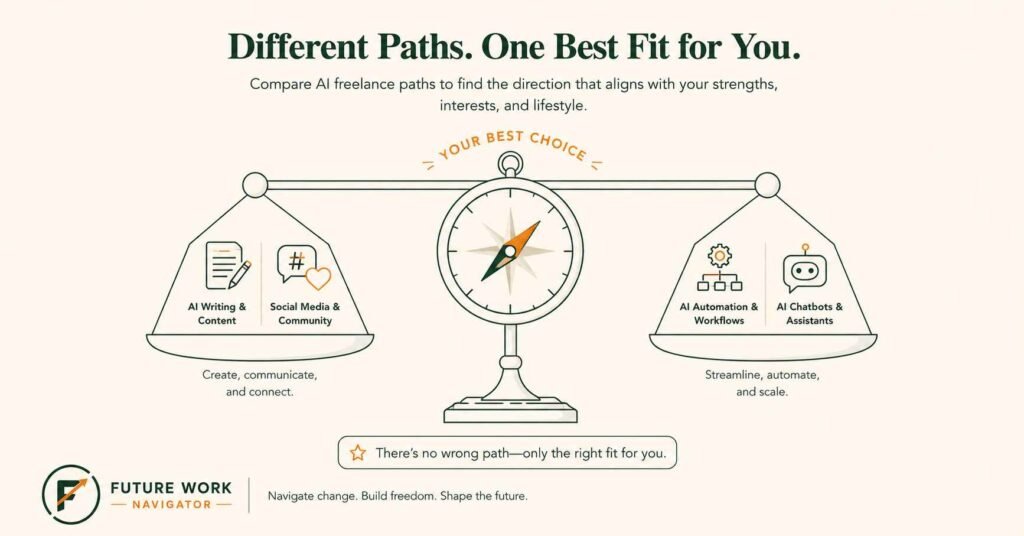
| Niche | Tech Skill Needed | Time to First Client | Earning Potential | Best For |
|---|---|---|---|---|
| AI Content Writing | Low | 1–2 weeks | £50–£250/piece | Writers, marketers, teachers |
| AI Automation | Medium | 3–6 weeks | £300–£1,500+/project | Logical thinkers, problem-solvers |
| Chatbot Setup | Medium | 3–5 weeks | £200–£800/project | Customer service backgrounds |
| AI Social Media | Low | 1–3 weeks | £300–£900/month retainer | Platform-savvy creatives |
| AI Virtual Assistant | Low | 1–2 weeks | £15–£35/hour | Organised, service-oriented people |
A few things worth noting here. “Time to first client” assumes you’re actively working on spec projects and putting your portfolio in front of people — not just reading about the niche.
And earning potential figures reflect the realistic range for beginners to mid-level freelancers, not the ceiling. With experience and specialization, all of these niches can earn significantly more.
Why You Must Pick Just One Niche (At First)

I want to be direct about this because it’s the mistake I see most often, and it’s the one that costs beginners the most time.
The temptation when you’re starting out is to hedge. To offer content writing and automation and chatbots, so you cast the widest net possible. The logic feels sound — more services means more potential clients, right?
In reality, it works the other way around. A freelancer who says “I help e-commerce brands write better product descriptions using AI” will book more clients than someone who says “I offer AI content writing, social media management, chatbot setup, and automation.”
The first person sounds like an expert. The second sounds like someone who hasn’t decided what they do yet.
Here’s the thing: Clients aren’t looking for someone who does everything. They’re looking for someone who solves their specific problem. The more specifically you describe your service, the more instantly recognisable you become to the person who needs exactly that thing. That’s when “this is the right person” lands — and that’s when you get hired.
Picking one niche also has a huge practical benefit: it dramatically shortens your learning curve. Instead of spreading your attention across five tools and five types of deliverable, you go deep on one. You build speed, confidence, and quality faster. And faster results mean faster income.
Real example: Two beginners start at the same time. Person A offers “all AI freelance services.” Person B offers “AI-assisted weekly newsletters for independent coaches and consultants.” Six weeks later, Person B has two paying clients and a third in conversation — because every coach they spoke to immediately understood the value. Person A is still tweaking their website bio.
Specificity doesn’t limit you. It makes you findable.
You can — and should — expand your services once you have clients, a portfolio, and a clear sense of where the opportunities are. But that comes later. For now: one niche, one target client, one clear offer.
What to Do the Day After You Choose Your Niche
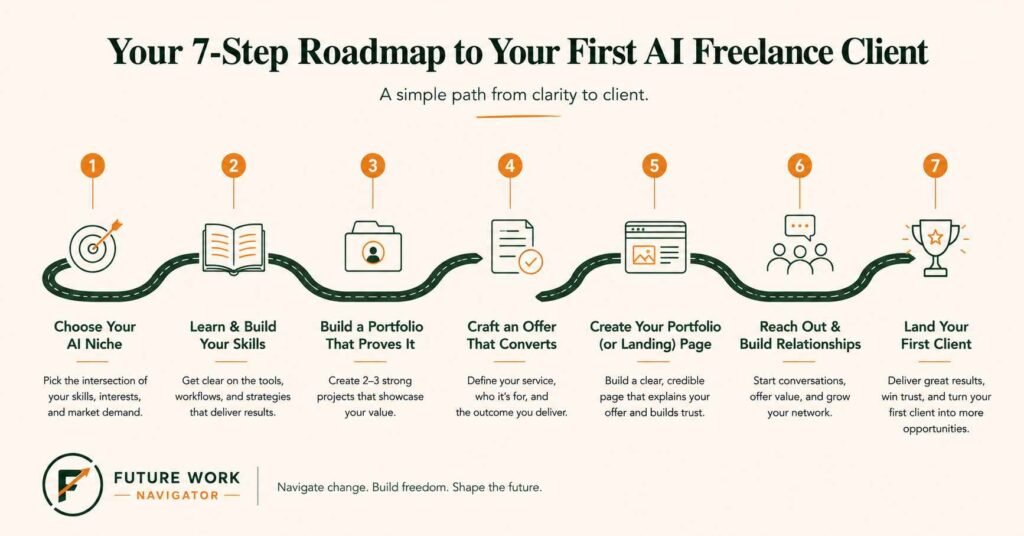
Choosing your niche is step one. What you do immediately after is what separates the people who build real freelance businesses from the ones who spend another three months “getting ready.”
Here’s exactly what to do in the first seven days after you’ve made your decision:
- Day 1–2: Spend two focused hours learning the primary AI tool for your chosen niche. For content writing, that’s ChatGPT or Claude. For automation, that’s Make.com or Zapier. Don’t just read about it — open an account and actually use it.
- Day 3–4: Create your first spec project. Pick a fictional business you find interesting, define a real problem they’d have, and create the kind of deliverable you’d produce as a freelancer. Treat it as if a real client paid for it.
- Day 5: Write your simple one-sentence offer. “I help [type of client] [achieve this outcome] using AI tools.” That sentence will go on your LinkedIn bio, your Upwork profile, and everywhere else you introduce yourself professionally.
- Day 6: Set up a simple portfolio page — Notion, a PDF, or a LinkedIn Featured post. Your spec project goes here. Your one-sentence offer goes here. A way to contact you goes here. That’s your portfolio. Done.
- Day 7: Tell five people what you do. A former colleague, a friend with a business, someone in a relevant Facebook group, someone in your LinkedIn network. Not a pitch — just a genuine mention: “I’ve just started offering AI content writing for small businesses — if you know anyone who might find it useful, I’d love an introduction.” Five conversations started in seven days beats five weeks of perfecting a website nobody’s visiting yet.
The honest truth about momentum: The biggest risk for a beginner isn’t picking the wrong niche. It’s picking a niche, feeling good about it for a day, and then never doing anything concrete. Action — even imperfect action — is the only thing that converts a decision into a freelance career. The seven days above are about making sure your clarity becomes movement.
Key Takeaways
- Niche overwhelm is normal — but the solution is a clear framework, not more research.
- Your first niche is your starting niche, not your forever niche. Pick one and start moving.
- The five most beginner-accessible AI niches are: content writing, automation, chatbot setup, social media management, and AI virtual assistance.
- Your past experience — every job, interest, and skill — gives you a genuine head start in certain niches. Use it.
- The four questions that matter: What do you already know? Do you prefer words, systems, or people? Who do you want to serve? How quickly do you need income?
- Picking one specific niche and one specific type of client will get you hired faster than offering everything to everyone.
- After choosing, take concrete action within seven days — a spec project, a simple portfolio, and five conversations started.
Frequently Asked Questions
What is the easiest AI freelance niche for a complete beginner?
AI-assisted content writing is widely considered the most accessible starting point for beginners with no technical background. It requires no coding, the tools are free or low-cost to start with, and the demand from businesses is strong and consistent. If you’re comfortable with words and enjoy communicating clearly, this is the fastest route from zero to your first paying client.
Do I need to be technical to freelance with AI?
No — and this is one of the most important things to understand about AI freelancing in 2026. The most in-demand AI freelance services for beginners require no coding, no engineering background, and no technical degree. What they require is curiosity, a willingness to learn specific tools, and strong human skills like communication, critical thinking, and understanding what clients actually need.
How do I know if I’ve chosen the right AI niche?
The most reliable signal is whether you can keep going when it gets boring. Every niche has a learning curve that includes dull moments — reading documentation, troubleshooting a workflow, rewriting a piece for the third time. If you find you’re still willing to do that, you’ve probably found the right niche. If you’re finding reasons not to, it might be worth reconsidering. The right niche isn’t the one that sounds exciting in theory — it’s the one you’ll actually sit down and do every day.
Can I switch AI niches later if I change my mind?
Absolutely — and many freelancers do exactly that. Your first niche teaches you how to find clients, how to price your work, how to communicate with businesses, and how to deliver consistently. Those skills transfer to any other niche you move into later. In fact, people who start in one niche often find that their early clients open doors to adjacent services naturally, without any formal pivot needed.
What if I’m interested in more than one AI niche?
Pick one and keep the others as a mental note for later. Trying to build expertise in two or three niches simultaneously usually means building expertise in none of them quickly enough to land clients. Go deep on one for three to six months. Once you have paying clients and a clear understanding of that market, you’ll be in a much better position to decide whether expanding makes sense — or whether doubling down on your core niche is the smarter move.
How much can I realistically earn as a beginner AI freelancer?
Earnings at the beginner stage vary significantly by niche and the amount of time you put in. AI content writers typically charge £50–£150 per article when starting out. Automation freelancers can charge £300–£800 for a first project. Social media managers often start with retainers of £300–£600 per month per client. These aren’t guaranteed figures — they depend on your ability to demonstrate value and find the right clients. But they’re realistic targets for someone who commits to building a genuine skill, not just experimenting casually.
Ready to Build on This?
Once you’ve chosen your niche, the next step is building a portfolio that proves you can deliver — even without clients or experience. I’ve written a full beginner’s guide that walks you through exactly how to do that. Read: How to Build an AI Freelance Portfolio.
Uta zur ğoya faqat tizim tezroq ishlashi kerak