
If you’ve been seeing the term AI automation everywhere lately — on LinkedIn, job boards, YouTube, or even in WhatsApp groups — you’re not imagining it. AI automation has quickly become one of the most in-demand digital skills in the world.
And here’s the good news: you do not need to be a software engineer to get started.
That might sound surprising, but it’s true. Businesses of every size are now searching for people who can automate repetitive work, connect apps, streamline operations, and build AI-powered systems. Thanks to modern no-code tools, many of these workflows can be built without writing a single line of traditional code.
In this guide, you’ll learn:
- What an AI automation specialist actually does
- The most important skills to develop
- Beginner-friendly tools to start with
- A 90-day plan to build your skills
- How to make money with AI automation
- Common mistakes beginners should avoid
Whether you’re in Kigali, Lagos, Nairobi, or anywhere else in the world, this career path is more accessible than ever. All you need is a laptop, an internet connection, and the willingness to learn.
You may also read: What Is an AI Agency and Can Beginners Start One? (Complete Guide 2026)
What Is an AI Automation Specialist?
An AI automation specialist designs, builds, and manages automated workflows using AI-powered tools.
Rather than writing complex software from scratch, they use platforms like Make, Zapier, n8n, and Airtable — combined with AI models like ChatGPT or Claude — to connect apps, automate repetitive tasks, and create intelligent systems for businesses.
These specialists work at the intersection of:
- Artificial intelligence
- Workflow automation
- Process improvement
- No-code and low-code development
For example, an AI automation specialist might build systems that:
- Automatically respond to customer inquiries
- Summarize incoming emails using AI
- Extract data from invoices and push it into accounting software
- Turn content drafts into scheduled social media posts
- Generate weekly reports from spreadsheets or CRMs
In plain terms, they help businesses save time, cut manual work, and operate more efficiently.
Why AI Automation Is One of the Best Skills to Learn Right Now
Businesses everywhere are drowning in repetitive tasks. Employees spend hours copying data between apps, sending follow-up emails manually, updating spreadsheets, organizing customer records, and creating the same reports week after week.
These tasks waste time and money — and companies are actively looking for people who can automate them.
According to McKinsey & Company, nearly 45% of current work activities could already be automated using existing technology. At the same time:
- AI automation roles continue to grow on platforms like LinkedIn Jobs and Upwork
- Freelance automation specialists often charge between $30–$150 per hour
- Beginners can realistically land their first small project within a few months of consistent practice
- The skills transfer across industries — e-commerce, marketing, healthcare, education, finance, and more
Once you understand automation logic, you can apply it almost anywhere.
What Does an AI Automation Specialist Actually Do?
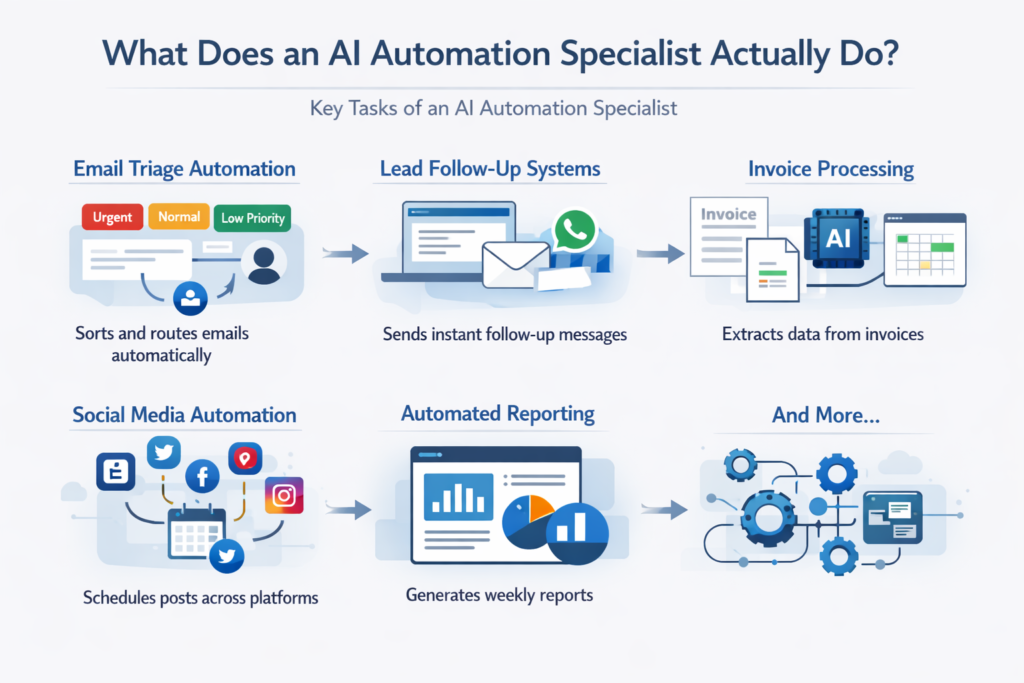
Many beginners struggle to visualize what this work looks like day to day. Here are some real-world examples.
Email triage automation — Building a workflow that reads incoming emails, categorizes them by urgency, and routes them to the right team member automatically.
Lead follow-up systems — When someone submits a contact form, the system instantly sends a personalized email or WhatsApp message without any manual action.
Invoice processing — Using AI to extract data from PDF invoices and automatically populate accounting software.
Social media automation — Converting content from Google Docs or Notion into scheduled posts across multiple platforms.
Automated reporting — Pulling data from spreadsheets, CRMs, or ad platforms and generating formatted weekly reports on their own.
Notice a pattern? None of these tasks require advanced programming. What they do require is:
- Workflow thinking
- Problem-solving ability
- Clear communication
- An understanding of how tools connect
The Core Skills You Need
The learning curve here is lower than most people expect.
Skills you actually need
Workflow logic — The ability to break any process into clear, sequential steps.
Basic API knowledge — You don’t need to build APIs from scratch. You just need to understand how apps communicate with each other.
Prompt engineering — Writing effective prompts for AI tools like ChatGPT and Claude is a genuinely valuable skill.
No-code tool proficiency — Platforms like Make, Zapier, Airtable, and Notion are your core working environment.
Problem-solving — The ability to spot inefficient processes and improve them is what clients actually pay for.
Skills that are helpful but not required at the start
- Python programming
- Machine learning theory
- Cloud infrastructure
- Advanced database management
These become useful over time, but don’t let them stop you from starting. Clients care more about whether you can solve their problem clearly and reliably than whether you know advanced programming. Communication and practical results matter far more than technical jargon.
The Best AI Automation Tools for Beginners
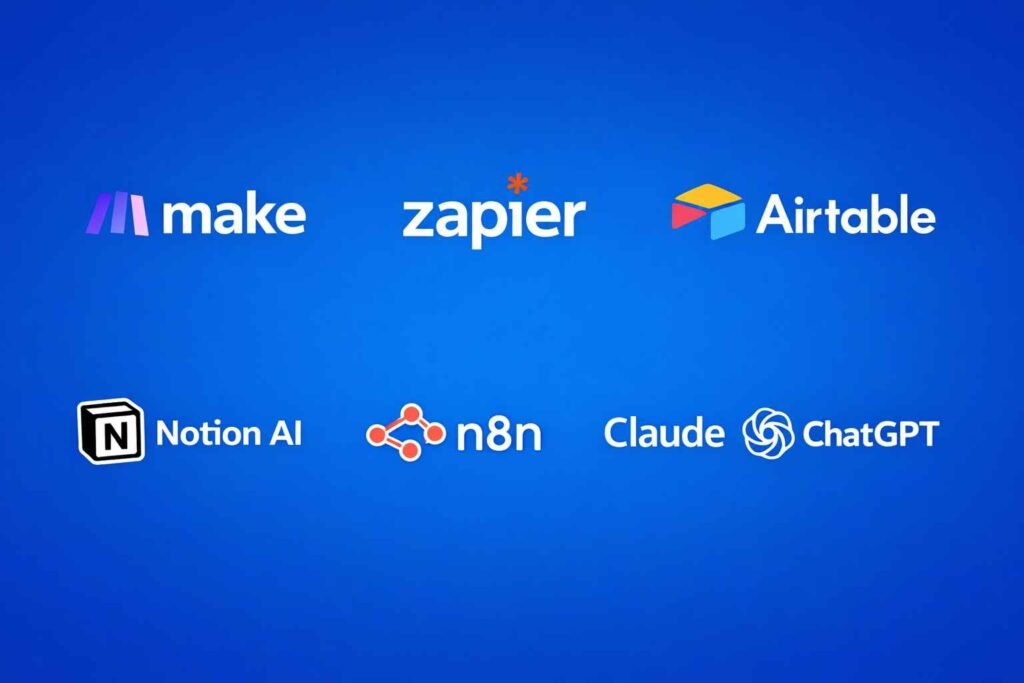
There are hundreds of automation tools available, but beginners should focus on just a few to start.
| Tool | Best For | Difficulty | Free Plan |
|---|---|---|---|
| Make | Visual workflow automation | Beginner | Yes |
| Zapier | App integrations | Beginner | Yes |
| Airtable | Databases + automation | Beginner | Yes |
| Notion AI | Documentation + workflows | Beginner | Yes |
| n8n | Advanced automations | Intermediate | Yes |
| Claude / ChatGPT | AI-powered tasks | Beginner | Yes |
Where to start: If you’re completely new, begin with Make, Zapier, or Airtable. These tools are visual, beginner-friendly, and ideal for learning automation logic from the ground up. Once you’re comfortable, you can move into more advanced tools like n8n and AI agents.
A 90-Day Roadmap to Become an AI Automation Specialist
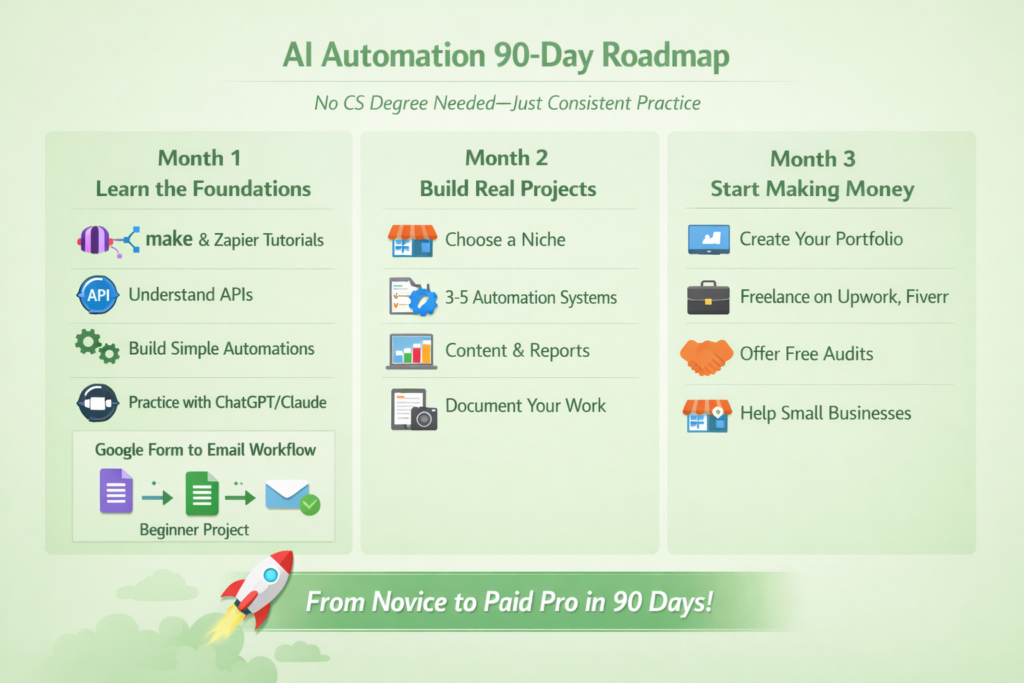
You don’t need a computer science degree. What matters most is consistent, deliberate practice.
Month 1 — Learn the Foundations
- Create accounts on Make or Zapier
- Complete the beginner tutorials for each platform
- Learn what APIs are and how they work at a basic level
- Build simple automations
- Practice writing prompts with ChatGPT or Claude
- Join online automation communities
Your first beginner project: Build a workflow where someone fills out a Google Form, their response is saved to Google Sheets, and an automated email confirmation is sent immediately. This one project teaches you the core principles that underpin almost everything else in automation.
Month 2 — Build Real Projects
Pick one industry to focus on — e-commerce, marketing, real estate, education, or HR — and build 3–5 automation systems for that niche.
Project ideas:
- Automated customer follow-up sequences
- AI-powered email summarization
- Content scheduling workflows
- Automated reporting dashboards
Document every project with screenshots and a short written explanation of what the workflow does and why it matters. This documentation becomes your portfolio.
Month 3 — Start Making Money
Build a simple portfolio using Notion, Carrd, WordPress, or Google Sites. Keep it clean and focused on results, not features.
Start freelancing on platforms like Upwork, Fiverr, Contra, and LinkedIn.
Offer free automation audits to small businesses. Identify three to five repetitive tasks they could automate and explain the time and money savings in concrete terms. Even one small project done well can become a testimonial that opens further doors.
How to Make Money as an AI Automation Specialist
1. Freelancing
This is the fastest path for most beginners. Typical hourly rates:
- Beginner: $15–$30/hour
- Intermediate: $40–$75/hour
- Advanced: $100+/hour
The key is specializing in a niche. Automation for real estate agents, AI workflows for marketing agencies, or lead generation systems for coaches will earn you more than generalist positioning.
2. Remote Employment
Companies are increasingly hiring for roles such as Automation Specialist, No-Code Developer, Operations Analyst, and AI Workflow Builder. Many of these roles are fully remote.
3. Selling Automation Templates
Once you’ve built useful workflows, package and sell them online. Platforms like Gumroad and the Notion Marketplace make this straightforward, and templates can generate ongoing passive income.
4. Creating Content or Teaching
There is growing demand for educational content around AI automation — YouTube channels, newsletters, online courses, and niche blogs. There is especially strong opportunity for African creators in this space, where local context and community knowledge can set you apart.
You may also read: 7 AI Side Hustles Beginners Can Start in 2026 (No Experience Needed)
Not every automation specialist wants to work for someone else. If going independent appeals to you, I’ve laid out the whole path in how to start your own AI automation agency — from your first demo workflow to your first paying client.
Common Mistakes Beginners Make
Trying to learn everything at once. Focus on one tool until you’re genuinely comfortable before adding another.
Building automations without a real problem in mind. Start with actual pain points that businesses face and work backwards from there.
Skipping documentation. Take screenshots. Write short explanations. Your portfolio is built from the evidence you collect along the way.
Underpricing your work. Cheap projects often attract difficult clients and undervalue the real time savings you’re creating.
Waiting until you feel “ready.” The fastest learning happens through real projects. Start before you feel ready — everyone does.
Best Resources to Keep Learning
Free:
Paid:
Frequently Asked Questions
Do I need to know coding? No. Most modern automation tools are visual and designed for non-developers. Basic technical literacy becomes helpful as you advance, but you don’t need it to get started.
How long does it take to land a first client? Most beginners can realistically secure their first small project within 60–90 days of consistent practice.
Is AI automation a good career in 2026? Yes. Demand for automation skills continues to grow as businesses look to reduce costs and increase efficiency. This is not a trend — it is a structural shift in how work gets done.
Can I learn this part-time? Absolutely. Many people start while working full-time or studying. Even five to ten focused hours per week can produce meaningful progress over a few months.
Final Thoughts
AI automation is not a short-term internet trend. It represents a fundamental shift in how businesses operate — and people who know how to build automated systems will be valuable for years to come.
The best part is that the barrier to entry has never been lower. You don’t need a computer science degree. You don’t need expensive software. You don’t need to know everything before you begin.
You simply need to start.
Learn one tool. Build one workflow. Solve one real problem. Then build from there.
If this guide helped you, share it with someone interested in remote work, freelancing, or breaking into tech. The more people who learn these skills — especially across Africa and other emerging tech ecosystems — the more opportunities we create for one another.
Интересная статья, спасибо за информацию!