
TL;DRAn AI agency is a service business where you use AI tools like ChatGPT and Claude to deliver real work for paying clients — writing, social media, design, and more. You’re not building AI, you’re using it. You don’t need a team, an office, or years of experience. You need one skill, one client, and the willingness to start.
When you hear the word “agency,” you probably picture a big office with twenty employees and a client roster full of famous brands. Something way out of reach for someone starting from zero.
I used to think the same thing. Then I realized the word “agency” has quietly changed meaning. In 2026, an AI agency can be one person, a laptop, and a handful of free tools — delivering work that used to take a whole team, and getting paid real money for it.
Here’s what I want to walk you through: what an AI agency actually is, what it isn’t, and whether it’s something you can realistically start with no experience and no budget. Let’s break it down.
“You are not building AI. You are being the intelligent human layer on top of powerful AI tools — and that layer is exactly what clients are paying for.”
What Is an AI Agency, Really?
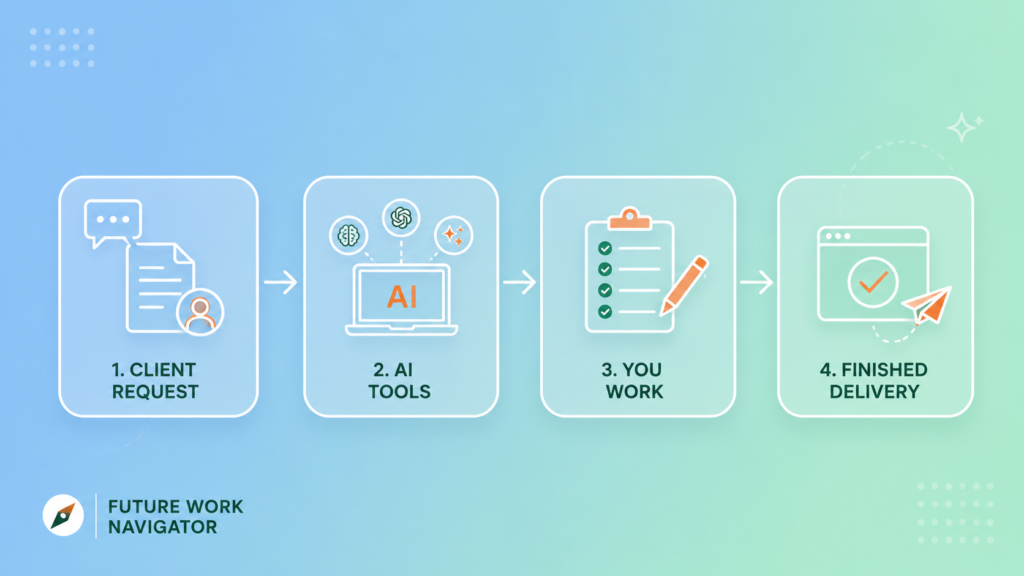
An AI agency is a service business that uses AI tools to produce and deliver work for paying clients. That’s the whole definition. No office. No team. No technical degree.
Here’s what that looks like in practice. A small restaurant needs social captions and graphics posted three times a week. You use ChatGPT to write the captions and Canva to design the graphics. You charge $80 a month. That’s an AI agency.
Or a busy freelance writer needs blog posts faster than she can produce them alone. You use Claude to research and draft, edit until it sounds human, and deliver on time. You charge $15 a post. That’s an AI agency too.
The pattern is always the same: a client has a problem, you use AI to solve it efficiently, and you get paid for the outcome — not for the tool.
What It’s Not
- Not a tech company — you’re not coding or training models, just using tools that already exist
- Not passive income — especially at the start, you’re doing real work with real deadlines
- Not a get-rich-quick scheme — it takes time to find clients and build trust, just faster than traditional freelancing
Six Services You Can Actually Offer as a Beginner
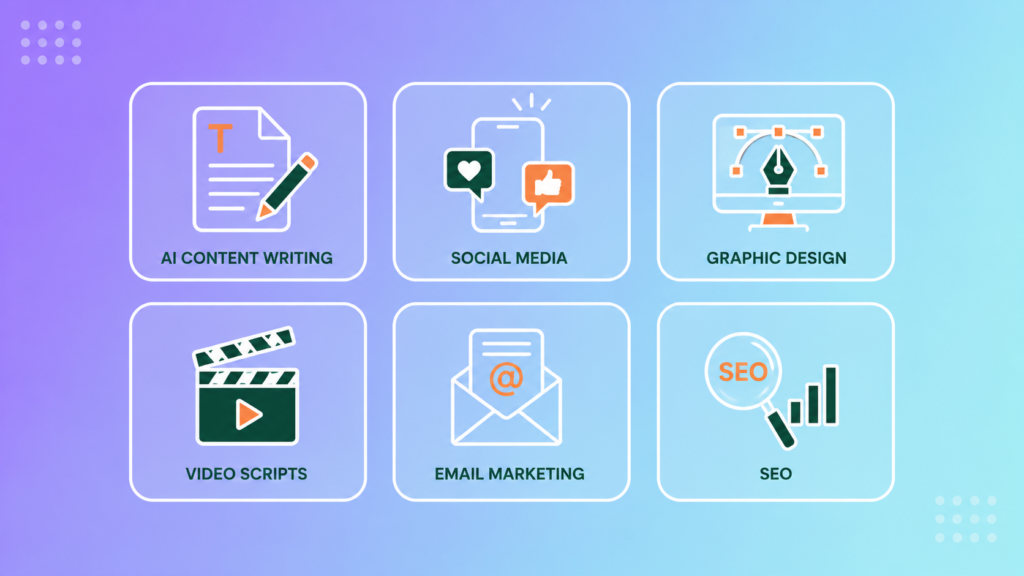
1. AI Content Writing
Businesses constantly need blog posts, website copy, and product descriptions. Draft with ChatGPT or Claude, edit for the client’s voice, deliver fast. Best for people who enjoy writing — see our guide on becoming an AI content writer.
Beginner rate: $10–$50 per article
2. Social Media Management
Most small businesses know they need social media and don’t have time for it. Write captions with AI, design graphics in Canva, schedule with a free tool, charge monthly.
Beginner rate: $50–$200 per client, per month
3. Graphic Design
With Canva AI and Adobe Firefly, you can create logos, banners, and flyers without any formal design training.
Beginner rate: $20–$100 per project
4. Video Script Writing
YouTubers and course creators need scripts but often struggle to write them. Use AI to research, outline, and draft scripts ready for recording.
Beginner rate: $15–$60 per script
5. Email Marketing
Email is still one of the highest-converting channels. Draft campaigns, personalize for different audiences, and manage the send schedule.
Beginner rate: $100–$500 per month, ongoing
6. SEO Content Services
Use AI to research keywords and structure articles that actually rank. One of the highest-paying niches once you build a track record.
Beginner rate: $50–$300 per article
Can Beginners Actually Do This?
Yes — and I want to be specific about why, not just give you a motivational answer. Starting a service business used to require years of experience and a professional portfolio. AI changes that math.
AI gives you speed: a month of social content that used to take days now takes hours. It gives you quality: with the right prompts and honest editing, AI-assisted work can match experienced freelancers.
And it cuts your costs to nearly zero, since most tools you need have solid free tiers. If you’re weighing this against other paths, our breakdown of AI side hustles for beginners is a useful comparison — and no, you don’t need a degree to do any of this.
How to Start: A Step-by-Step Plan
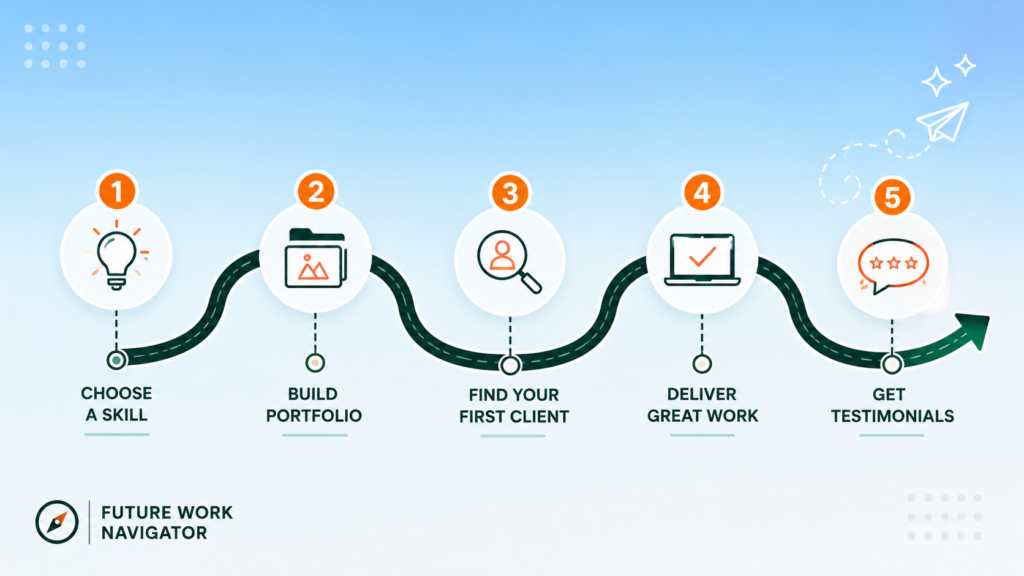
- Pick one service. Don’t try to offer everything. If you’re unsure which fits you, this guide on choosing your AI freelance niche will help you decide.
- Build a simple portfolio. You don’t need a website — three to five sample pieces in a Google Drive folder is enough. Here’s exactly how to build one from scratch.
- Find your first client locally. Every small business around you is a potential client. Offer a free one-week trial to remove the risk on their end.
- Over-deliver, then ask for a testimonial. Your first happy client is your most powerful sales tool for the next one.
- Expand deliberately. Once you have a testimonial, look at the best platforms to find AI freelance work and keep approaching local businesses directly.
Free Tools to Get Started
- ChatGPT — captions, drafts, brainstorming
- Claude — long-form writing, editing, research
- Canva — graphics, presentations, templates
- Adobe Firefly — original AI-generated visuals
- Buffer — scheduling social posts
- Notion — organizing clients and content calendars
Getting sharp results from any of these comes down to one underrated skill — worth spending real time on our beginner’s guide to prompt engineering.
What You Can Realistically Earn
Months 1–2 are the learning phase — expect $0 to $100 while you find your first client. That’s normal. Months 3–4 tend to bring momentum, with one or two paying clients and $100–$400. By months 5–6, with three to five clients, $400–$1,000+ becomes realistic.
These are conservative numbers on purpose. Even the slow path here is meaningful, life-changing income for a lot of people — no exaggeration needed.
The Real Challenges — And How to Handle Them
Finding clients is the hardest part, full stop. Active outreach beats waiting on a profile every time — message local businesses, offer free trials, be visible. Some clients will be skeptical of AI-made work; let your free trial do the convincing instead of arguing the point.
And for payments, mobile money works well for local clients, while PayPal or Payoneer should be set up before you start pitching international ones. If any of this feels overwhelming at first, that’s expected — see our honest look at the real challenges beginners face learning AI.
Key Takeaways
- An AI agency is a service business — you use AI, you don’t build it
- Start with one service, not six, and practice on sample projects first
- Your first client is almost always local, not online
- A single genuine testimonial beats ten portfolio samples
- Realistic income builds over 5–6 months, not overnight
You Don’t Need Permission to Start
In 2026, running an agency doesn’t require a team, an office, or a degree. It requires a laptop or smartphone, a free ChatGPT account, and the willingness to find one client and do genuinely great work for them.
Start with one service. Find one client. Do one excellent job. Build from there.