

When I first started learning about AI, one of the first questions I had was simple: which tool should I actually use?
Everyone kept mentioning ChatGPT. But then I discovered Claude — and suddenly I wasn’t so sure. They both seemed powerful. They were both free to try. But which one was actually better for someone like me — a beginner in Africa with no coding background, just trying to learn and maybe earn something online?
I spent weeks testing both. I used them for writing blog posts, answering questions, helping with research, and creating content. And in this guide, I’m going to share exactly what I found — the honest, practical comparison that I wish someone had written for me when I was starting out.
Whether you’re a student, a freelancer, or just someone curious about AI tools available in Africa in 2026 — this guide will help you decide which one is right for you.
TL;DR — Quick Verdict
ChatGPT (GPT-5.4) wins for multimodal tasks, real-time web browsing, voice mode, image & video generation, and ecosystem breadth. Claude (Sonnet 4.6 / Opus 4.6) wins for coding quality, long-document analysis, nuanced writing, and privacy by default. Both cost $20/month at the standard paid tier. If you only pay for one — pick based on your primary use case below.
1. The 2026 Landscape: A Quick Overview
When OpenAI launched ChatGPT in late 2022, it reshaped how the world thought about AI. Anthropic’s Claude entered shortly after, with a sharper focus on safety, nuanced reasoning, and writing quality. By 2026, both platforms have evolved dramatically — and both are genuinely excellent.
The key insight for 2026: the gap between top models has narrowed significantly. The decision between ChatGPT and Claude now hinges less on raw intelligence and more on which features and use cases matter most to you.
| Category | ChatGPT | Claude |
|---|---|---|
| Top Model | GPT-5.4 | Opus 4.6 / Sonnet 4.6 |
| Developer | OpenAI | Anthropic |
| Founded | 2015 | 2021 |
| Free Tier | Yes (GPT-4o Mini) | Yes (limited daily use) |
| Paid Entry | $20/mo (Plus) | $20/mo (Pro) |
| Primary Edge | Features breadth, multimodal | Coding depth, writing, privacy |
| Context Window | 128K default / 1M max | 200K default / 1M max |
2. Models: What Powers Each Platform?
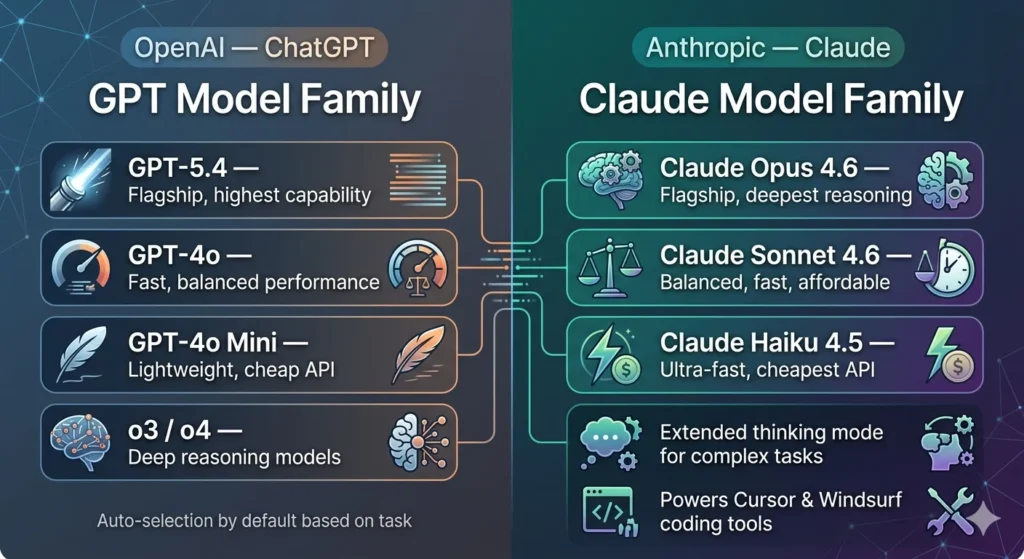
Both companies offer a range of models for different use cases and budgets. Here’s the current lineup in 2026:
OpenAI — ChatGPT
GPT Model Family
- GPT-5.4 — Flagship, highest capability
- GPT-4o — Fast, balanced performance
- GPT-4o Mini — Lightweight, cheap API
- o3 / o4 — Deep reasoning models
- Auto-selection by default based on task
Anthropic — Claude
Claude Model Family
- Claude Opus 4.6 — Flagship, deepest reasoning
- Claude Sonnet 4.6 — Balanced, fast, affordable
- Claude Haiku 4.5 — Ultra-fast, cheapest API
- Extended thinking mode for complex tasks
- Powers Cursor & Windsurf coding tools
A key benchmark to note: on the SWE-bench coding evaluation, Claude Opus 4.6 scores 74%+ and GPT-5.4 scores around 74.9% — essentially tied at the frontier. The meaningful differences show up in specialized tasks and integrated features, not raw intelligence scores alone.
3. Features Head-to-Head
This is where the two platforms diverge most clearly. ChatGPT takes an “everything-AI” approach; Claude is more focused.
| Feature | ChatGPT | Claude |
|---|---|---|
| Web Browsing | ✅ Deep Bing integration, real-time data | ⚠️ Limited, less polished |
| Image Generation | ✅ DALL-E 3 / GPT Image | ❌ Not available natively |
| Video Generation | ✅ Sora (720p, 5-sec clips on Plus) | ❌ Not available |
| Voice Mode | ✅ Advanced Voice with natural speech | ❌ No voice mode |
| Coding Tools | ✅ Codex, Code Interpreter | ✅ Claude Code (CLI), powers Cursor & Windsurf |
| Memory | ✅ Persistent user memory | ✅ Conversation memory (improving) |
| Custom GPTs / Agents | ✅ GPT Store, thousands available | ⚠️ Projects feature, more limited |
| File Uploads | ✅ Yes | ✅ Yes |
| Data Analysis | ✅ Advanced Data Analysis (Python) | ✅ Excellent with large datasets in context |
| Privacy Default | ⚠️ Opt-in to disable training | ✅ No training on data by default |
| API Access | ✅ Full API | ✅ Full API |
| Third-party Integrations | ✅ Zapier, Slack, MS Office, hundreds more | ⚠️ Growing but less extensive |
Bottom line on features: ChatGPT is the more feature-complete platform in 2026. But for developers and knowledge workers, Claude’s coding depth and privacy posture can outweigh the missing multimedia tools.
4. Coding Ability
Coding is one of the clearest areas where Claude maintains a practical edge — not just on benchmarks, but in real-world developer workflows.
Claude — Why Developers Prefer It
Coding Strengths
- Powers Cursor & Windsurf (the two most popular AI coding editors)
- Claude Code CLI for terminal-based agentic coding
- ~95% functional accuracy on independent 30-day coding tests vs ~85% for ChatGPT
- Stronger on complex refactors and multi-file reasoning
- Better at explaining its own code in plain language
ChatGPT — Coding Strengths
Where GPT Competes
- OpenAI Codex for agentic code tasks
- Python execution in-browser via Code Interpreter
- Strong on quick scripts, data analysis, SQL
- Better ecosystem integrations with developer tools
- Broad programming language support
If writing and debugging code is a central part of your work, Claude is the recommended choice in 2026. The combination of Claude Code, deep IDE integrations via Cursor, and superior multi-step reasoning in complex codebases gives it a meaningful practical advantage.
5. Writing Quality
Both AI assistants produce strong written content, but they have distinctly different voices and approaches.
Claude’s Writing Style
Claude is widely regarded as producing the most natural, human-sounding prose of any AI in 2026. Its writing feels considered and layered — less like content generation, more like a thoughtful editor. It’s especially strong with long-form documents, nuanced analysis, and creative writing that requires a distinct voice. One caveat: Claude will sometimes push back on a prompt, offer alternatives, or ask clarifying questions rather than blindly executing. Writers who want a collaborator will love this; those who want pure obedience may find it slightly frustrating.
ChatGPT’s Writing Style
ChatGPT is more obedient and versatile. It follows instructions precisely, making it excellent for structured formats, templated content, and multilingual writing (it’s fluent in 100+ languages). The Canvas editing environment makes ChatGPT particularly good for iterating on drafts in real time — think Google Docs with an AI co-writer built in.
Writing Verdict
Claude wins on depth; ChatGPT wins on breadth
For long-form documents, articles, essays, and creative writing — Claude produces more natural, memorable prose. For multilingual content, quick templates, and structured formats — ChatGPT is more reliable. Writers who primarily produce long documents will also benefit from Claude’s 200K default context window (vs ChatGPT’s 128K), allowing entire manuscripts to stay in context.
Recommended to read: Generative AI Explained: Simple Guide for Beginners 2026
6. Multimodal Capabilities
This is ChatGPT’s clearest and most decisive advantage in 2026. If your work touches images, video, or voice, there is no competition.
| Capability | ChatGPT | Claude |
|---|---|---|
| Generate Images | ✅ DALL-E 3 & GPT Image (incl. HD) | ❌ Not available |
| Analyze Images | ✅ Vision | ✅ Vision |
| Generate Videos | ✅ Sora on Plus plan | ❌ Not available |
| Voice Conversation | ✅ Advanced Voice Mode | ❌ Not available |
| Audio Input | ✅ Whisper transcription | ❌ Limited |
| Read PDFs & Docs | ✅ Yes | ✅ Yes |
If you are a content creator, marketer, social media manager, or anyone who needs image/video generation, ChatGPT Plus at $20/month is the stronger value. Claude simply does not have these capabilities yet.
7. Context Window & Long Documents Claude Edge
Context window size determines how much information an AI can “hold in mind” during a single conversation — and it matters enormously for document analysis, large codebases, and research work.
| Tier | ChatGPT | Claude |
|---|---|---|
| Default (Paid) | 128K tokens | 200K tokens |
| Maximum | 1M tokens (GPT-5.4) | 1M tokens (Opus 4.6 beta / API) |
| Output Length | Standard | Up to 128K output tokens in a single pass |
Claude’s 200K default context window means you can feed it an entire book manuscript, a large codebase, or a 300-page legal document without losing context mid-conversation. This is a tangible, practical advantage for researchers, lawyers, analysts, and developers working with complex material.
The ability to generate up to 128K output tokens in a single pass is also unique to Claude — meaning it can produce an entire long-form report, a full codebase, or a book chapter without interruption.
8. Pricing Comparison (2026) Tied at $20
Both platforms have converged on the same entry-level price point, but diverge significantly at premium tiers.
📊 ChatGPT vs Claude AI Pricing Plans (2026)
| Plan | ChatGPT | Claude AI |
|---|---|---|
| Free | $0/mo – GPT-4o Mini, limited messages, no image generation | $0/mo – Claude Sonnet & Haiku, daily message limits |
| Plus / Pro | $20/mo – Full GPT-5.2, DALL·E images, Sora video (720p), voice mode, 5× limits | $20/mo – 5× limits, priority access, Claude Code, Cowork feature ($17/mo annually) |
| Pro / Max | $200/mo – Highest limits, all models, priority access | $100–200/mo – Highest limits, extended thinking, full Opus 4.6 access |
| Team | $25–30/user/mo – Admin controls, collaboration features | $25–30/user/mo – Collaboration tools, shared projects |
| Enterprise | Custom – SSO, unlimited GPT-5.4, analytics dashboards | Custom – Enhanced privacy, compliance controls |
API Pricing (Developers)
| Model | Input (per 1M tokens) | Output (per 1M tokens) |
|---|---|---|
| GPT-5.4 (OpenAI) | $2.50 | $15.00 |
| GPT-4o (OpenAI) | $2.50 | $10.00 |
| Claude Opus 4.6 | $15.00 | $75.00 |
| Claude Sonnet 4.6 | $3.00 | $15.00 |
| Claude Haiku 4.5 | Very low | Ultra cheap — best value |
Developer note: Claude Sonnet 4.6 delivers roughly 98% of Opus 4.6’s quality at a fraction of the cost, making it the recommended API choice for most production applications. Claude Haiku 4.5 is one of the best-value models in the entire AI market for high-volume, cost-sensitive tasks.

9. Privacy & Safety
Privacy is an underrated differentiator — especially for professionals handling sensitive data, proprietary code, or confidential documents.
ChatGPT Privacy
Opt-out Required
- Data may be used for training by default
- Must manually disable training in settings
- Enterprise tier offers stronger protections
- Strong safety measures overall, some refusals
- Manages billions of conversations globally
Claude Privacy
Privacy by Default
- No training on conversation data by default
- Built from the ground up with Constitutional AI safety framework
- Preferred by enterprises with compliance requirements
- Anthropic’s safety mission is central to product design
- Ideal for legal, medical, and financial use cases
For professionals working with proprietary code, confidential business data, or sensitive personal information, Claude’s default no-training stance is a meaningful, practical advantage. It removes the need to configure privacy settings and reduces risk exposure for organizations.
10. Best Choice by Use Case
The simplest way to decide: match the tool to the task.
Use Claude for
Software Development & Coding
Claude powers Cursor & Windsurf. Claude Code CLI is best-in-class for agentic coding workflows.
Use ChatGPT for
Image & Video Creation
DALL-E image generation and Sora video on Plus plan. Claude has no equivalent.
You may also read: 10 Free AI Image Generators in 2026 That Still Feel Fresh & Unique (No Midjourney Subscription Needed)
Use Claude for
Long-Document Analysis
200K default context. Feed entire legal contracts, research papers, or codebases without losing context.
Use ChatGPT for
Real-time Research & News
Deep Bing web integration means live data, current events, stock prices, and breaking news.
Use Claude for
Long-form Writing & Editing
Most natural AI prose. Best for essays, articles, books, and nuanced creative writing.
Use ChatGPT for
Voice Conversations
Advanced Voice Mode lets you have natural spoken conversations. Claude has no voice feature.
Use Claude for
Privacy-Sensitive Work
No data training by default. Ideal for legal, medical, financial, and proprietary business data.
Use ChatGPT for
Third-party Tool Integrations
Zapier, Slack, Microsoft Office, and thousands of GPTs in the GPT Store make ChatGPT the integration king.
Power tip: Many heavy AI users pay for both ($40/month total) and route tasks based on strengths. Use Claude for deep work; use ChatGPT for multimedia and real-time data. If you can only afford one, the choice depends purely on the breakdown above.
11. Final Verdict
🤖 Choose ChatGPT if you…
ChatGPT Plus at $20/mo
- Need image or video generation
- Want voice conversation capabilities
- Rely on real-time web data
- Use third-party tools heavily (Zapier, Slack, Office)
- Want the biggest AI feature set in one app
- Create multilingual content regularly
✍️Choose Claude if you…
Claude Pro at $20/mo
- Write code or work in software development
- Analyze large documents or codebases
- Prioritize natural, high-quality writing
- Handle sensitive or confidential data
- Want the best AI coding CLI (Claude Code)
- Need the longest default context window
The Bottom Line
Neither AI wins everything — and that’s the point.
In 2026, both ChatGPT and Claude are genuinely excellent AI assistants at an identical price point. ChatGPT is the better “all-in-one” platform with multimedia superpowers. Claude is the better specialist for developers, analysts, and serious writers. The most successful AI users pick the right tool for the right task — and increasingly, that means having access to both. If you’re forced to choose just one: developers and writers → Claude. Everyone else → ChatGPT.
12. Frequently Asked Questions
Is Claude better than ChatGPT for coding in 2026?
Yes, for most coding tasks. Claude powers the two most popular AI coding editors (Cursor and Windsurf), and independent tests show Claude achieving ~95% functional accuracy on coding tasks vs ~85% for ChatGPT. Claude Code CLI also provides superior agentic coding capabilities in the terminal.
Is ChatGPT free? Is Claude free?
Both offer free tiers with limitations. ChatGPT’s free plan gives access to GPT-4o Mini with rate limits. Claude’s free tier offers limited daily messages with Claude Sonnet and Haiku. For serious use, both charge $20/month for their standard paid plan.
Can Claude generate images?
No. As of March 2026, Claude cannot generate images natively. This remains ChatGPT’s clearest competitive advantage — it offers DALL-E 3 and GPT Image generation on paid plans. If image generation is important to you, choose ChatGPT.
Which AI has a better context window in 2026?
Claude holds the edge at the standard paid tier: 200K tokens by default vs ChatGPT’s 128K. At the maximum tier, both now support up to 1 million tokens, though pricing structures differ beyond certain thresholds.
Is Claude safer and more private than ChatGPT?
Yes, by default. Claude does not use your conversation data for model training by default. ChatGPT uses data for training unless you opt out in settings. For professionals working with sensitive information, Claude’s privacy-first approach is a genuine practical advantage.
Should I pay for both ChatGPT and Claude?
Many power users do pay for both ($40/month combined), using Claude for deep coding and writing work and ChatGPT for images, voice, video, and integrations. If budget is a concern, choose one based on your primary use case using the decision guide above.
Which AI is best for writing in 2026?
Claude produces more natural, nuanced prose that most writers prefer for long-form content. ChatGPT is more obedient and excels at structured formats, multilingual content, and iterative editing via its Canvas interface. For creative and analytical writing, Claude; for templated or multilingual content, ChatGPT.
Recommended to read: What Is Artificial Intelligence? A Simple and Powerful Beginner’s Guide (2026)
Related Posts You’ll Find Helpful
- Generative AI Explained: Simple Guide for Beginners
- Master Prompt Engineering: Beginner’s Guide
- 10 Best AI Careers You Can Start Today
- How to Start Learning AI With No Experience
📩 Enjoyed This Post? Get More Like It
Join other beginners across Africa learning how to use AI to build skills and earn money online. No spam — just practical tips, straight to your inbox.
[mc4wp_form id=”2093″]