
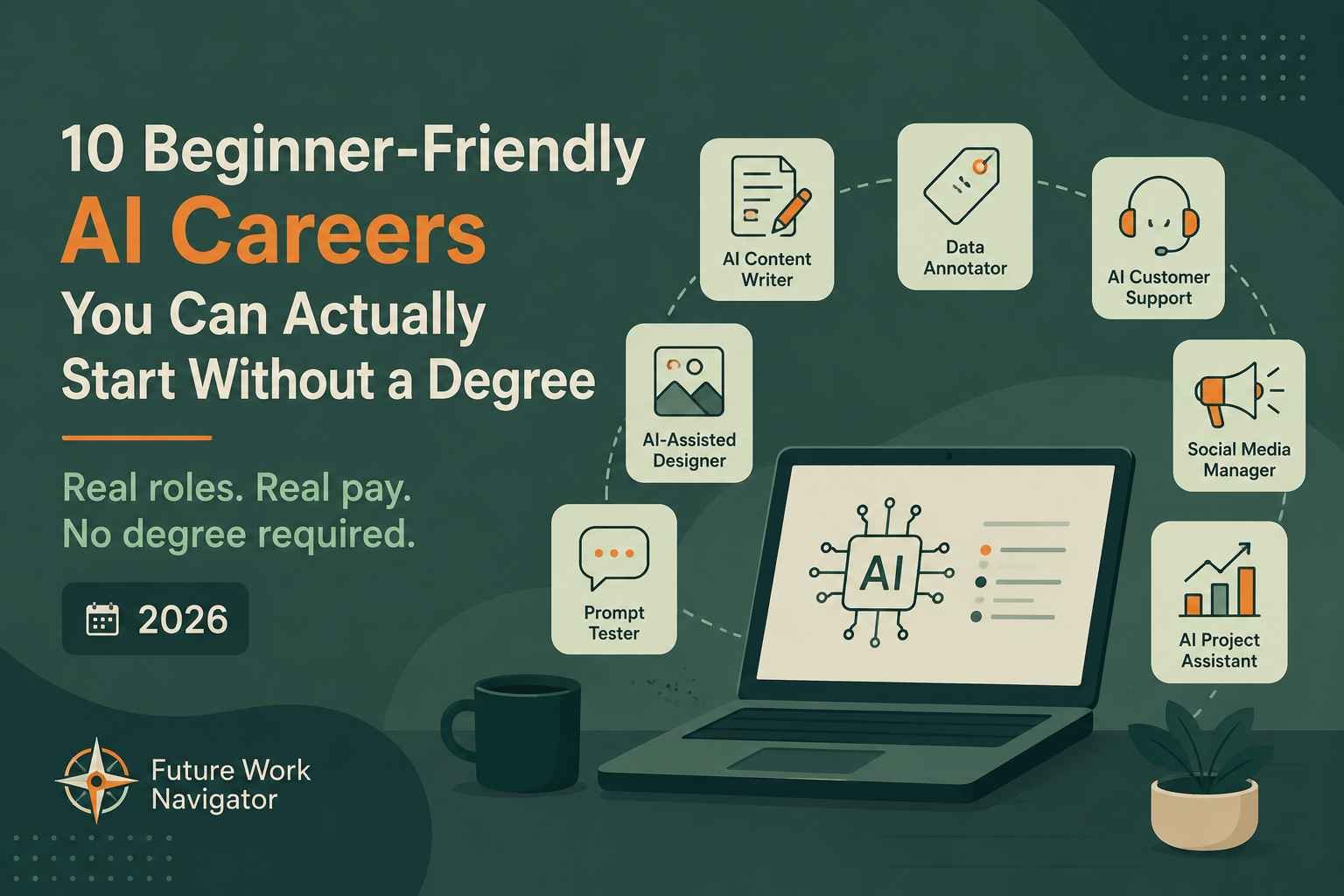
TL;DR You don’t need a computer science degree to get an AI-adjacent job in 2026. Roles like AI content writing, data annotation, AI-assisted design, and AI project support are hiring people for judgment and communication skills, not code. Pay varies a lot by country and platform — global freelance rates are usually lower than US in-house salaries — and AI is also displacing some jobs at the same time it creates others, so go in with clear eyes. Pick one role, build a small portfolio in a week, and apply before you feel “ready.”
If you’ve been scrolling past AI job posts thinking they’re only for people with a computer science degree, I want to stop you right there — because for a long time, I believed that too.
I remember looking at a “Prompt Engineer” job listing and assuming I’d need to understand machine learning to even apply. Then I actually read the requirements. Strong writing. Clear thinking. Willingness to test and iterate. No mention of code at all.
That’s the part nobody explains clearly enough: a huge share of AI-adjacent work in 2026 is about using AI tools well, not building them. This guide walks through ten of the most realistic entry points, what they actually pay (and where those numbers come from), and the honest mistakes that slow beginners down.
This post is part of our larger guide on how to earn money with AI as a complete beginner — read that first if you’re still deciding whether any of this is realistic for you.
“The biggest barrier usually isn’t skill. It’s starting before you feel ready.”
Why Are AI Careers More Accessible Now — And What’s the Catch?
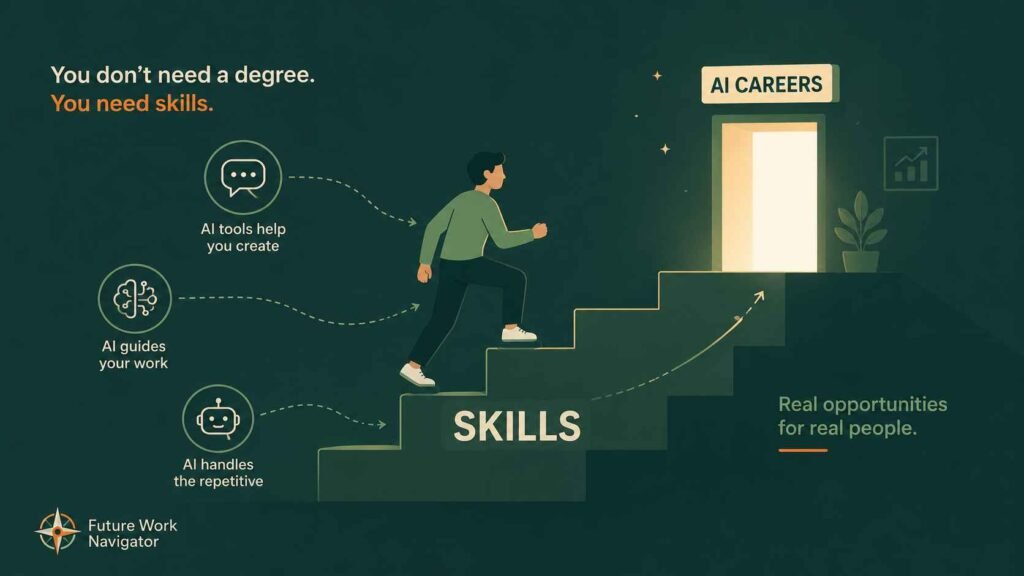
A few years ago, breaking into anything “AI” meant a master’s degree in machine learning. That’s genuinely changed for a specific slice of roles: the ones focused on directing, checking, and applying AI tools rather than building the models underneath them.
The evidence for this is real but narrower than most “AI job boom” headlines suggest. PwC’s 2025 Global AI Jobs Barometer found that the share of AI-exposed jobs requiring a degree has been falling since 2019, and that workers with AI skills earned a 56% wage premium in 2025 — up sharply from the year before.
Separately, the World Economic Forum’s Future of Jobs Report 2025 estimates that employers expect 39% of core workplace skills to change by 2030, which is exactly why tool literacy is becoming more valuable than a specific credential.
Here’s the honest other half, though: 2025 also saw real AI-linked layoffs, concentrated in tech and back-office roles that AI automation replaced outright. This isn’t a one-directional story where AI only adds jobs — it’s shifting which jobs exist.
The roles below are ones where, as of mid-2026, demand for a human is still growing rather than shrinking. That could change, so treat any specific role as a starting point, not a lifetime bet.
Which AI Careers Can You Start Without a Degree?
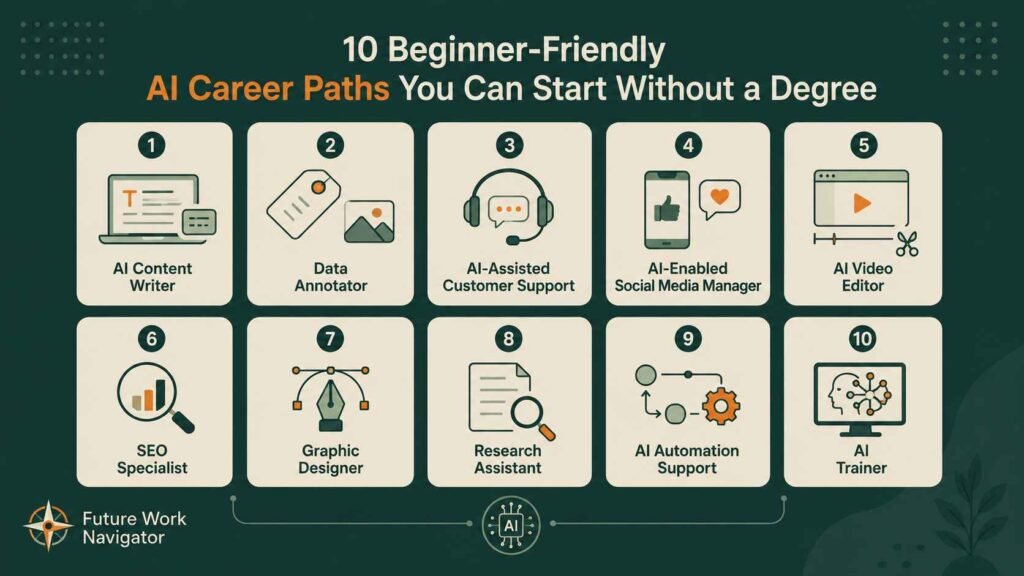
These ten roles show up consistently in beginner-friendly job postings and freelance platforms. None of them require coding to get started, though a few benefit from picking it up later.
1. AI Content Writer / Prompt Editor
What you do: draft and refine prompts for tools like ChatGPT or Claude, then edit the output so it reads like a real person wrote it — accurate, on-brand, and not generic.
Why it’s beginner-friendly: if you can write a clear paragraph and spot when something sounds off, you have the core skill already.
Where to start: build 4–5 before/after writing samples, then look for freelance briefs on Upwork. Our guide to prompt engineering for beginners is a good next stop if this is your pick.
2. AI Data Labeler / Annotator
What you do: review and tag data — text, images, audio — so AI models can learn from clean examples. Think of it as quality control for machine learning.
Why it’s beginner-friendly: tasks are usually well-defined and platforms train you on the job. No résumé screening for most listings.
Where to start: platforms like Outlier, Appen, and Remotasks are the common entry points, including for applicants based in Africa. We cover this in more depth in our AI side hustles guide.
3. AI-Assisted Customer Support
What you do: manage and improve AI chatbots — handling the edge cases they can’t, and training them on new scenarios based on real customer conversations.
Why it’s beginner-friendly: prior customer service experience transfers almost directly. The AI layer is something you learn on the job.
Where to start: search “chatbot trainer” or “AI support specialist” on Indeed or LinkedIn, and lead with any help-desk or CRM background you already have.
4. AI-Enabled Social Media Manager
What you do: use AI tools to plan, draft, and analyze social content faster — the strategy work is still yours, AI just removes the grunt work.
Why it’s beginner-friendly: it’s an extension of a skill set that already exists in a lot of people, just sped up.
Where to start: run one platform for yourself or a small local business for a month, and use the results as your portfolio.
5. AI Video Editor
What you do: produce short-form video using AI-assisted tools for scripting, voiceover, and captions — a fast-growing area given how much content is now short-form video.
Why it’s beginner-friendly: many tools are drag-and-drop, so there’s no film-school learning curve.
Where to start: make 5–10 short sample videos across different styles and post them publicly so people can see your range.
6. AI-Assisted SEO Specialist
What you do: use AI tools for keyword research, competitor analysis, and content briefs, alongside standard SEO fundamentals.
Why it’s beginner-friendly: free courses exist for the fundamentals, and AI tools handle a lot of the heavy analysis.
Where to start: take a free SEO fundamentals course, build a small practice site, and document any ranking movement you get.
7. AI-Assisted Graphic Designer
What you do: use AI image tools to produce logos, ads, and marketing graphics at a pace traditional design work can’t match.
Why it’s beginner-friendly: a good eye matters more than formal design training — you’re directing the tool, not drawing from scratch.
Where to start: build a portfolio on Behance showing AI-assisted work next to your own creative direction. Our roundup of free AI image generators for beginners is a practical starting point.
8. AI Research Assistant
What you do: use AI tools to gather, summarize, and fact-check information for businesses, law firms, or content teams — essentially becoming a faster analyst.
Why it’s beginner-friendly: strong reading comprehension and attention to detail matter more than technical training.
Where to start: offer research services on Fiverr or Upwork, and niche down — research for a specific industry beats “general research” every time.
9. AI Implementation / Automation Support
What you do: help small businesses set up and manage AI-driven workflows and automations — coordinating what needs to connect to what, without necessarily writing custom code.
Why it’s beginner-friendly: project coordination skills transfer directly, and no-code tools like Make.com do the technical heavy lifting.
Where to start: our guide on becoming an AI automation specialist walks through the exact tools and first projects to try.
10. AI Trainer / Educator
What you do: teach others how to use AI tools — through short courses, workshops, or a YouTube channel — as adoption keeps outpacing people’s confidence with the tools.
Why it’s beginner-friendly: you only need to be a few steps ahead of your audience, not an expert.
Where to start: create one free mini-lesson and see if people engage before building anything bigger. If you’re still building your own foundation first, start with what AI actually is.
Key Takeaways So Far
- None of these ten roles require coding to get started.
- Most reward one transferable skill you likely already have — writing, coordination, customer service, or design taste.
- Platforms like Outlier, Appen, Upwork, and Fiverr are common, low-barrier entry points.
- A small portfolio of real samples matters more than a polished résumé.
How Much Do These AI Careers Actually Pay?
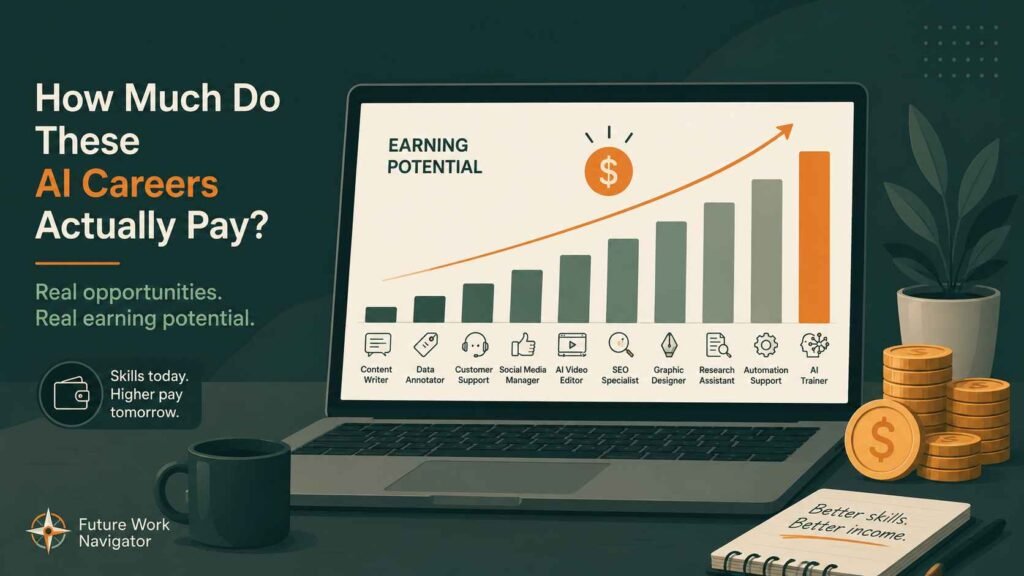
Here’s the honest answer: it depends heavily on where you’re based and which platform you use, more than most listicles admit.
US-based, in-house salary ranges you’ll see quoted online (often $40,000–$95,000/year for these roles) come from US job-board averages — they are not what a beginner working through a global freelance platform from Rwanda, Nigeria, or Pakistan should expect to earn in year one.
Global platforms like Outlier, Appen, and Upwork typically pay per task or per hour, and entry-level rates on these platforms are usually well below US in-house salaries for the same type of work — often in the range of a few dollars an hour when you’re new, rising as you build a track record and take on more specialized tasks.
This isn’t a reason to avoid these roles; it’s a reason to treat the first few months as skill-building and reputation-building rather than a full income replacement.
If your goal is a full income from AI work as a beginner, it’s worth reading the honest expectations we lay out in the pillar guide linked above before picking a specific role to chase.
What Mistakes Do Beginners Make — And How Do You Avoid Them?
- Trying to learn everything at once — pick one role, go deep, and land your first small client or gig before expanding.
- Skipping the portfolio — even five solid samples beat a polished résumé with no proof of work.
- Waiting to feel “ready” — you’ll never feel fully ready; apply, learn on the job, and improve as you go.
- Staying too general — “AI writer” is vague; “AI writer for SaaS onboarding emails” gets hired faster.
- Relying on one tool or platform — diversify across two or three so you’re not stuck if one changes its terms or shuts down.
How Do You Get Started This Week?
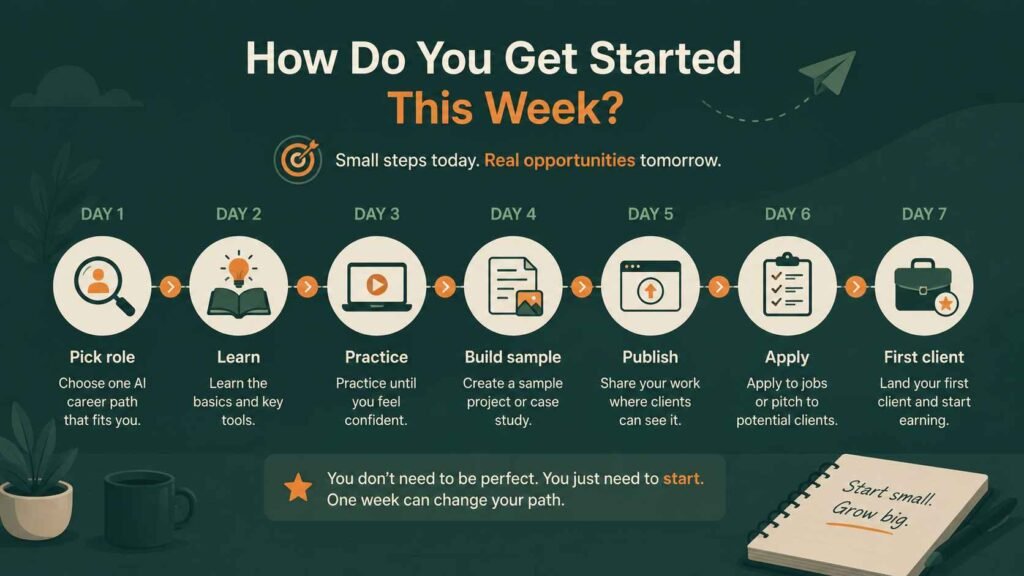
A simple five-step plan to kick things off:
Day 1–2: pick one role from this list that matches skills you already have.
Day 3–4: learn the basics through free tutorials for that specific tool or platform.
Day 5–6: create one sample piece of work — a practice article, a labeled dataset, a short video.
Day 7: put it in front of someone — post it on LinkedIn, a freelance profile, or message a local business directly.
If you want a fuller roadmap before you commit to a specific platform, our guide to starting AI freelance work as a beginner compares the realistic fees and competition level on each one.
Frequently Asked Questions
Can I really start an AI career with zero experience?
Yes, for the roles on this list — they’re built around directing and checking AI tools, not building them. Writing, coordination, and customer-service skills transfer directly. The honest caveat: pay usually starts modest, and rises as you build a track record.
Do I need to learn to code?
No, not for any role on this list. If you later want to move into more technical AI work, basic Python is the common next step — but it isn’t a requirement to start earning.
Are these jobs remote-friendly?
Most are fully remote or hybrid, which is part of why they’re attractive if you’re outside a major tech hub. Confirm time-zone expectations before committing to ongoing client work.
What’s the fastest AI skill to pick up?
Prompt writing and basic data annotation have close to zero learning curve — most people are functional within one to two weeks of regular practice. Building a paying track record still takes longer than that.
Want more beginner-friendly automation ideas?
I send one practical AI or automation tip a week — no fluff, no hype, just what actually works.
Join Free →
Founder, Future Work Navigator — writing for beginners learning AI, automation, and digital income, one honest guide at a time.