
TL;DR Artificial intelligence is technology that lets computers do things that normally take human thinking — understanding language, recognizing images, and learning from patterns in data. You’ve already used it today, probably without noticing. It’s genuinely useful, it’s also flawed, and for beginners — especially in Africa — understanding it well enough to use it is opening real, paid opportunities right now.
Artificial Intelligence (AI) is everywhere today. It helps us search the web, recommend videos, answer questions, write emails, create images, and even drive cars. Whether you realize it or not, you’ve probably used AI several times today.
But here’s an important question: Do you actually know what Artificial Intelligence is?
For a long time, I used AI without fully understanding it. I knew it was powerful, but I didn’t really know how it worked or why it was changing the world so quickly.
Once I learned the basics, I realized AI wasn’t just another tech trend—it was a tool that could help me work faster, learn new skills, solve problems, and create opportunities I never thought possible.
The truth is, you don’t need a computer science degree to understand AI. Knowing the basics is enough to completely change the way you work, learn, and earn. Instead of relying on outdated methods, you can use AI to save time, boost your productivity, and make smarter decisions.
By the end, you’ll have a real, clear understanding of what AI is — not the textbook version, but the kind you can explain to a friend over tea. And you’ll understand why it matters for your life right now, especially if you’re in Africa.
If you’re also wondering whether you can actually earn money with AI as a complete beginner, I break that down honestly in a separate guide — this post is where I’d start first.
What Is Artificial Intelligence (AI)?

Artificial intelligence is technology that allows computers to do things that normally require human thinking — understanding language, recognizing images, making decisions, and learning from experience. That’s the whole definition. No engineering degree required to understand it.
Think about what your brain does every day. You look outside and decide whether to carry an umbrella. You read a message and sense the emotion behind it. You recognize your mother’s voice on the phone in a noisy room. All of that requires intelligence. AI is the attempt to give computers some of those same abilities.
Have You Already Used Artificial Intelligence (AI) Today Without Knowing It?
Yes — almost certainly. If you opened WhatsApp this morning, the spam filter that kept scam messages out of your inbox is AI. If you watched a YouTube video last night, the system that suggested it is AI. If you used Google Maps, the part that calculated your fastest route and warned you about traffic is AI too.
In Rwanda and across Africa, versions of this are already part of daily life — mobile money platforms like M-Pesa use machine learning to flag suspicious transactions in real time, protecting millions of transfers a day. It’s not coming.
It’s already here, quietly, in tools you already use. Once you can spot it, you’ll start seeing it everywhere — which is actually the fastest way to get comfortable with it.
If you want a gentler on-ramp for that, How to Start Learning AI With No Experience walks through exactly how I did it.
How Does Artificial Intelligence (AI) Actually Learn?
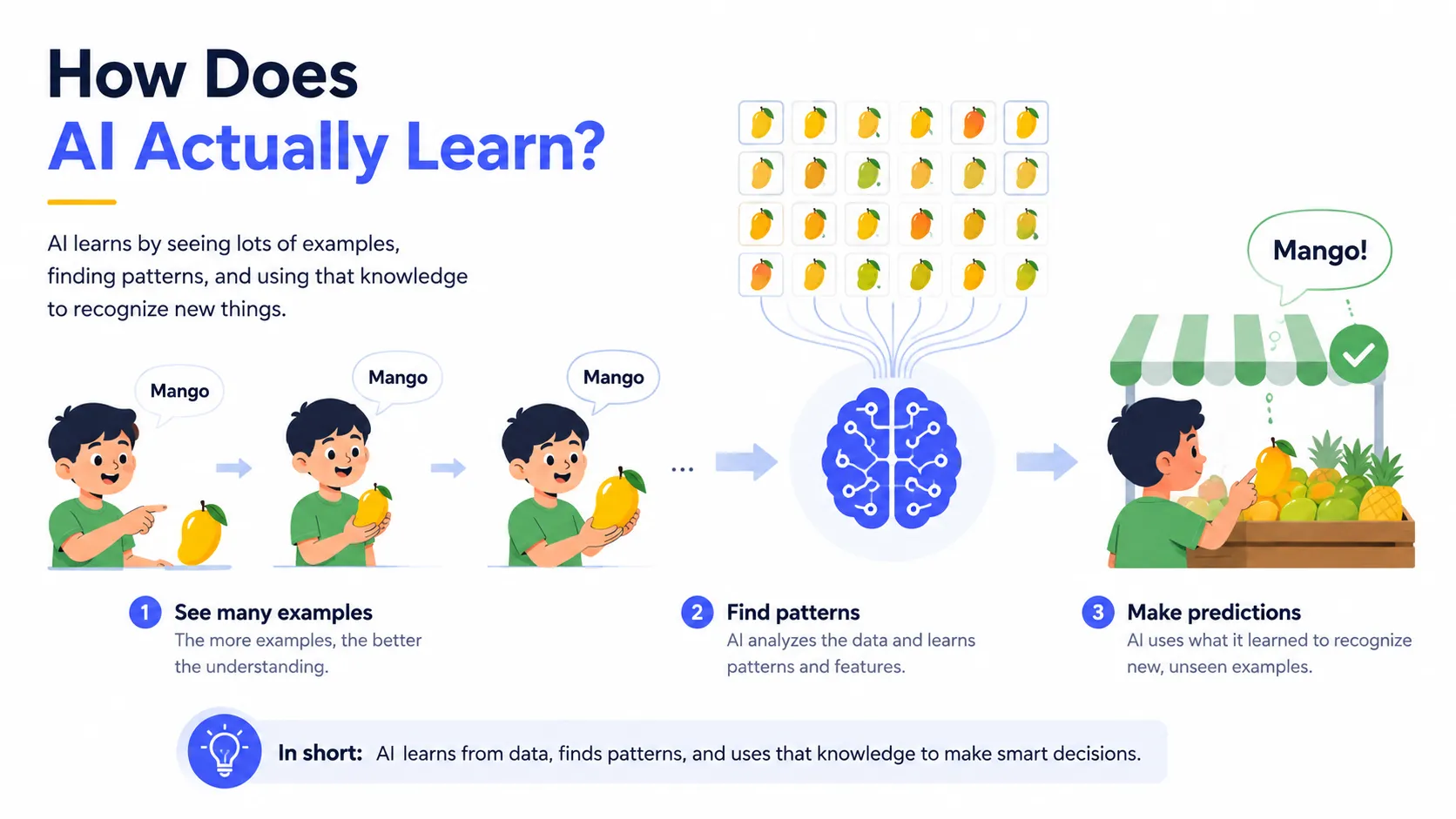
This is the part most people get confused about, so let me use a simple story.
Imagine teaching a child to recognize mangoes. You show them one and say “mango.” Then another. Then another. After enough examples, the child can walk into a market and point out a mango they’ve never seen before.
AI learns the same way — except instead of a child, it’s a computer program, and instead of a few examples, it learns from millions of them. Feeding a computer huge amounts of data so it can learn patterns is called machine learning, and it’s the engine behind most AI you encounter today.
Artificial Intelligence (AI) vs. Machine Learning — What’s the Difference?
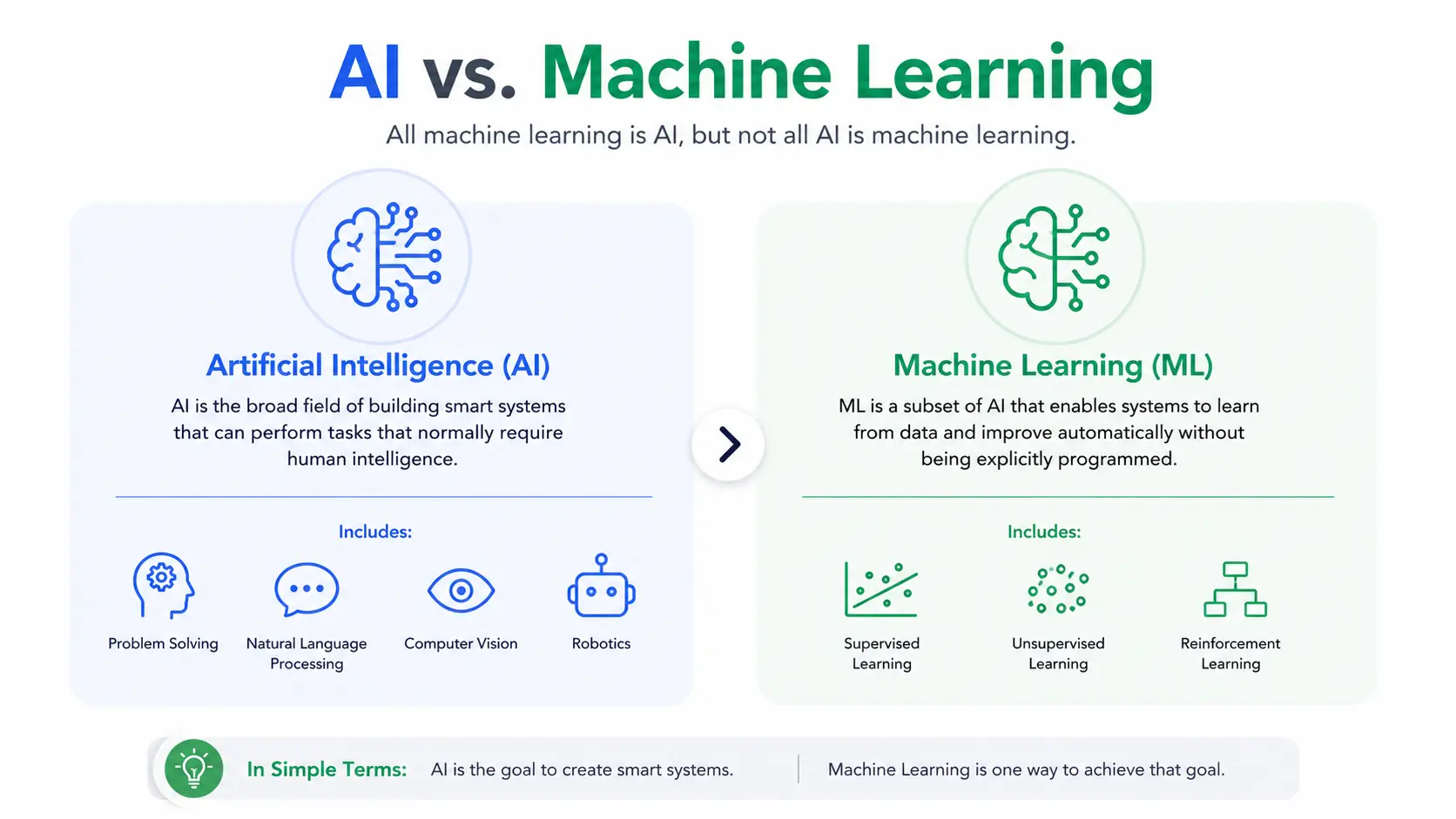
Artificial intelligence is the big goal: making computers intelligent. Machine learning is one of the main tools used to get there. All machine learning is AI, but not all AI uses machine learning — a simple rule-based system, like a basic calculator, is technically AI too. It just doesn’t learn or improve over time.
What Are the Three Types of Artificial Intelligence (AI) You Should Know?
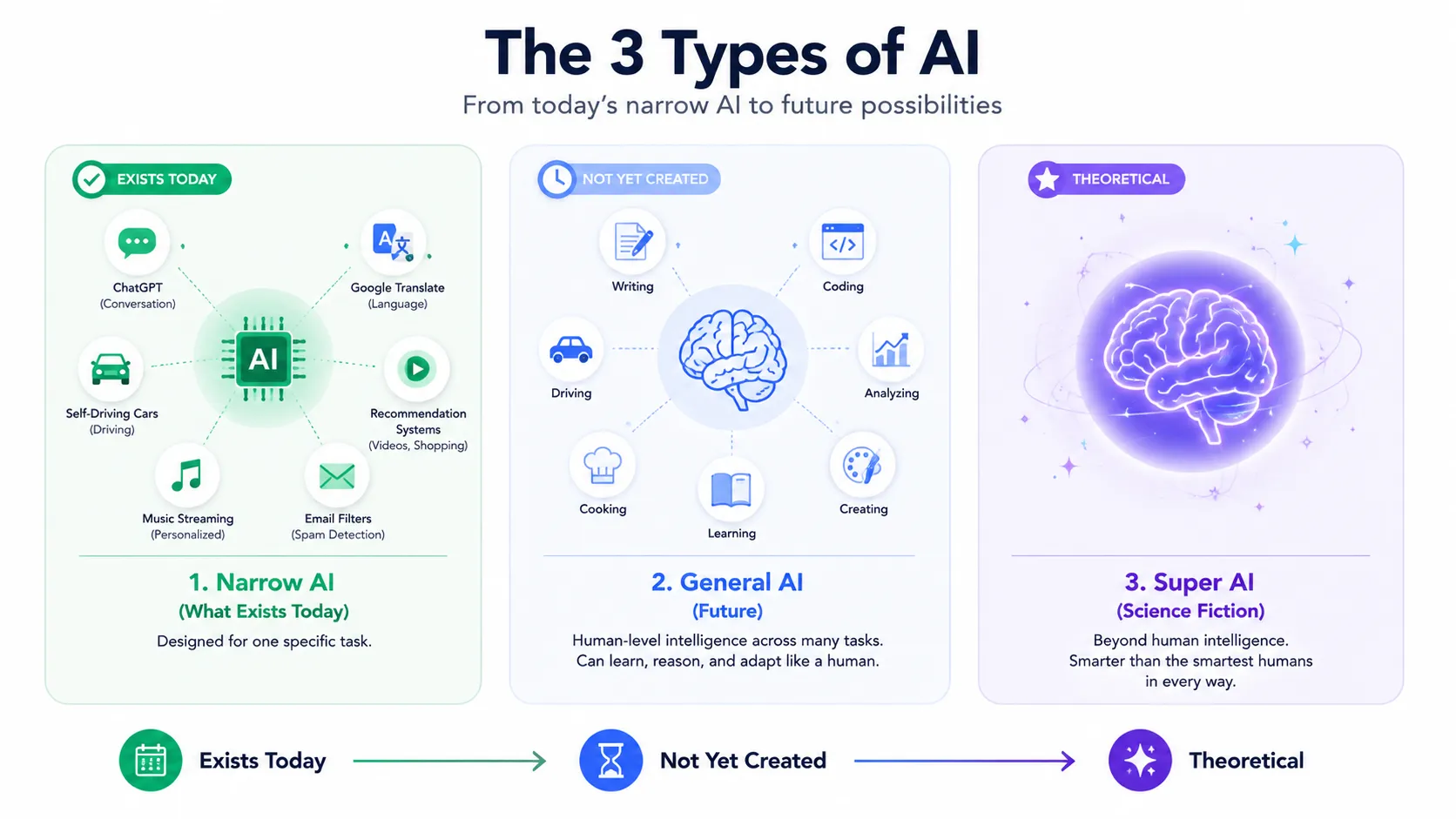
AI is usually split into three levels: narrow AI, which exists today and is very good at one specific job; general AI, a hypothetical system that could do anything a human can, which doesn’t exist yet; and super AI, which would surpass human intelligence and remains firmly in the realm of science fiction.
1. Narrow AI (What Exists Today)
ChatGPT is brilliant at conversation and writing — but it can’t drive a car. Google Translate is great at language — but it can’t recommend a video. Every AI tool you use today is narrow AI. That’s not a weakness.
When a system focuses on one job, it can become extraordinarily good at it. Want a closer look at one of these tools specifically? What Is ChatGPT? The Complete Beginner’s Guide covers exactly what it can and can’t do.
2. General AI (The Goal Researchers Are Working Toward)
General AI would be a computer that can switch between tasks, learn new skills on its own, and understand context and emotion the way a person does. We don’t have this yet, and most researchers think it may still be decades away.
3. Super AI (Science Fiction — For Now)
Super AI would surpass human intelligence in every area — the kind of thing you see in movies like I, Robot. It doesn’t exist, and serious researchers say we’re nowhere close. Don’t worry about this one yet.
“AI isn’t just happening in Silicon Valley — it’s already solving African problems, quietly, right now.”
What Does Artificial Intelligence (AI) Actually Look Like in Africa Right Now?
AI is already showing up across Africa in mobile money fraud detection, crop-disease diagnosis apps for farmers, and logistics systems that route medical deliveries — not as futuristic hype, but as quiet, working infrastructure most people don’t think of as “AI” at all.
One thing that frustrated me early on was how most AI articles only used American or European examples. So here are a few that hit closer to home:
- Agriculture in Kenya: An app called Plantix uses image recognition to help diagnose crop diseases from a photo taken on a basic smartphone. Farmers across East Africa use it to catch problems before they wipe out a harvest.
- Logistics in Rwanda: Zipline’s medical delivery drones have been flying blood and medicine to rural clinics since 2016, using AI-assisted route planning and computer vision to navigate without a pilot on board.
- Finance across Africa: Mobile money platforms use machine learning to flag unusual transaction patterns in real time, which is a big part of how services like M-Pesa keep fraud rates low at massive scale.
- Education in Kenya, Ghana, and beyond: Platforms like Eneza Education deliver curriculum-aligned lessons and quizzes over basic SMS — no smartphone or internet required. It leans more on smart automation than deep AI, but it’s a genuinely useful example of tech reaching learners that most edtech ignores.
What Are AI’s Biggest Limitations?
AI makes mistakes — sometimes confidently wrong ones. It can misstate facts, and tools like facial recognition have shown documented bias against darker skin tones, which matters directly for African users. AI also can’t replace human judgment, empathy, or cultural understanding; it finds patterns in data, which isn’t the same thing as actually thinking.
I want to be real with you here, because a lot of AI content online only shows the exciting side. Chatbots have given confidently wrong historical facts. Artificial Intelligence (AI) medical tools have misdiagnosed patients.
Understanding these limits isn’t pessimism — it’s what lets you use AI wisely, as a powerful tool rather than a magic oracle. If you want a fuller, unfiltered list of what trips beginners up, The Hidden Challenges Beginners Face When Learning AI is the honest version of that conversation.
Why Does Artificial Intelligence (AI) Matter for Young Africans Specifically?
AI is creating real, paid remote work — labeling data, testing tools, writing prompts, translating content into African languages, and giving human feedback on AI responses — that requires curiosity and communication skills rather than a computer science degree, which levels the playing field for African youth in a genuinely new way.
Here’s what nobody tells you in the standard “What Is Artificial Intelligence (AI)” article: the AI revolution is creating an enormous amount of opportunity, and much of it doesn’t require a degree. It requires curiosity, language ability, and the willingness to learn — things African youth already have in abundance.
Right now, Artificial Intelligence (AI) companies need people to label data, test tools, write prompts, translate content into African languages, and give human feedback on AI responses. These are real, paying jobs done remotely from Kigali, Nairobi, Lagos, Accra, or anywhere with a decent internet connection.
If you want to see what those roles actually look like day to day, How to Become an AI Automation Specialist and Can You Really Get an AI Job Without a Degree? both dig into specific paths.
Beyond paid work, AI tools are leveling the playing field in a quieter way too. A student with a smartphone and a free ChatGPT account now has access to a writing assistant, research tool, and tutor that would have cost real money just a few years ago.
How Can You Start Learning AI With No Background?
Start by actually using free AI tools like ChatGPT or Claude today — ask questions, experiment, and see what happens — rather than reading about AI in the abstract; hands-on experimenting for one hour teaches you more than a week of passive reading.
- Start using AI tools today. Sign up for ChatGPT or Claude (both have free plans). Ask questions. Try prompts. You’ll learn more in an hour of experimenting than a week of reading about AI.
- Follow AI news in African context. Look for how Artificial Intelligence (AI) is applied in Rwanda, Kenya, Nigeria, and Ghana specifically — it makes the topic feel real instead of abstract.
- Learn the basics of prompting. The single most valuable AI skill for beginners is knowing how to give clear instructions. This is called prompt engineering, and it takes zero technical knowledge. Master Prompt Engineering: The Best Beginner’s Guide to AI Prompts is where I’d start.
- Stay consistent. AI moves fast. Even 20 minutes a day of reading, experimenting, and learning puts you ahead of most people around you.
If generative tools specifically — the kind that create text, images, or audio — are what caught your attention, Generative AI Explained: Simple Guide for Beginners is the natural next stop after this post.
Key Takeaways
✓ AI is technology that lets computers do things that normally need human thinking — understanding language, recognizing images, learning from patterns.
✓ You’ve already used AI today, probably without noticing, in tools like WhatsApp, YouTube, and Google Maps.
✓ Machine learning — teaching a computer from huge amounts of examples — is the engine behind most AI you’ll encounter.
✓ Real AI examples exist across Africa right now, but company-specific examples change fast — always check the date before repeating one.
✓ AI makes real mistakes and has real limitations. Understanding them is what lets you use it wisely. ✓ For African youth specifically, AI is creating real remote income opportunities that don’t require a degree — curiosity and consistency matter more.
Frequently Asked Questions
Is Artificial Intelligence (AI) the same thing as robots?
No. A robot is physical hardware; AI is the software “brain” that can (but doesn’t have to) control one. Most AI you’ll use — like ChatGPT or a translation app — has no physical form at all.
Do I need to know how to code to use AI?
No. Using AI tools like ChatGPT, Claude, or Google Translate requires zero coding. Coding only becomes relevant if you want to build your own AI-powered systems later on.
Will AI take my job?
It depends on the job, and nobody can promise you a clean answer here. AI is automating some repetitive tasks, but it’s also creating new categories of remote work — data labeling, prompt writing, AI-assisted content — that didn’t exist five years ago.
The safest move is learning to work alongside it rather than waiting to see what happens.
Is ChatGPT the same as Artificial Intelligence (AI)?
ChatGPT is one specific AI tool, built on a type of AI called a large language model. “Artificial Intelligence (AI)” is the broad category; ChatGPT, Claude, and Google Gemini are all individual products within it.
Final Thoughts
AI doesn’t have to be confusing or intimidating. At its core, it’s technology that learns from examples and tries to mimic human thinking — imperfectly, but increasingly powerfully.
The people who thrive over the next decade won’t necessarily be the ones who can build Artificial Intelligence (AI). They’ll be the ones who understand it well enough to use it, work alongside it, and spot the opportunities it creates.You just took the first step. Keep going.
Want More Like This?
I share practical, honest AI tips every week — no hype, no income promises, just what’s actually working for beginners. Join other learners across Africa and beyond who are figuring this out one step at a time.
Join the Free Newsletter →