
Let me be honest with you about something.
The first time I used ChatGPT, I was disappointed. I typed something like “write me a blog post about AI” and got back something so flat and boring that I thought — maybe AI tools are overhyped.
Then I learned about prompt engineering. And everything changed.
I started asking AI in a completely different way. Instead of “write me a blog post,” I said: “Write a 1,000-word blog post for beginners in Africa who are just learning about AI for the first time. Use a warm, encouraging tone, include a real-life example from everyday African life, and end with a call to action.” The difference in output was like night and day.
That’s what prompt engineering is — and it’s one of the most valuable skills you can learn right now, especially if you want to use AI tools to work, write, or earn money online.
The best part? You don’t need to know coding. You don’t need a degree. You just need to understand how to talk to AI in a way it understands — and that’s exactly what this guide will teach you.
Artificial intelligence is changing how we work, learn, and create content. Tools powered by AI can now write articles, generate images, help with coding, and even assist in research. But there is one important skill that determines how useful these tools become: prompt engineering.
Prompt engineering is the ability to write clear instructions that guide AI to produce the best possible results. When you learn how to write better prompts, AI tools become far more powerful and useful.
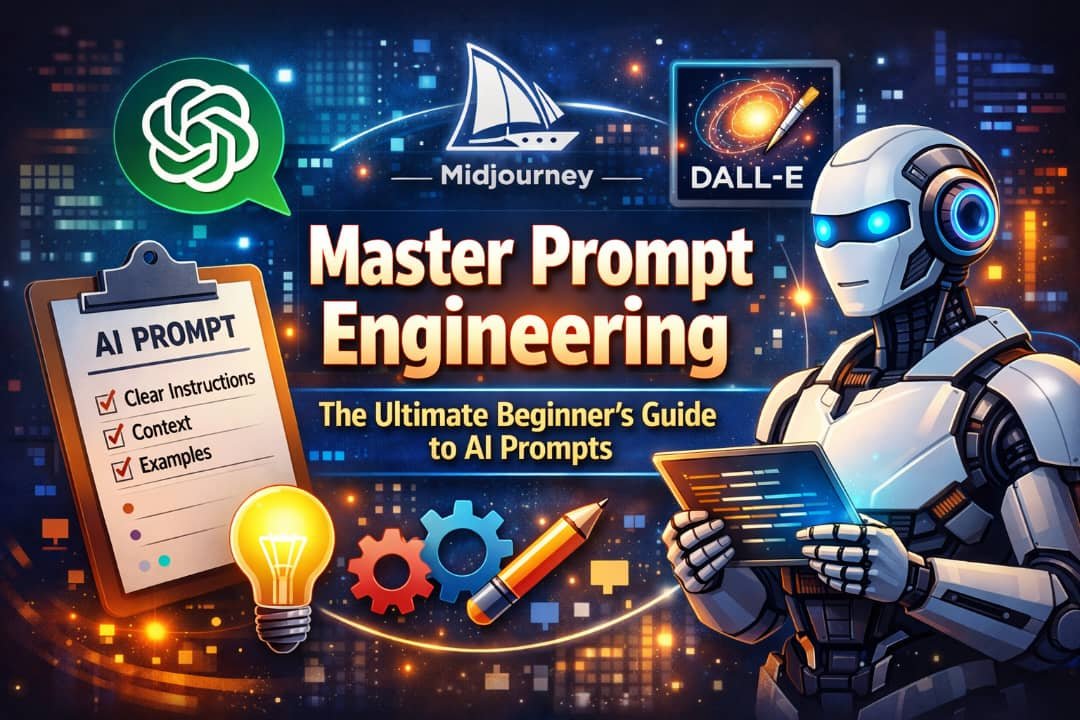
Many popular AI tools like ChatGPT, Midjourney, and DALL·E rely heavily on prompts. The better the prompt, the better the output.
In this beginner-friendly guide, you will learn:
- What prompt engineering is
- How AI understands prompts
- Practical techniques for writing better prompts
- Real-world uses of prompt engineering
- Common mistakes beginners make
- Tips to improve your prompt skills
By the end of this guide, you will understand how to communicate effectively with AI tools.
What Is Prompt Engineering?
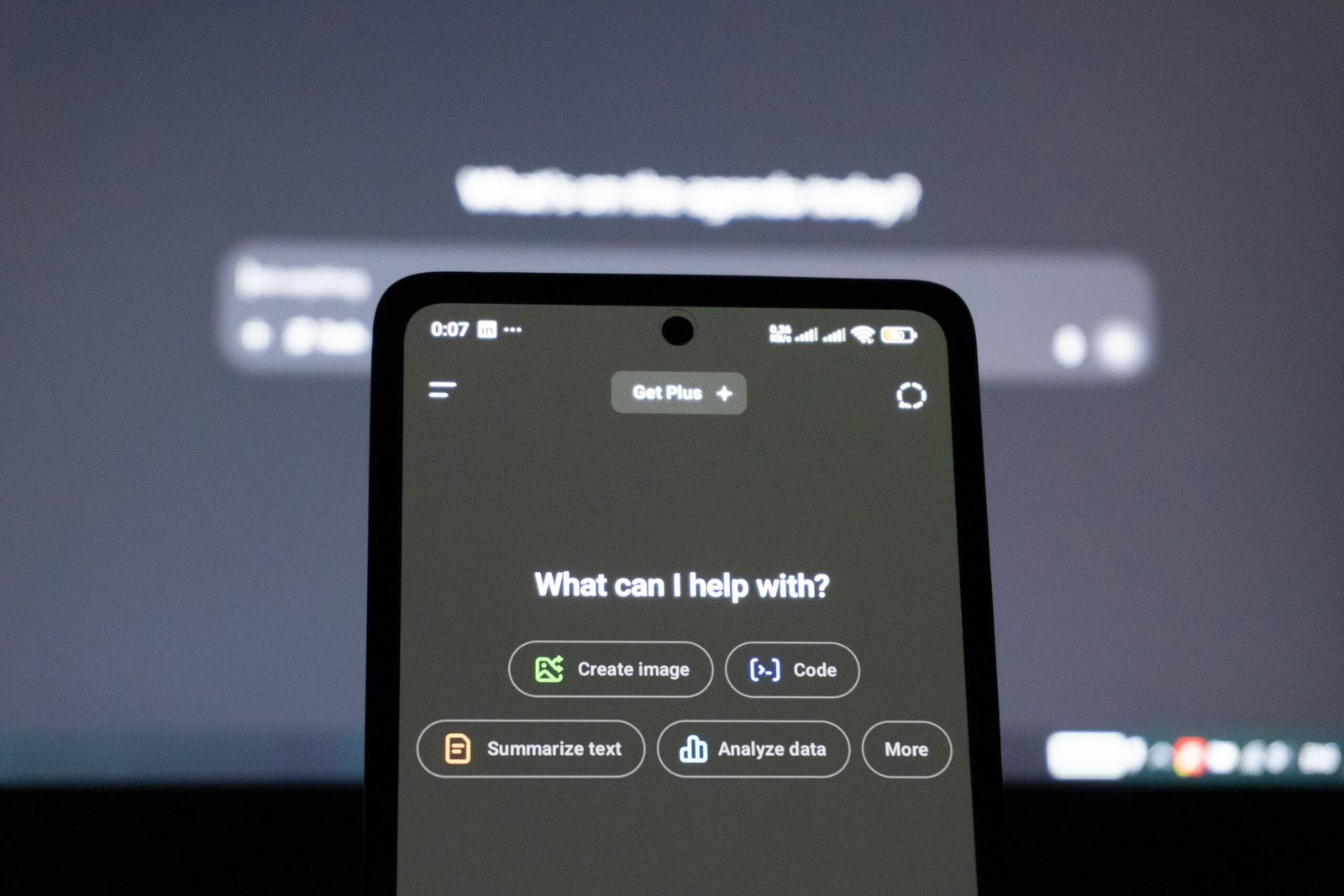
Simple Definition
Prompt engineering is the process of designing clear and structured instructions that help AI produce useful responses.
In simple terms, a prompt is the instruction you give to an AI system.
For example:
Prompt:
Explain artificial intelligence in simple terms.
The AI then analyzes this instruction and generates a response.
The quality of the result depends largely on how well the prompt is written.
How Prompts Guide AI Models
AI models generate answers based on patterns they learned from massive amounts of text data. When you give a prompt, the AI interprets the instruction and predicts the most relevant response.
This means that the wording of your prompt directly affects the output.
For example:
Prompt 1:
Explain marketing.
Prompt 2:
Explain digital marketing for beginners using simple examples.
The second prompt produces a much better answer because it provides clear direction and context.
Why the Same AI Gives Different Answers
Many beginners are surprised that the same AI tool can produce completely different responses to similar questions. This happens because:
- AI relies on the exact wording of prompts
- Small changes in phrasing can change the output
- More detailed prompts provide better guidance
This is why prompt engineering has become such an important skill.
How AI Understands Prompts
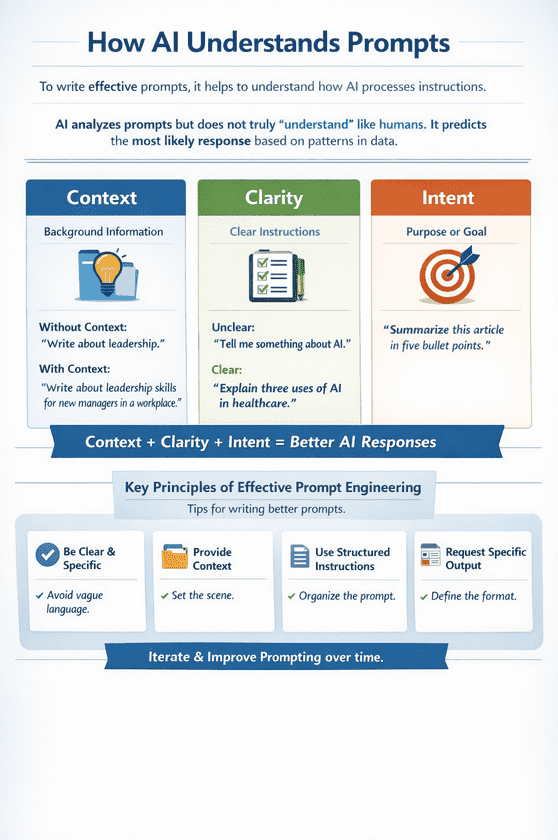
To write effective prompts, it helps to understand how AI processes instructions.
Tools like ChatGPT use advanced language models that analyze the prompt and generate responses based on patterns in data.
However, the AI does not truly “understand” language the way humans do. Instead, it predicts the most likely response based on context.
Three key elements help AI interpret prompts correctly.
1. Context
Context tells the AI what background information it should consider.
Example:
Without context:
Write about leadership.
With context:
Write about leadership skills for new managers in a workplace.
The second prompt is more useful because it provides clear context.
2. Clarity
Clear instructions reduce confusion.
Example:
Unclear prompt:
Tell me something about AI.
Clear prompt:
Explain three real-world uses of artificial intelligence in healthcare.
3. Intent
Intent describes what you want the AI to accomplish.
Example:
Summarize this article in five bullet points.
The intent is clear: produce a short summary.
When context, clarity, and intent are included in a prompt, AI responses become much more accurate.
Key Principles of Effective Prompt Engineering
Writing good prompts becomes easier when you follow a few basic principles.
Be Clear and Specific
Avoid vague instructions whenever possible. Instead of:
Provide Context
Context helps AI generate more relevant responses.
Example:
Explain search engine optimization for beginner bloggers.
The audience and topic are clearly defined.
Use Structured Instructions
Structured prompts make it easier for AI to organize responses.
Example:
Write a blog introduction about artificial intelligence.
Audience: beginners
Tone: simple and friendly
Length: 150 words.
This format guides the AI more effectively.
Request Specific Output Formats
You can ask AI to structure answers in many formats.
Examples include: Bullet lists, Tables, Step-by-step guides, Summaries.
Example prompt:
Create a table comparing SEO and social media marketing.
Iterate and Improve
Prompt engineering is rarely perfect on the first try.
Often you need to:
1. Review the AI response
2. Adjust the prompt
3. Try again with better instructions
This process is called prompt iteration.
Practical Prompt Engineering Techniques
Several techniques can dramatically improve the quality of AI responses.
Role Prompting
Role prompting tells the AI to respond from a specific perspective.
Example:
Act as a digital marketing expert and explain how SEO works.
This often produces more detailed and professional responses.
Step-by-Step Prompting
This technique asks the AI to break down tasks into steps.
Example:
Explain how to start a blog step by step for beginners.
Step-by-step prompts work especially well for tutorials.
Few-Shot Prompting
Few-shot prompting provides examples before requesting an output.
Example:
Example title:
Beginner’s Guide to SEO
How to Start a Blog in 2026
Now generate five similar blog titles.
Providing examples helps the AI understand the pattern you want.
Chain-of-Thought Prompting
Chain-of-thought prompts encourage AI to explain reasoning.
Example:
Solve this math problem and explain your reasoning step by step.
This technique improves complex problem solving.
Output Formatting Prompts
You can instruct AI exactly how to format its response.
Example:
Summarize the benefits of artificial intelligence in a table.
Clear formatting instructions improve readability.
Examples of Good vs Bad Prompts
Understanding the difference between good and bad prompts can improve your results immediately.
Example 1: Content Writing
Bad prompt:
Write about artificial intelligence.
Good prompt:
Write a 500-word beginner-friendly article explaining artificial intelligence with real-life examples.
Why it works:
Specifies length
Defines the audience
Requests examples
Example 2: Learning Prompt
Bad prompt:
Teach me Python.
Good prompt:
Teach me Python basics with simple examples and beginner exercises.
Why it works:
Specifies difficulty level
Requests examples and exercises
Example 3: Image Generation Prompt
Bad prompt:
Create a robot.
Good prompt:
Generate a futuristic AI robot working in a modern office, digital art style, high resolution.
Detailed prompts produce better visuals when using tools like Midjourney or DALL·E.
Real-World Uses of Prompt Engineering
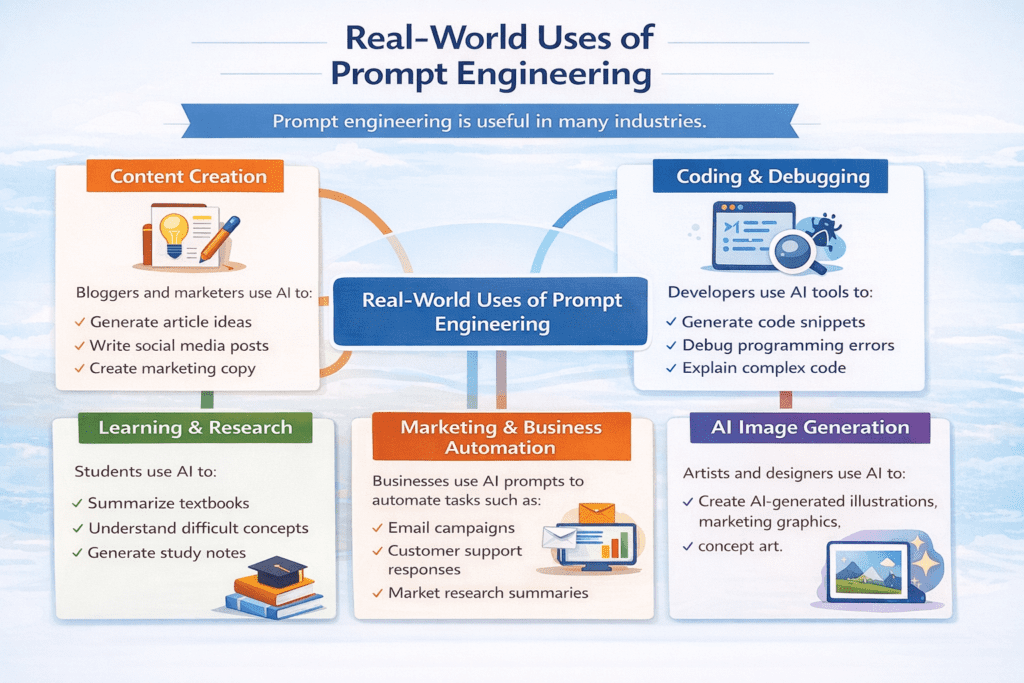
Prompt engineering is becoming an essential skill because AI tools are now used in many industries. By writing clear and structured prompts, people can guide AI systems to produce more accurate, useful, and creative results.
Below are some of the most common real-world applications.
Content Creation
Content creators such as bloggers, marketers, and social media managers use AI tools to speed up the writing process.
With well-written prompts, AI can help generate:
- Blog post ideas
- Article outlines
- Social media captions
- Product descriptions
- Marketing copy
For example, instead of spending hours brainstorming topics, a blogger can ask AI to generate 10 blog ideas about beginner SEO or create a 150-word introduction for a digital marketing article.
Prompt engineering helps ensure the AI produces content that matches the target audience, tone, and style required.
Coding and Debugging
Software developers use AI assistants to help with programming tasks.
With the right prompts, AI can:
- Generate code snippets in different programming languages
- Suggest solutions to coding problems
- Debug errors in existing code
- Explain complex code logic
For example, a developer might prompt AI with:
“Explain what this Python function does and suggest improvements.”
This can help programmers save time, learn new techniques, and solve problems faster.
Learning and Research
Students and researchers use AI tools to simplify complex information.
Prompt engineering helps AI provide clearer explanations and better summaries.
Students can use AI to:
- Summarize textbook chapters
- Explain difficult concepts in simple terms
- Generate study notes
- Create practice questions
For example:
“Explain quantum computing in simple terms for a high school student.”
This type of prompt helps AI adjust the explanation to the appropriate level of understanding.
Marketing and Business Automation
Businesses increasingly use AI prompts to automate repetitive tasks and improve efficiency.
AI can assist with:
- Writing email marketing campaigns
- Generating customer support responses
- Creating product descriptions
- Summarizing market research reports
For instance, a business might use a prompt like:
“Write a friendly email announcing a new product launch to existing customers.”
This allows companies to produce professional communication quickly while maintaining consistency.
AI Image Generation
Prompt engineering is also widely used in AI image generation tools such as Midjourney, DALL·E, and Stable Diffusion.
These tools allow users to create images by describing what they want in text.
For example, a prompt might be:
“A futuristic city at sunset, cyberpunk style, ultra-detailed, cinematic lighting.”
Artists, designers, and marketers use these prompts to generate:
- Digital illustrations
- Marketing graphics
- Concept art
- Social media visuals
This technology allows creators to produce high-quality images quickly without traditional design software.
If you’re interested in this topic, you may also want to read my other article: “How to Make Money with AI Images in 2026: 10 Smart Ways Beginners Are Doing It.”
Boosting Productivity with Better Prompts
One of the biggest advantages of prompt engineering is that it can significantly increase productivity.
When prompts are clear and detailed, AI tools can deliver better results with fewer corrections.
Saving Time
Well-written prompts reduce the need to repeatedly edit or regenerate responses.
Instead of asking a vague question and correcting the output several times, you can include clear instructions from the start.
For example, instead of writing:
“Write about SEO.”
A better prompt would be:
“Write a 200-word introduction explaining SEO for beginner bloggers.”
This level of clarity helps AI generate the correct output faster, saving time and effort.
Automating Repetitive Tasks
Many everyday tasks involve repetitive writing or summarizing. AI prompts can automate these tasks efficiently.
Common examples include:
- Writing email drafts
- Summarizing long documents
- Generating meeting notes
- Creating reports or outlines
For example, a prompt like:
“Summarize the following meeting notes into five key action points.”
can quickly turn a long discussion into a clear list of next steps.
By automating routine work, prompt engineering allows individuals and businesses to focus more on creative thinking, strategy, and decision-making.
Example Workflow
A simple AI workflow might look like this:
1. Create a prompt template
2. Insert the topic or task
3. Generate AI output
4. Review and refine
This process can dramatically speed up many types of work.
Common Mistakes Beginners Make
Many beginners struggle with prompt engineering because they are still learning how AI interprets instructions. Since AI tools rely on the information provided in the prompt, unclear or incomplete prompts can lead to poor results.
Understanding a few common mistakes can help you improve the quality of AI responses quickly.
Asking Vague Questions
One of the most common mistakes beginners make is asking vague or overly general questions.
When a prompt is unclear, the AI does not have enough direction to generate a useful response. As a result, the answer may be too broad, incomplete, or not relevant to what you actually need.
For example:
Vague prompt
Tell me about marketing.
This prompt is very general. Marketing includes many topics such as digital marketing, SEO, social media, advertising, and branding.
A better prompt would be:
Specific prompt
Explain three beginner-friendly digital marketing strategies for small businesses.
The second prompt is much clearer and helps the AI generate a more focused response.
Not Providing Enough Context
Context helps the AI understand the background of your request.
Without context, the AI may misunderstand the topic, audience, or goal of the prompt. This can lead to responses that are technically correct but not useful for your situation.
For example:
Without context
Write about leadership.
This could result in a very general explanation.
With context
Write a short explanation of leadership skills for new managers in the workplace.
Adding context tells the AI:
- who the audience is
- what the topic is
- what perspective to use
This improves the quality and relevance of the response.
Expecting Perfect Answers Immediately
Another common mistake is expecting AI to produce the perfect result on the first try.
In reality, prompt engineering often involves iteration, which means gradually improving the prompt based on the AI’s response.
For example, you might:
- Start with a basic prompt
- Review the response
- Add more details or instructions
- Ask for improvements or changes
Each iteration helps refine the output until it matches what you need.
This process is normal and is part of using AI effectively.
Ignoring Formatting Instructions
AI can produce information in many different formats, but beginners sometimes forget to request the format they want.
If you need structured output, it helps to include formatting instructions directly in the prompt.
For example, instead of writing:
Explain the benefits of remote work.
You could write:
List five benefits of remote work in bullet points.
Or:
Create a table comparing remote work and office work.
By clearly specifying the format—such as bullet points, tables, or step-by-step guides—you make the response easier to read and more useful.
Tips to Become Better at Prompt Engineering
Improving your prompt engineering skills takes time and practice. The more you work with AI tools, the better you understand how they respond to different instructions. By learning how to write clearer prompts and experimenting with different approaches, you can significantly improve the quality of AI-generated results.
Here are several practical tips that can help you become better at prompt engineering.
Experiment With Different Prompts
One of the best ways to improve your prompt skills is to experiment. AI responses can change significantly depending on how a prompt is written, even if the question is similar.
Try asking the same question in different ways and compare the results. For example, instead of writing:
Explain artificial intelligence.
You might try:
Explain artificial intelligence in simple terms for beginners.
Or:
Give three real-world examples of how artificial intelligence is used today.
Small changes in wording, context, or structure can lead to much more useful responses. Experimenting helps you discover which types of prompts produce the best outcomes.
Study Prompts That Work Well
When you get a particularly helpful or well-structured response from AI, take note of the prompt that produced it.
Over time, you can build a collection of prompts that consistently work well. This becomes your personal prompt library, which you can reuse whenever you need similar results.
For example, you might save prompts for:
- Writing blog introductions
- Generating article outlines
- Creating social media posts
- Summarizing long documents
Studying and reusing successful prompts helps you improve efficiency and maintain consistent results.
Use Prompt Templates
Prompt templates make it easier to repeat successful instructions without rewriting them each time. A template provides a structure that you can quickly customize for different tasks.
For example, a simple template for blog writing might look like this:
Write a blog post about [topic].
Audience: beginners
Length: 800 words
Tone: friendly and informative.
Whenever you want to create a new article, you only need to replace the topic. This method saves time and ensures that your prompts remain clear and organized.
Templates are especially useful for tasks you perform regularly, such as writing content, generating reports, or creating marketing copy.
Practice Regularly
Like any other skill, prompt engineering improves with regular practice. The more you interact with AI tools such as ChatGPT, the better you will understand how to guide them effectively.
Through practice, you learn:
- how to phrase questions more clearly
- how to provide useful context
- how to request specific output formats
- how to refine prompts when results are not ideal
Over time, this experience helps you produce higher-quality results faster and with fewer revisions.
The Future of Prompt Engineering
Prompt engineering is quickly becoming one of the most valuable skills in the age of artificial intelligence. As AI systems continue to improve and become widely adopted, the ability to communicate effectively with these systems is becoming increasingly important.
People who know how to craft clear and effective prompts can use AI tools more efficiently, making them more productive in many professional fields.
Growing Demand for Prompt Skills
As businesses adopt AI tools for content creation, automation, research, and customer service, there is a growing demand for individuals who understand how to use these systems effectively.
Professionals with strong prompt engineering skills can help organizations:
- generate high-quality content faster
- automate repetitive tasks
- improve AI-generated responses
- optimize workflows that rely on AI tools
Because of this, prompt engineering is becoming an important digital skill for writers, marketers, developers, and many other professionals.
Businesses Are Hiring Prompt Engineers
Some companies are now hiring specialists known as prompt engineers. These professionals focus on designing and optimizing prompts so that AI systems produce accurate, useful, and efficient outputs.
Prompt engineers may work on tasks such as:
- improving chatbot responses
- optimizing AI content generation systems
- designing prompts for automation workflows
- testing and refining AI outputs
As AI technology continues to expand, careers related to prompt engineering are expected to grow. Learning how to write effective prompts today can help individuals stay competitive in a future where AI tools play a major role in everyday work.
AI Career Opportunities
Now careers are being changed by AI. Prompt engineering skills can benefit careers in:
Digital Marketing
AI prompting helps marketers generate campaign ideas, write ad copy, create email marketing content, and analyze customer behavior. For example, a marketer can prompt an AI tool to generate SEO keywords, social media captions, or targeted ad messages based on a specific audience, saving time and improving marketing strategies.
Software Development
In software development, AI prompting can assist developers in writing code, debugging errors, generating documentation, and explaining complex programming concepts. By providing a clear prompt, developers can ask AI to generate code snippets, suggest improvements, or help solve programming issues quickly.
Data Analysis
AI prompting allows analysts to interpret large datasets more efficiently. Users can prompt AI to summarize data trends, generate visualizations, or explain statistical results in simple language. This helps businesses make faster, data-driven decisions without manually analyzing every dataset.
Automation
AI prompting can automate repetitive tasks such as customer support responses, report generation, scheduling, and workflow management. By giving AI specific instructions through prompts, businesses can streamline processes and reduce manual work, improving productivity and efficiency.
Content Creation
AI prompting is widely used to create blog posts, articles, product descriptions, scripts, and social media content. By writing detailed prompts, creators can guide AI to generate high-quality content tailored to their topic, audience, and tone, making content production faster and more scalable.
Learning how to write effective prompts can provide a strong advantage in the future job market.
Conclusion
Prompt engineering is the skill of communicating effectively with artificial intelligence. When you write clear and structured prompts, AI tools become far more powerful and useful.
Key points to remember:
- Clear prompts produce better results
- Context improves accuracy
- Iteration helps refine responses
- Practice builds better prompt skills
As AI tools continue to evolve, prompt engineering will become an essential digital skill for students, professionals, and businesses.
Start experimenting with prompts today, and you will quickly discover how powerful AI tools can be.
Frequently Asked Questions About Prompt Engineering
What is prompt engineering?
Prompt engineering is the process of writing clear and structured instructions for AI tools so they can generate accurate and useful responses. By providing context, details, and formatting instructions, users can guide AI systems like ChatGPT to produce better results.
Why is prompt engineering important?
Prompt engineering is important because the quality of an AI response depends heavily on the prompt it receives. Clear prompts help AI understand the task, which leads to more accurate answers, better content, and fewer revisions.
What are the key elements of a good prompt?
A good prompt usually includes three main elements:
- Context – background information about the topic
- Clarity – clear and specific instructions
- Intent – what you want the AI to do (summarize, explain, list, etc.)
When these elements are included, AI responses are usually much more useful.
What are examples of prompt engineering?
Examples of prompt engineering include:
- Asking AI to write a blog post with a specific tone and length
- Requesting a summary of a long document
- Generating code snippets for a programming task
- Creating marketing copy or social media posts
These prompts help guide AI tools to produce structured and relevant outputs.
What tools use prompt engineering?
Many AI tools rely on prompt engineering, including:
- ChatGPT
- Midjourney
- DALL·E
- Claude
- Google Gemini
These tools generate text, images, and other content based on the prompts users provide.
Can beginners learn prompt engineering?
Yes, prompt engineering is beginner-friendly and does not require advanced technical skills. Anyone can improve their prompts by practicing, experimenting with different instructions, and learning how AI interprets context and formatting.