
TL;DR You don’t need a computer science degree to build real AI skills in 2026. The 12 skills below — from writing better ChatGPT prompts to understanding basic automation with tools like Make.com — are the ones actually opening doors for beginners right now. Start with prompt writing and general AI literacy, then pick one or two specialty skills (automation, AI content, or AI freelancing) based on where you want to go. Nobody needs all 12 on day one.
If you’ve been scrolling LinkedIn or YouTube lately, it probably feels like everyone already knows how to “use AI” except you. Here’s the thing: most of them don’t either. They just learned a handful of specific, learnable skills — and started before you did. That’s the whole gap.
I felt exactly this kind of overwhelmed when I started. There were so many tools, so many “AI experts” online, and no clear list of what actually mattered.
So I built one — based on what beginners in our own community keep asking about, and what’s actually paying off for people with zero technical background.
This guide breaks down the 12 AI skills worth learning in 2026, why each one matters, and how to start practicing it today — even if you’ve never touched an AI tool before.
“You don’t need to learn everything about AI. You need to learn the handful of things that actually change what you can do.”
Key Takeaways
- Prompt writing and general AI literacy are the two foundational skills — learn these before anything else.
- Specialty skills (automation, AI content, AI image tools) let you turn AI literacy into income.
- Employers are already paying a premium for AI skills — data from a 2026 World Economic Forum study of over 10 million UK job postings found candidates with AI-related skills commanded an average advertised salary 23% higher than comparable candidates without them.
- You don’t need to master all 12 skills. Pick 2–3 based on your goal, then go deep.
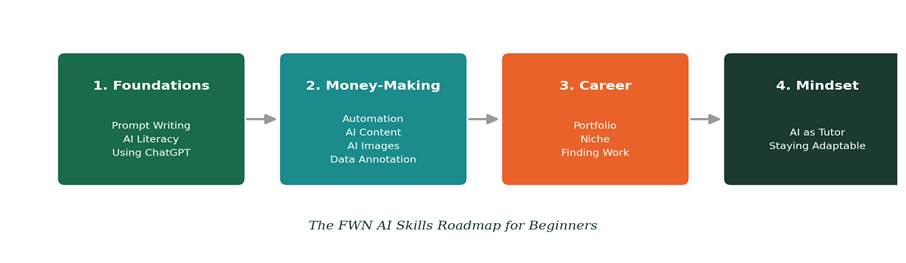
The four stages this guide walks through, in order.
The 12 AI Skills at a Glance
Before diving into each skill, here’s a quick scan of how they compare. These are general starting-point estimates based on typical beginner learning curves and common feedback from our own readers — not precise data, since “time to learn” and income always depend on the person and the market.
| Skill | Difficulty | Time to Learn | Income Potential |
| 1. Prompt Writing | Easy | Days | Foundational |
| 2. AI Literacy | Easy | Days | Foundational |
| 3. Using ChatGPT | Easy | Days–1 week | Foundational |
| 4. Automation (Make.com etc.) | Medium | Weeks | High |
| 5. AI Content Writing | Easy–Medium | Weeks | Medium |
| 6. AI Image Tools | Easy | Days | Medium |
| 7. Data Annotation | Easy | Days | Low–Medium |
| 8. Freelance Portfolio | Medium | 1–2 weeks | Enables income |
| 9. Choosing a Niche | Medium | Days | Enables income |
| 10. Finding AI Work | Easy | Days | Enables income |
| 11. AI as Tutor | Easy | Ongoing | Compounding |
| 12. Staying Adaptable | Mindset | Ongoing | Compounding |
Why AI Skills Are Worth Learning Right Now
Let’s be honest: “learn AI” is vague, overused advice. What actually matters is which specific, practical skills you build — because those are what employers, clients, and your own side projects will actually reward.
This isn’t hype. A 2026 World Economic Forum analysis of more than 10 million job postings found that candidates with AI-related skills were advertised at salaries roughly 23% higher than otherwise similar candidates without them — and that AI skills particularly helped older applicants and people without advanced degrees, two groups that often face hiring disadvantages.
That’s real evidence that specific, demonstrable AI skills — not vague “AI awareness” — are what move the needle.
So instead of trying to “learn AI” in the abstract, treat it like learning a trade: a set of concrete, practiceable skills. Here are the 12 that matter most for beginners right now.
What Are the Foundational AI Skills Every Beginner Needs?
Two skills come before everything else on this list: writing effective prompts, and understanding what AI tools can and can’t actually do. Skip these and every other skill on this list gets harder. Master these first and everything else becomes much easier to pick up.
1. Prompt Writing (Prompt Engineering Basics)
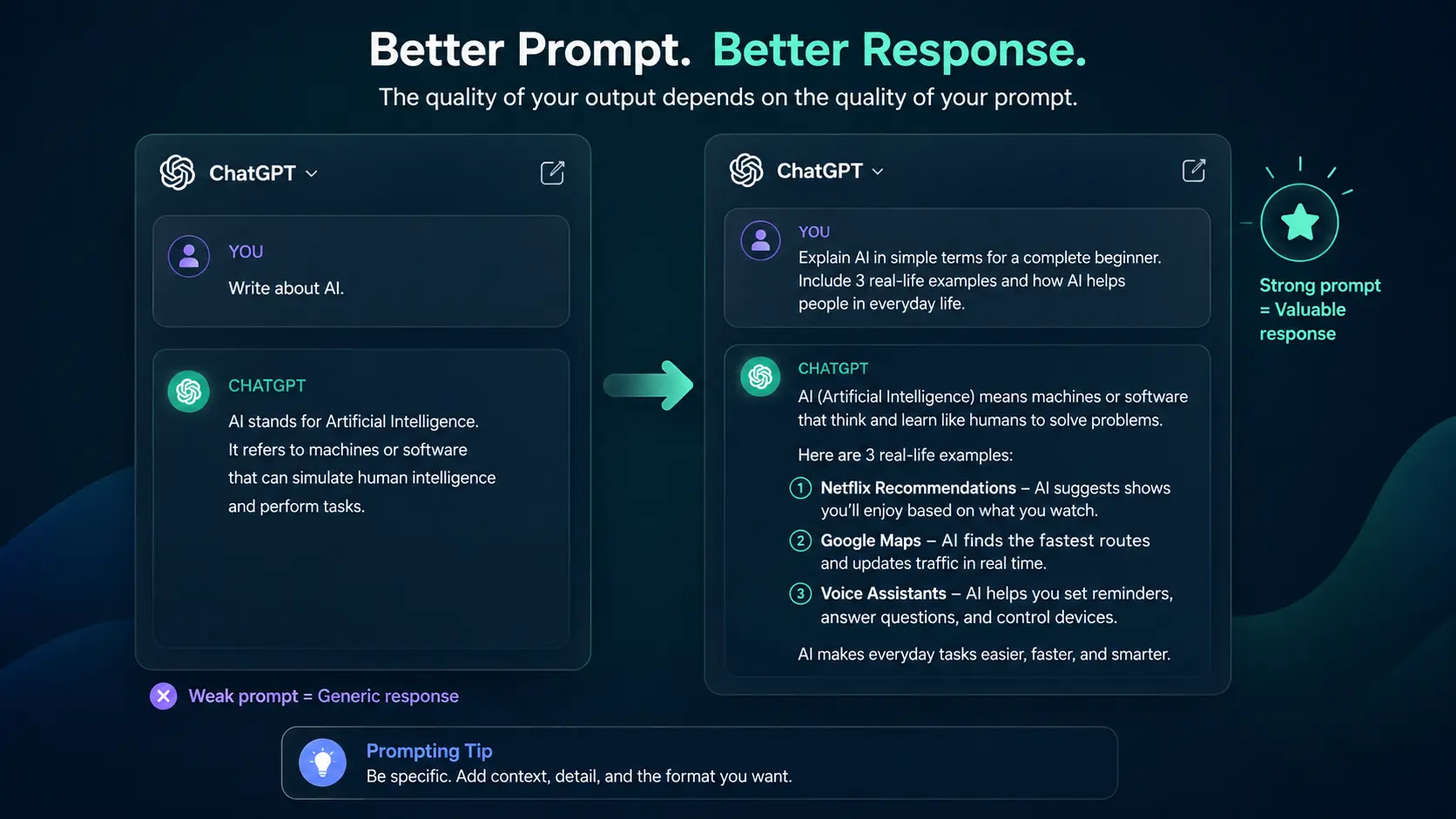
Prompt writing is the skill of giving AI clear, specific instructions so it produces the results you want. Think of it as learning how to communicate effectively with AI. The better your prompt, the better the output.
This is the highest-impact skill on this list because it improves the quality of everything you do with AI—from writing articles and creating images to coding, researching, and brainstorming ideas.
If you want to dive deeper, check out our Beginner’s Guide to Prompt Engineering and our collection of 20 Beginner Prompts to start practicing right away.
For example, I once copied one of my blog posts into ChatGPT and simply asked, “Generate a featured image.” The result was cluttered, generic, and didn’t match the style I wanted.
Then I rewrote my prompt with more detail. I specified that I wanted a minimalist design, described the layout, color palette, illustration style, and overall mood. The difference was dramatic—the second image looked clean, professional, and was much closer to what I had imagined.
The lesson is simple: AI isn’t a mind reader. The more context and direction you provide, the better the results.
Practice today: Ask ChatGPT the same question three different ways—starting with a simple prompt, then adding more details each time. Compare the responses and notice how clarity improves the quality of the output.
2. General AI Literacy
AI literacy means understanding, in plain terms, what large language models and generative AI tools actually are, where they’re reliable, and where they confidently get things wrong.
This matters because it protects you from both extremes — dismissing AI as a gimmick, or trusting it blindly. Start with our complete beginner’s guide to artificial intelligence if you want the full picture.
Practice today: Ask an AI tool a question you already know the answer to, and check exactly where it gets it wrong or makes something up.
3. Using ChatGPT (or a Similar AI Assistant) Confidently
This means knowing how to hold a back-and-forth conversation with an AI tool, refine your requests, and use it for real daily tasks — emails, research, brainstorming, learning.
Our ChatGPT beginner’s guide walks through exactly how to get started, and if you’re curious how it stacks up against alternatives, we also compared ChatGPT vs. Claude AI head to head.
Practice today: Have a five-message back-and-forth conversation with ChatGPT, refining a single request until the output is exactly what you wanted.
Which AI Skills Actually Help You Make Money?
Once you’ve got the foundations down, the next layer of skills is what turns “I know how to use AI” into “I can get paid for this.” These are the skills worth specializing in.
4. Basic AI Automation (Make.com, Zapier, or n8n)
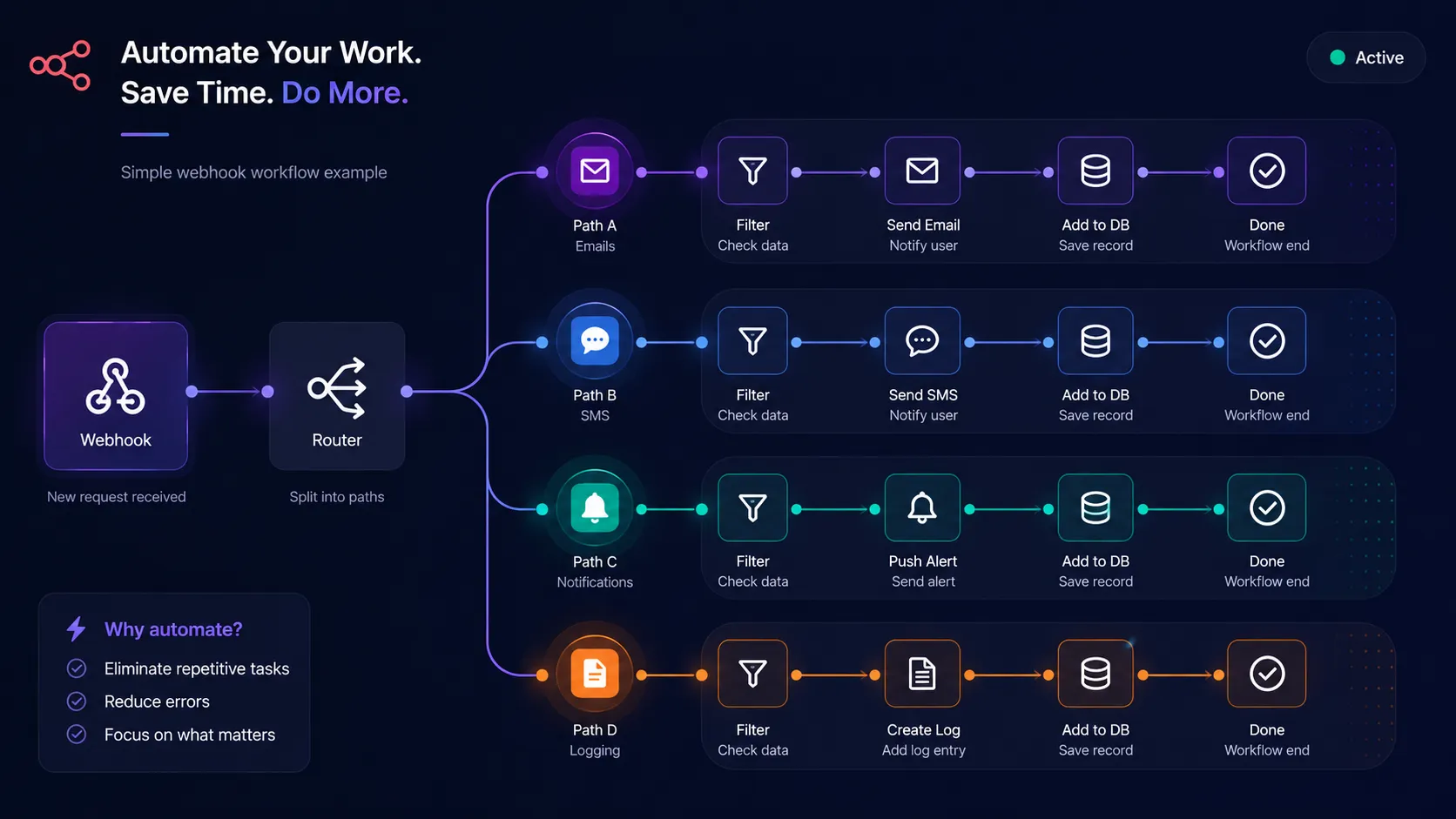
Automation skills let you connect AI tools to your everyday apps — so tasks that used to take an hour happen automatically. This is one of the fastest-growing beginner-friendly skills because businesses of every size are looking for people who can set up simple automations.
I use Make.com myself, and our complete beginner’s guide to Make.com is the best place to start if you’ve never built an automation before.
Not sure which automation tool to learn first? Our Zapier vs. Make vs. n8n comparison breaks down which one fits a true beginner best.
Practice today: Build one simple two-step automation in Make.com’s free plan — even something as small as saving form responses to a spreadsheet.
5. AI Content Writing and Editing
This is the skill of using AI to draft, edit, and improve written content — blog posts, social captions, emails — while still adding your own judgment and voice so it doesn’t read like generic AI filler.
It’s one of the more accessible AI-adjacent careers because it builds on a skill many beginners already have: writing. See our guide on how to become an AI content writer for a realistic starting path.
Practice today: Ask ChatGPT to rewrite the same email in three different tones, then pick your favorite and edit it into your own voice.
6. Working with AI Image Tools
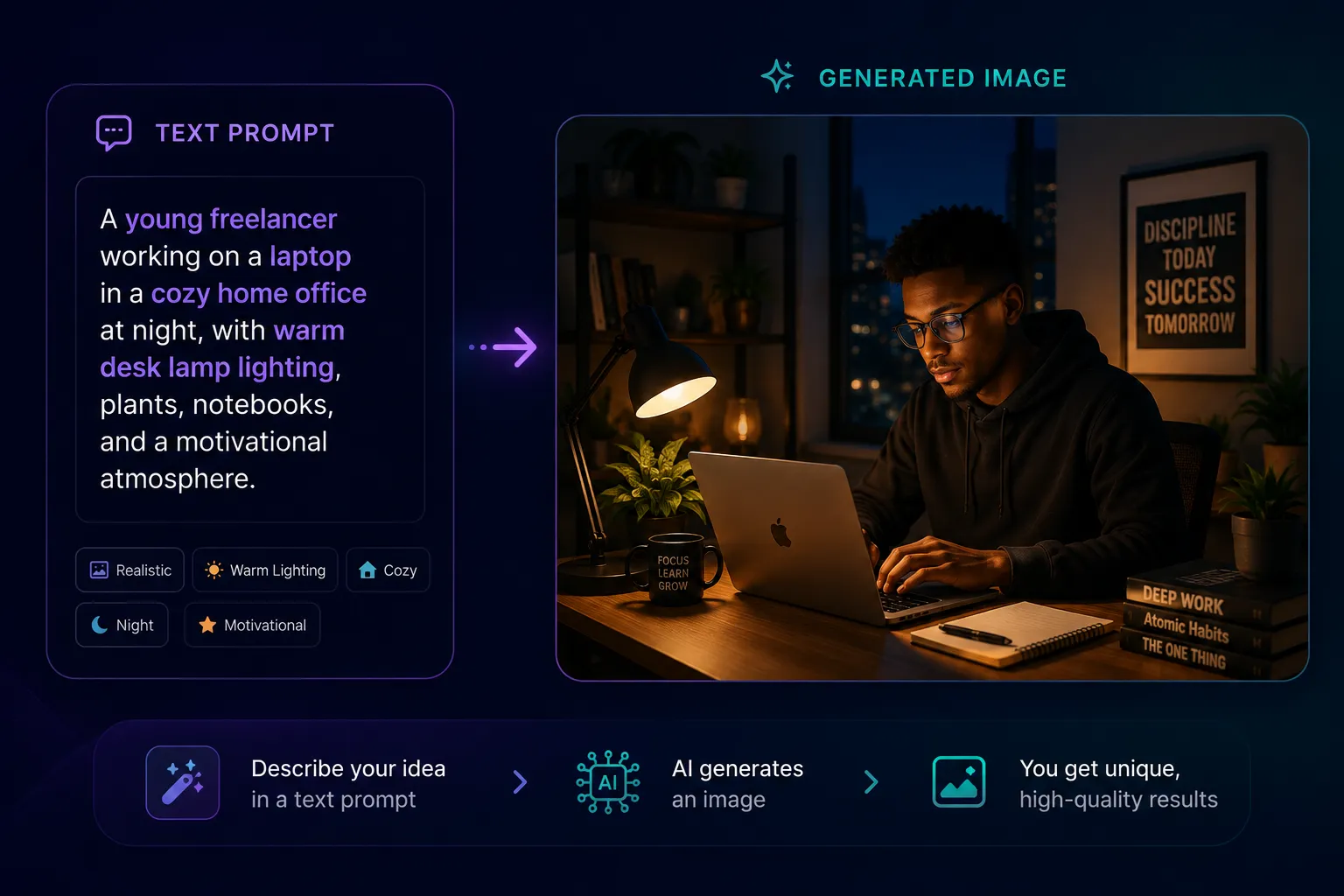
AI image generation lets you create graphics, illustrations, and visual content without any design background. It’s a genuinely beginner-friendly skill because most tools just need a clear text description to get started.
Our roundup of 10 free AI image generators is a good place to start experimenting, and if you want to see how it can turn into income, we also cover making money with AI images.
Practice today: Generate the same image prompt in two different free AI image tools and compare the results side by side.
7. AI Data Annotation and Training Work
Data annotation means helping AI companies label, review, or rate data so their models improve — and it’s one of the lowest-barrier ways to earn with AI-adjacent skills, since it usually just requires attention to detail rather than technical training.
Our guide on data annotation for beginners explains how it actually works and how to get started.
Practice today: Research two data annotation platforms and compare their entry requirements and pay structure.
How Do You Turn AI Skills Into Income or a Career?
Learning the skills above is only half the picture. The other half is knowing how to package what you know into something a client or employer will pay for.
8. Building an AI Freelance Portfolio
A portfolio is simply proof — real examples, even small ones, that show you can actually do the work you’re claiming to offer. This matters because clients hire based on evidence, not enthusiasm.
Our beginner’s guide to building an AI freelance portfolio walks through how to put one together with zero prior client work.
Practice today: Write one paragraph describing a real (even small) project you could add to a portfolio today.
9. Choosing a Niche Instead of Trying to Do Everything
Niching down means picking one specific problem you solve with AI — instead of vaguely offering “AI help” — so potential clients instantly understand what you do. Generalists are harder to hire; specialists are easier to trust. See how to choose your AI freelance niche for a practical framework.
Practice today: Write down the one specific problem you’d want to solve for clients, in a single sentence.
10. Knowing Where to Find AI Work
This is the practical skill of knowing which platforms, job boards, and communities actually have real AI-related work for beginners — rather than wasting time on saturated, low-paying gig marketplaces. Our list of best platforms to find AI freelance work is a good starting map.
Practice today: Create a profile on one platform from the list above and fill out every section completely — don’t leave it half-done.
What Mindset Skills Matter Just as Much as Technical Ones?
The tools you use today won’t be exactly the same tools you use in a year. That’s why two “soft” skills matter as much as any technical one on this list.
11. Treating AI as a Learning Tool, Not Just a Task Tool
Beyond using AI to complete tasks, you can use it to actually teach yourself new skills — coding, a language, a new career field — at your own pace and for free. This compounds everything else on this list. Our guide on using AI as your personal tutor shows exactly how to set this up.
Practice today: Pick one skill you’ve wanted to learn and ask AI to build you a 7-day starter lesson plan for it.
12. Staying Comfortable With Constant Change
This is the ability to keep learning as tools update, rather than getting attached to one specific app or workflow. It matters because the specific tools will keep changing — the underlying skills above are what stay valuable.
If the pace of change has been the part that’s overwhelmed you most, our post on common challenges beginners face learning AI was written for exactly that feeling.
Practice today: Spend 10 minutes reading the changelog or release notes of one AI tool you already use — notice how much changes in a single update.
Do You Need to Learn All 12 AI Skills to Get Started?
No — and trying to would probably slow you down. Start with prompt writing and general AI literacy, since those make every other skill easier. Then pick one specialty (automation, content, images, or data work) based on what genuinely interests you, and go deep on that one before adding another.
What Should You Learn First If You’re a Complete Beginner?
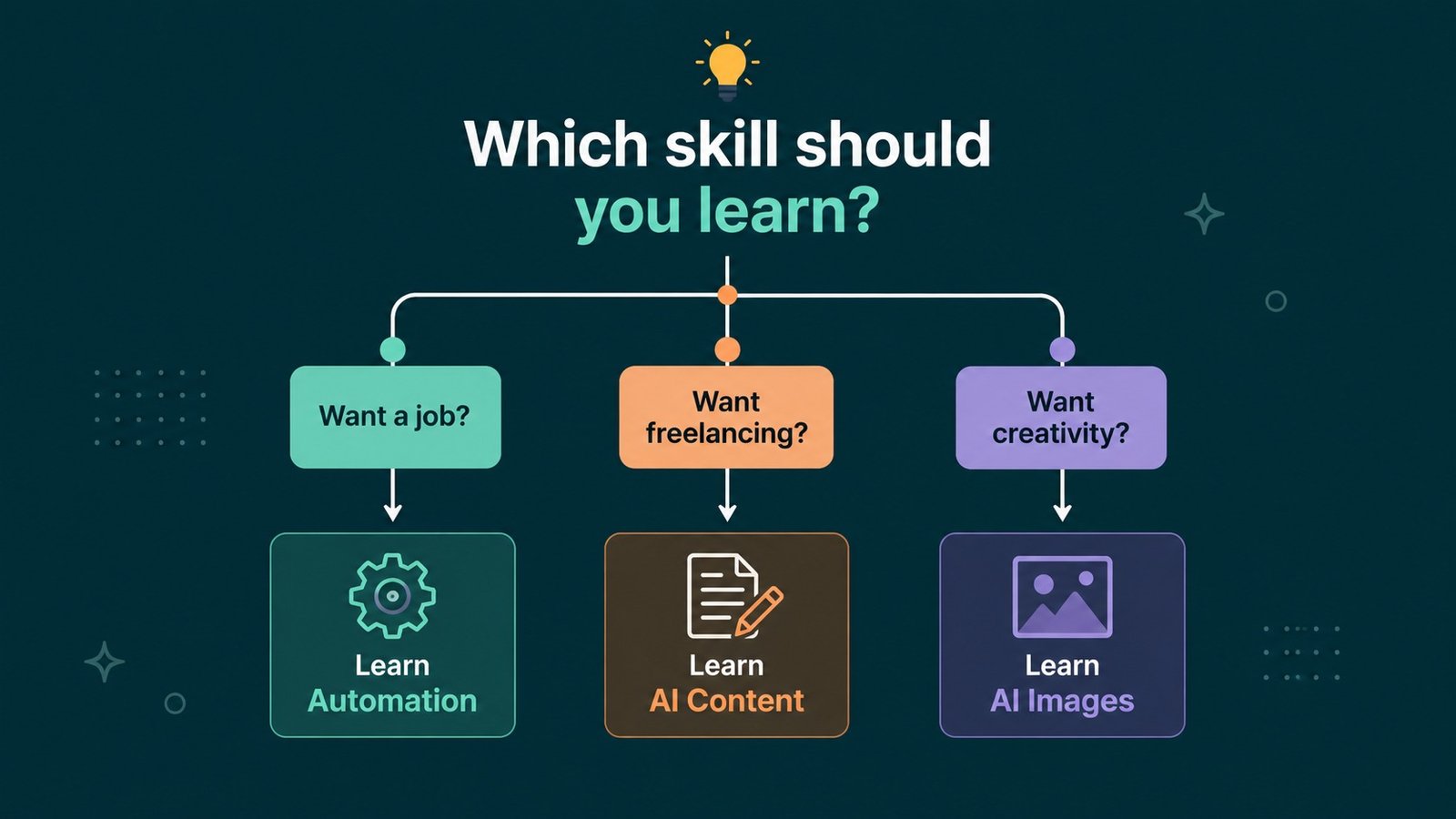
Start with prompt writing, then spend a week just using ChatGPT for real daily tasks until it feels natural. Once that feels comfortable, pick one specialty skill to go deeper on based on your goal.
If your goal is income specifically, our pillar guide on earning money with AI as a complete beginner lays out the realistic paths beginners are actually using right now — and it’s the best next stop after this post.
Frequently Asked Questions
Is it too late to learn AI skills in 2026?
No. AI tools and the job market around them are still changing quickly, which means the skills gap employers are dealing with is real and ongoing — not something that closed while you weren’t looking. Starting now still puts you ahead of most people who haven’t started at all.
Do I need to know how to code to learn these AI skills?
No. Every skill on this list — prompt writing, automation tools like Make.com, AI content, AI images, and data annotation — is designed to be usable without any coding background. Some deeper automation work eventually benefits from light technical knowledge, but you don’t need it to start.
How long does it take to learn a useful AI skill?
Basic prompt writing and AI literacy can feel comfortable within a week of regular practice. Specialty skills like automation or AI content work usually take a few weeks of hands-on practice before you’d feel ready to offer them to a client.
Which AI skill pays the most for beginners?
It varies by region and platform, but automation skills and AI freelancing niches tend to have higher earning ceilings than entry-level data annotation work, though annotation is often the easiest to start immediately. Our AI careers guide breaks down realistic options by starting difficulty.
Your Next Step
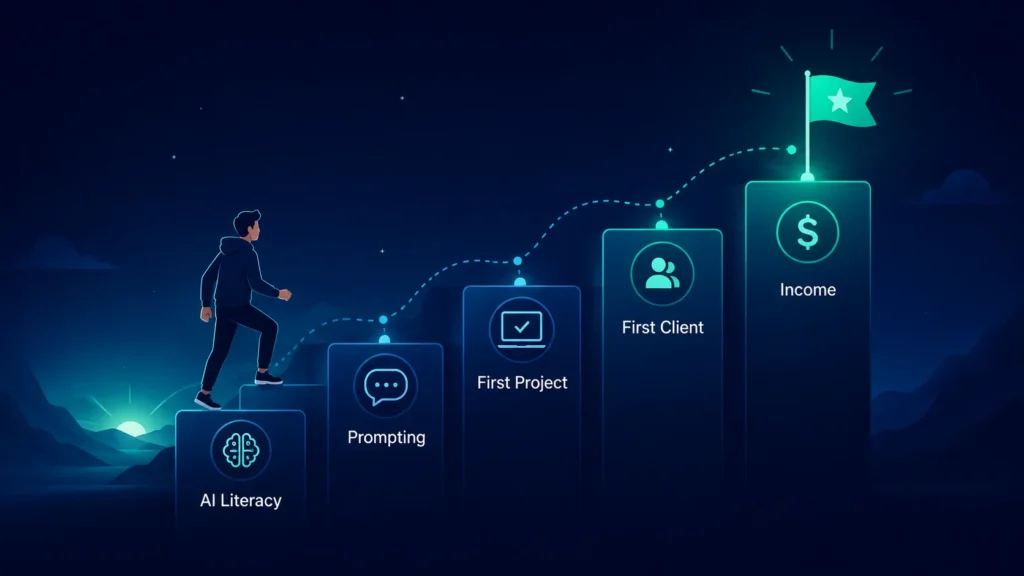
You don’t need to master all 12 of these skills this month — or ever, really. Pick prompt writing and AI literacy first, then choose one specialty based on where you actually want to go. That’s a realistic starting point, and it’s exactly how most people in our community got going too.
If this gave you a clearer picture of where to start, our pillar guide on earning money with AI as a complete beginner is the natural next read — it ties these skills directly to real income paths.
I share posts like this every week, walking through exactly what’s working for beginners right now. If you’d like them in your inbox, join the newsletter below — and if you have questions after reading, drop them in the comments. I read every one.
Полезно. Тир-лист и схемы: Sete a Zero: /. Sete a Zero